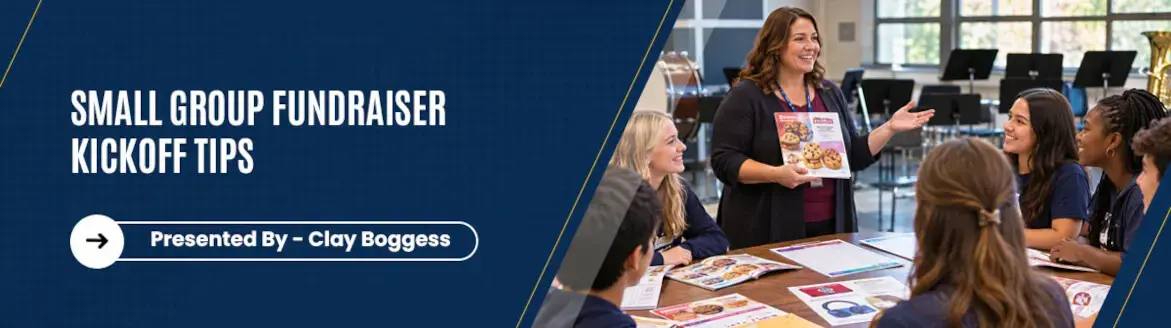
How to Make Small Group Fundraising Productive
If you're sponsoring a small group at your school, like a high school choir or middle school band, your fundraiser kickoff will be crucial to its success. It allows you to set the tone for the sale in your students' minds. The time you invest in preparing and executing your kickoff presentation can have a profound effect on your outcome.
You haven't done enough if you think you can pass out your materials and say a few words at the end of practice. Like anything else, you'll get out what you put in. Successful small group fundraising kickoffs should be official, planned meetings that require 30-45 minutes of your students’ time.
For the bigger picture on small groups, see small fundraiser group profit tips. For other groups, see band fundraisers, middle school fundraisers, and high school fundraising ideas.
A 40-Minute Kickoff Agenda
Adjust the timing to fit 30 to 45 minutes. A shorter meeting can combine the goal and the materials.
Prepare the Week Before
- Know the Brochure: Familiarize yourself with it before the kickoff.
- Make Copies: Copy the parent letter, and confirm you have enough order forms and money envelopes.
- Do the Math: Work out each student's goal before the meeting.
- Rehearse: Practice your opening so you come across as organized, passionate, and convincing.
- Book the Time: Schedule the kickoff as an official meeting, not the last five minutes of practice.
For more on timing and planning, see the perfect time to kick off a school fundraiser, exciting fundraiser kickoff steps, and the high school fundraiser kickoff guide.
Why are Kickoff Meetings Important?
The main reason for the kickoff is to generate excitement and enthusiasm for your sale and ensure your students understand what they need to do. You must come across as credible. In other words, your group must see you as organized, passionate, and convincing. Otherwise, they won't buy in. The more passionate you are, the more excited your sellers will be and the more they want to get involved. As a result, you will make more money. You must also be prepared to convince your sellers to participate.
- Organized: Have your materials, agenda, and numbers ready.
- Passionate: Let students see that the purpose matters to you.
- Convincing: Explain why this is worth every student's effort.
Do You Have a Fundraiser Purpose?
The very first thing you need to do is communicate your purpose. Don't assume your group will automatically embrace your campaign just because they like you or the group. Once you introduce it, you must continue reinforcing it throughout your sale. It will matter to them if it matters enough to you. How will you convince your sellers that your purpose is important to them directly? A well-communicated purpose will motivate everyone to work harder.
- Be Specific: New robes for the choir, a trip for the band, or instruments and music.
- Make It Personal: Explain what the purpose means for each student.
- Repeat It: Mention the purpose at every check-in.
Have a Sales Goal and Reinforce It
How many items will each student need to sell to reach the financial goal?
Do your calculations beforehand and choose a reasonable number based on the time you'll have to sell. Ensure that your students put this number at the top of their order form.
For example, "MY GOAL: 10 or more items by __________ date".
You can do this by:
- First, determine the total amount each seller will need to raise.
- Then multiply the retail amount (Use $12.00) by your profit percentage to determine the total profit/item.
- Finally, divide the total money needed/seller by the total profit/item to determine how many items each seller will need to sell.
The $12.00 figure is a simple average price. For the best result, use your program's actual average price. For example, if a group of 30 sellers needs $3,000, each seller needs to raise $100. At $12.00 and a 40% profit, that is $4.80 per item, so each seller needs 21 items. The Otis Spunkmeyer cookie dough fundraiser lists an average price of about $22 and 40% profit ($8.80 per item), so each seller needs 12 items.
Goal divided by profit per item, rounded up. Illustration only. Use your program's actual average price and profit.
For more help with targets, see how to set realistic fundraiser goals, the fundraiser goal setting guide, and the Otis Spunkmeyer cookie dough fundraiser.
Discuss the Fundraising Process
Pass out your supplies and review the following:
Order Taker
- Have your students fill in the spaces at the top, and make sure they understand how their customers will need to fill out the order forms.
- Ensure they only talk to neighbors, family, and friends, and encourage them to ask mom or dad to take the brochure and order form to work.
- Remind them that a parent or guardian should supervise their selling. See school fundraising safety tips.
Fundraiser Brochure
- Review the sales brochure page by page with your sellers.
- Familiarize yourself with it before the kickoff.
Prize Brochure
- Explain what they can win based on how many items they sell. See traditional prize programs for general school groups.
- They only need to sell a few items daily to reach their goal.
Parent Letter
- Make copies of your letter before your kickoff and review it with them. See the parent fundraising information letter.
- Ask them to go over it with their parents.
Money Envelopes
- Explain that money must be collected upfront.
- Make checks payable to your group. Learn whether school fundraisers should accept checks.
- Money and order forms are due back by the turn-in day.
Track progress with the sales tracking sheet.
Maintain Student Enthusiasm
Check in with your sellers and talk about the sale daily.
A progress display helps. See why every fundraiser needs a thermometer and how to improve school fundraiser participation.
Add Extra Fundraising Incentives
Foster competition between sellers by offering fun, rewarding incentives. Here are some examples:
- Top seller after the 1st day.
- Prize Drawings using coupons.
- Grand Prize Drawing (Sell 5 to get your name at one time. Then, for every additional five items sold, you get your name at additional times)
- Top Overall Seller (Reward the one who works the hardest and turns in the most orders)
Before you run a drawing, check your school's and district's rules. For more ideas, see additional fundraising incentive ideas and prize drawing ideas. Keep incentives optional and positive, so every student feels included. See inclusive fundraising for schools.
If you incorporate these ideas into your next fundraiser, you will help ensure you reach and exceed your sales goal, so you may not need additional fundraisers.
Common Kickoff Mistakes
Ready to plan? See our brochure fundraisers and the online store option.
For ideas on involving parents, see how to get parents to support your school fundraiser, and for the numbers behind the example, see how much a school can make from an Otis Spunkmeyer fundraiser.
Frequently Asked Questions About Small Group Fundraiser Kickoffs
How do you run a small group fundraiser kickoff meeting?
Hold an official, planned 30- to 45-minute meeting. Open with the purpose; explain the goal and how each student can reach it; walk through the materials; review safety rules; explain the incentives; and plan daily check-ins. Prepare ahead and come across as organized, passionate, and convincing.
How long should a fundraiser kickoff meeting be?
Plan 30 to 45 minutes of your students' time. Passing out materials and saying a few words at the end of practice is not enough. A planned meeting gives you time to explain the purpose, set goals, and make sure every student knows what to do.
Why is a kickoff meeting important for a small group?
The main reason is to build excitement and enthusiasm and ensure students understand what they need to do. In a small group, every member's effort is visible, so a strong kickoff sets the tone for the whole sale and builds a sense of ownership.
How do you figure out how many items each student needs to sell?
Divide the money your group needs by the number of sellers to get each seller's target. Then multiply the average price per item by your profit percentage to get the profit per item, and divide the target by that figure. For the Otis Spunkmeyer fundraiser, at about $22 per item and 40% profit, that is $8.80 per item.
What should students receive at the kickoff?
An order form to fill out at the top, the fundraiser brochure, the prize brochure (if your program includes one), a parent letter to review with parents, and a money collection envelope. Review each item with students so they know what it is for.
How do you motivate a small group like a choir or band?
Explain the purpose in a way that matters directly to each student, set a personal goal, show what they can win, and check in daily. Small groups also respond to unity, so celebrate group progress and make sure every member feels included.
What incentives work for small fundraiser groups?
Examples include a top seller after the first day, prize drawings using coupons, a grand prize drawing where students earn extra chances for every five items sold, and a reward for the top overall seller. Keep them positive, optional, and consistent with your school's rules.
How do you keep students safe while they sell?
Review safety rules at the kickoff: students should sell only to people they know (neighbors, family, and friends), and a parent or guardian should supervise. Encourage students to ask a parent to take the brochure to work, and send the rules home in the parent letter.
How often should you check in after the kickoff?
Check in with your sellers and talk about the sale daily. Ask how much they have sold, share the group's progress, and remind them of the turn-in day. Regular check-ins keep enthusiasm from fading after the kickoff.
What if students lose enthusiasm during the sale?
Reinforce the purpose and the goal, share progress, and add incentives that reward effort during the sale, not only at the end. Recognize students who are keeping up and offer a new drawing or a short-term challenge to restore momentum.
Need more info? Reach out today for a FREE consultation with an expert. Contact Big Fundraising Ideas or call (866) 980-9930, Monday through Friday, 8:00 a.m. to 5:00 p.m. CST.
Author Bio
Clay Boggess has been designing fundraising programs for schools and various nonprofit organizations throughout the US since 1999. He’s helped administrators, teachers, and outside support entities such as PTAs and PTOs raise millions of dollars. Clay is an owner and partner at Big Fundraising Ideas.

Categories
Recent Articles
Can Schools Use Purchase…
How schools use purchase orders for fundraising, 15-day payment terms, who qualifies, W-9 and tax forms, and a step-by-step checklist.

Online Fundraiser vs. Face-to…
Compare the Otis brochure and online-only options, including profit tiers, shipping, and timelines, and determine which option best fits your school.

Popcorn Fundraiser Nutrition…
Popcorn fundraiser nutrition facts: allergens, gluten-free and peanut-free details, ingredients, bag sizes, shelf life, and Smart Snacks label checks.