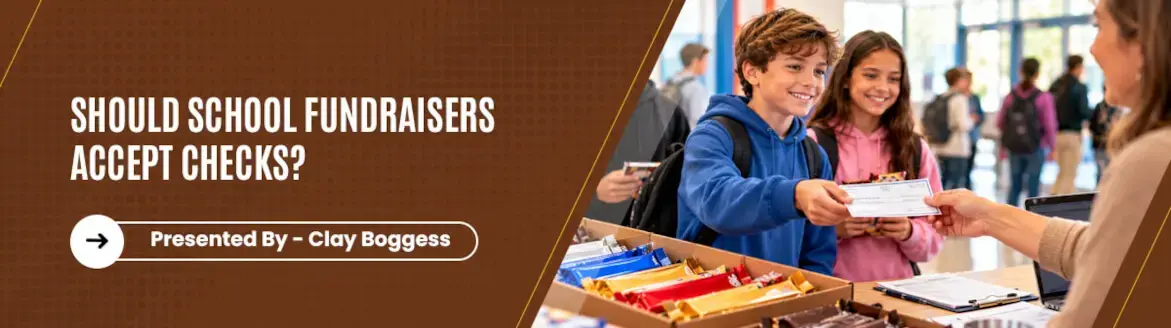
By Clay Boggess, owner and partner at Big Fundraising Ideas. Originally published August 1, 2020, and updated October 2026.
A guide to accepting fundraising checks for schools.
You're at a crossroads. Should you accept checks for your upcoming fundraiser? If you haven't experienced it, dealing with bounced checks can be a nightmare. This was especially painful when schools relied heavily on post-pay sales. Imagine receiving a bad check for a product that was already delivered. Schools had little to no leverage. With no money in hand, the money was still owed to the company.
But school fundraisers that don't accept checks don't sell as much. In our experience over many years, this holds. Unlike selling candy bars for a buck, brochure items cost more. Everyone can spare a dollar, but $15?
Paying for a brochure item on your mobile device is common today. Checks are used far less than they were in the past. Many young people today have only heard of a checkbook.
Yet many still use them. According to Qualtrics, a survey software company, 42% of millennials still write checks. That survey is several years old, and the Federal Reserve data below show where check use stands today. The reasons are fairly obvious. Many businesses prefer them over other methods. Credit cards come with extra payment-processing fees. The kid down the street who mows your lawn isn't set up to accept credit cards.
Many older adults who are less comfortable with online payments prefer to use checks. Writing checks also lets us track the funds. Once it clears, your bank will have a copy or an image of the canceled check. You can view it online, and it helps you and the bank track your expenses.
Often it comes down to your community. Schools that wrestle with this are often in areas where bounced checks are more common. They feel dealing with bad checks isn't worth it.
Schools that decide not to accept checks ask us to include 'No checks accepted' in their parent letter. They assume everyone will read it. But personal checks inevitably end up inside some students' money envelopes regardless.
Sponsors then have a choice. They can track down the buyer and attempt to collect an alternative form of payment. A second option is to ask the seller to do it. Or they can take a chance and deposit it.
But dealing with a few bounced checks may be worth it if you decide to accept checks. You're giving people another payment option. So what should you do?
What Current Data Shows About Checks
Federal Reserve Board and Federal Reserve Bank of Atlanta data, 2025 and 2026 releases.
What this means for a fundraiser: fewer buyers will reach for a checkbook than a decade ago, and they increasingly use checks for larger payments. But a meaningful share of consumers still pay by check, and a fundraiser that refuses them will turn some of those buyers away. The older millennial figure of 42% is no longer a reliable guide to today's habits, but it matches the direction of the story: checks are fading, not gone.
Should Your School Accept Fundraising Checks?
Deciding whether to accept personal checks may come down to answering one question. What percentage of returned checks did you receive from your previous sale? Decide what you can tolerate.
It may be worth it if you only have to deal with a couple of returned checks out of a few hundred payments. Still, you decide what percentage you can handle. Some sponsors tolerate more issues than others.
Pros and Cons of Accepting Checks
Employ a Check Payment Policy
Have a check payment policy before your fundraiser starts. This way, you'll have a plan in place to handle any issues that arise. We also have tools to help sponsors. An insufficient funds notice is provided in our school fundraising guidebook. Make copies as needed and keep the master in your booklet.
Sponsors should make their policy clear upfront. Warn everyone that returned checks will incur a fee. If your bank charges you, pass it along. Announcing this policy may not be necessary for some schools, but it can deter issues.
Because most schools collect money up front, checks take longer to clear. Since you deposit checks before receiving your order, you can always hold individual orders until you receive proper payment.
A Returned-Check Policy You Can Copy
- We accept personal checks made payable to [school or group name].
- Please write your child's name and a phone number on the check.
- Checks are deposited right away, and orders are released after a check clears.
- If a check is returned, we will contact you for another form of payment. Cash, a money order, or a cashier's check will be accepted.
- A returned-check fee of [amount] will be added to cover our bank's charge.
- Orders with an unpaid returned check will be held until payment is received.
An example policy, not legal advice. Fee limits and collection rules differ by state.
What to Do When a Check Is Returned
- Read the Bank Notice: Find out why the check was returned, such as insufficient funds, a closed account, or a stop payment.
- Contact the Buyer: Call or send a short written note, or ask the seller's parent to follow up, and use your insufficient funds notice.
- Ask for Another Form of Payment: Cash, a money order, a cashier's check, or an online option.
- Apply Your Policy Fee: Only if you announced it upfront and it is allowed where you are.
- Hold the Order: Do not release product until payment is made.
- Record the Result: Log the check, the contact, and the outcome.
- Follow School Procedures if it is Unresolved: Ask your principal or business office what comes next.
How to Take Checks Safely
- Check the Basics: Payee name, amount, date, and signature.
- Use Two Adults: Count and record checks together, and match them to order forms or a sign-out sheet. See the fundraiser sales tracking sheet.
- Deposit Promptly: Follow your school's procedures and collect fundraising money promptly.
- Hold Orders Until Checks Clear
- Keep Students Safe: Sellers should not carry large amounts of money alone. See school fundraising safety tips.
How No-Check Policies Affect School Fundraisers
Before deciding what to do about checks, consider how it might affect your sales. You're removing a payment option from your fundraiser. Not accepting checks may be less hassle, but will fewer people buy if you only accept cash or money orders? More than likely, yes.
It stands to reason that the more you restrict payment options, the fewer customers you will have. Some people don't carry cash, and obtaining a money order requires extra effort. Unlike cash, personal checks provide a paper trail, and most people like that security.
Should you allow personal checks for school fundraisers? If you can, it will most likely benefit your group financially.
Payment Options Compared
How an Online Store Changes the Question
When supporters buy from an online store, the vendor collects payment at checkout, and the group doesn't collect or deposit cash or checks for those sales. That means no returned checks to chase. Many schools run an online store alongside a brochure or direct-sale fundraiser so that buyers who prefer not to write a check have another choice. The Otis Spunkmeyer cookie dough fundraiser includes an online store, and online profit is credited against the brochure invoice. An online donation page gives supporters another way to give without a check.
In a direct-sale fundraiser, buyers pay on the spot, and the group pays the vendor's invoice within 15 days of receiving the product. If you accept checks, remember that a bounced check after you pay the invoice reduces your profit, so deposit promptly and count carefully. See how a school gets paid after a fundraiser.
Frequently Asked Questions About Fundraiser Checks
Should school fundraisers accept checks?
In most cases, yes, as long as you have a written returned-check policy. Accepting checks gives buyers another way to pay, and in Big Fundraising Ideas' experience, fundraisers that refuse checks tend to sell less. The risk is returned checks, which you can manage with a policy, a deposit-first routine, and a rule to hold orders until a check clears. Decide using the returned-check rate from your last sale.
What is a returned check?
A returned check, also called a bounced check, is one that the bank declines to honor. The most common reason is insufficient funds, but a closed account or a stop-payment order can also cause it. It usually comes back to your group days after you deposit it.
Can a school charge a fee for a returned check?
Often, yes, and many schools pass along the bank's fee. The amount a group may charge is often set by state law, so ask your principal or school business office before you announce a fee. This is general information, not legal advice.
Should we put 'No checks accepted' in the parent letter?
You can, but expect some checks to arrive anyway, so decide in advance how you will handle them. If you choose no checks, offer clear alternatives such as cash, a money order, or an online store, and make the policy easy to find in the parent letter.
How do we handle a check in a brochure fundraiser?
Most brochure fundraisers collect money with the order, so you can deposit checks before the product arrives. Hold individual orders until a check clears. If a check is returned, ask the buyer for another form of payment before you release the order.
Can we require cashier's checks or money orders instead?
Yes, if you want to limit the risk. Cashier's checks and money orders are harder to bounce, but they take extra effort to obtain, and some buyers won't use them. Requiring them may reduce sales, so compare that against your returned-check history.
How many returned checks are too many?
There is no universal number. A good test is to compare returned checks with the total checks you received. If you had a couple of returned checks out of a few hundred payments, accepting checks is probably worth it. If returns are common in your community, you may want a stricter policy or an online option.
Are checks still used?
Yes, but less than before. Federal Reserve data show check payments fell to 9.2 billion in 2024, and about one-third of consumers paid by check in 30 days in October 2024. Checks are also shifting toward larger payments.
How does an online store change the check question?
Supporters pay by card at checkout, so the group doesn't collect or deposit checks for online sales and doesn't have to chase returned checks. Many schools offer an online store alongside a brochure or direct-sale fundraiser, so buyers have a no-check option.
Who should handle fundraiser checks?
Adults, ideally two together, should receive and count checks, match them to order forms or a sign-out sheet, and deposit them according to your school's procedures.
Need more info? Reach out today for a FREE consultation with an expert. Contact Big Fundraising Ideas or call (866) 980-9930, Monday through Friday, 8:00 a.m. to 5:00 p.m. CST. For related reading, see accepting fundraiser check payment tips, accepting school fundraising checks, and school fundraiser payment processing.
Author Bio
Clay Boggess has been designing fundraising programs for schools and various nonprofit organizations throughout the US since 1999. He’s helped administrators, teachers, and outside support entities such as PTAs and PTOs raise millions of dollars. Clay is an owner and partner at Big Fundraising Ideas.

Categories
Related Articles

World's Finest Chocolate…
Compare the World's Finest Chocolate fundraiser to other competitors, including price per bar, bars per unit, profit tiers, and terms.

What Is the Minimum Order for…
Compare direct-sale, brochure, and online minimums to see how order size will affect your school's fundraising profit.

Global Cocoa Supply Crisis:…
What is the global cocoa supply crisis, why does chocolate cost more, where does supply stand, and what should schools do about it?