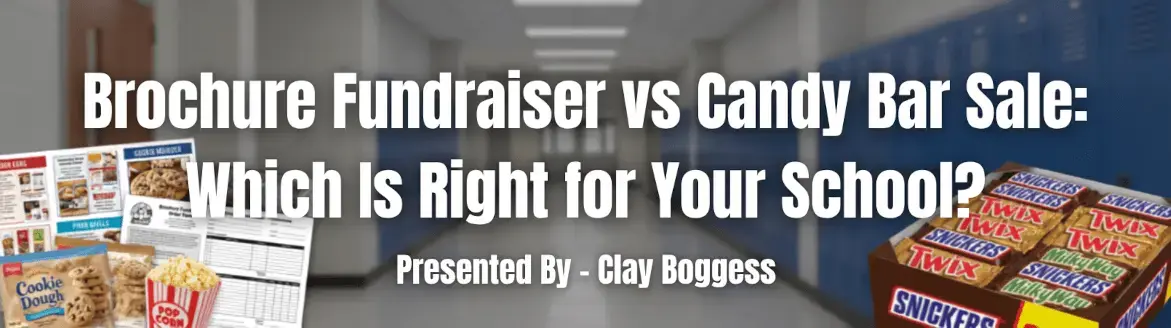
Both programs work. Schools run successful campaigns with each every year, and many run both at different points in the school year. The question is which structure matches your timeline, your volunteer capacity, and your tolerance for holding unsold inventory.
Big Fundraising Ideas has offered both brochure fundraisers and candy bar fundraisers since 1999. This guide covers how each program actually works, the real advantages and drawbacks of each, and how to decide which one fits your campaign.
How a Brochure Fundraiser Works
- Money is collected before product ships: the school never carries inventory risk, because every item ordered is already paid for
- Exact quantities: you receive precisely what was ordered — no surplus to dispose of and no shortage to explain
- Prepacked by the seller: orders typically arrive already packed per student, turning distribution day into a handoff rather than a sorting operation.
- Prizes for every participant: brochure programs generally include a prize structure that rewards every student who sells, not only the top performers
- The extra step: students must deliver items to their supporters after product arrives — an additional task that candy bar sales do not require
- Occasional discrepancies: with hundreds of individual orders, an occasional missing or damaged item is normal and needs a process
How a Candy Bar Sale Works
Candy bar programs through Big Fundraising Ideas include peanut-free and kosher options, which broadens the buyer pool at school events where dietary restrictions are a common objection. Because the transaction completes in a single interaction, candy bars are the fastest-converting format available for events, hallway selling, and any setting where the seller and buyer meet once.
- One contact completes the sale: the buyer receives the product and pays immediately — no return visit, no delivery step.
- Affordable to nearly everyone: at $1 to $2, the purchase decision requires no consideration, which is why candy bars convert at events where higher-priced products stall.
- Impulse purchase behavior: candy bars sell in settings where a brochure would never be opened — passing periods, ball games, community events
- Inventory risk: order too much and the group is left holding product it has already committed to
- Money collected after distribution: product goes out before funds come in, which requires tracking and follow-up with sellers
- Prizes usually for top sellers: candy bar programs typically reward the highest performers rather than every participant
Side by Side Comparison
Both programs available through bigfundraisingideas.com. No upfront cost. Free shipping.
Which One Should You Run?
Choose a brochure fundraiser when
- You want higher revenue per seller — brochure items carry higher price points, and buyers frequently order multiple items.
- Your group cannot absorb the risk of unsold inventory
- You want a prize structure that rewards every participant rather than only top sellers
- Your sellers' networks are family, neighbors, and parent workplace contacts rather than event crowds
- You have enough runway for the full cycle: sell, submit, produce, ship, deliver
Choose a candy bar sale when
- Your timeline is short, and you need money quickly with no production wait
- Your selling environment is events, games, or high-traffic gatherings rather than door-to-door
- You want the simplest possible transaction with no delivery step afterward
- Your group has a reliable sales history and can forecast quantity accurately
- Sellers are older students who can manage carrying product and turning in funds
Running Both
Adding an online store alongside a brochure campaign further expands reach, capturing extended family and out-of-area supporters who cannot receive a physical brochure. For groups where delivery logistics are the primary obstacle, scratch cards and discount cards offer a third path with neither inventory risk nor a distribution day to manage.
Frequently Asked Questions
What is the difference between a brochure fundraiser and a candy bar sale?
A brochure fundraiser is an order-taker: students collect orders and money first; the product arrives afterward, already paid for. A candy bar sale is on consignment: the group orders product up front, students sell it directly, and funds are collected after the product is distributed. The structural difference is who carries inventory risk.
Which raises more money, a brochure fundraiser or candy bars?
Brochure fundraisers generally produce higher revenue per seller because items carry higher price points and buyers frequently order several at once. Candy bars generate revenue faster with a simpler transaction. For total campaign revenue at a school-wide level, brochure programs typically lead; for speed and simplicity, candy bars lead.
Do you have to pay upfront for a candy bar fundraiser?
Candy bar programs through Big Fundraising Ideas operate with no upfront cost and free shipping. The consignment structure means the product ships before selling begins, but the financial commitment is settled after the sale. The practical risk is over-ordering: product ordered but not sold still belongs to the group. See candy bar fundraisers.
How much do candy bars sell for in a school fundraiser?
Typically $1.00 to $2.00 per bar. That price point is low enough that most purchases are impulse decisions, which is why candy bars convert well at events and in hallway settings. Peanut-free and kosher options are available through Big Fundraising Ideas candy bar programs.
Does a brochure fundraiser require students to deliver product?
Yes. Once the product arrives, students deliver items to the supporters who ordered them. This is the main additional step compared to a candy bar sale, where the transaction completes in one interaction. Some brochure programs can ship directly to the seller's home, which changes the logistics but not the delivery step itself.
Which fundraiser is better for a short timeline?
A candy bar sale. The product is already on hand when sales start, so there is no production or shipping delay between the close of the sale and the receipt of funds. A brochure fundraiser requires time for order submission, production, shipping, and delivery after the selling window closes.
Which fundraiser is better for younger students?
Both work, for different reasons. Brochure programs suit younger students because a parent typically helps present the catalog to family and neighbors, and prizes are awarded to every participant. Candy bars suit older students who can manage carrying product and turning in money. For very young sellers, lollipops offer a similar direct-sale simplicity at an even lower price point.
Can a school run both a brochure fundraiser and a candy bar sale?
Yes, and many do, at different points in the school year. The two formats reach different buyers — brochures reach family and neighbor networks, candy bars reach event crowds and hallway traffic. Running both across a school year generally produces more total revenue than running either format twice.
What happens if we order too many candy bars?
Unsold product remains with the group, which is the primary risk of the consignment model. Order conservatively for a first campaign and base quantities on confirmed active sellers rather than total roster size. Groups without a reliable sales history should consider an order-taker format instead, since brochure programs carry no inventory risk.
Which fundraiser has less work for the coordinator?
Candy bars require less work at the end — no order forms to compile, no delivery day to run. Brochure programs require less work during the sale because there is no product to track and no money circulating with inventory. For the least coordinator work of any format, scratch cards involve no product handling at all.
Author Bio
Clay Boggess has been designing fundraising programs for schools and various nonprofit organizations throughout the US since 1999. He’s helped administrators, teachers, and outside support entities such as PTAs and PTOs raise millions of dollars. Clay is an owner and partner at Big Fundraising Ideas.

Categories
Related Articles
How Much Can a School Make…
Learn how much a school can make from a popcorn fundraiser using the profit table, worked examples by group size, and what affects your total.
Cupcake Decorating Fundraiser…
How to run a cupcake-decorating contest fundraiser: entry fees, fair judging, allergen labeling, and three ways to raise money at one event.
Holiday Beef Stick Fundraiser…
How to run a holiday beef stick fundraiser: cover ordering and delivery timing, the 15-day invoice rule, and tips to avoid leftovers.