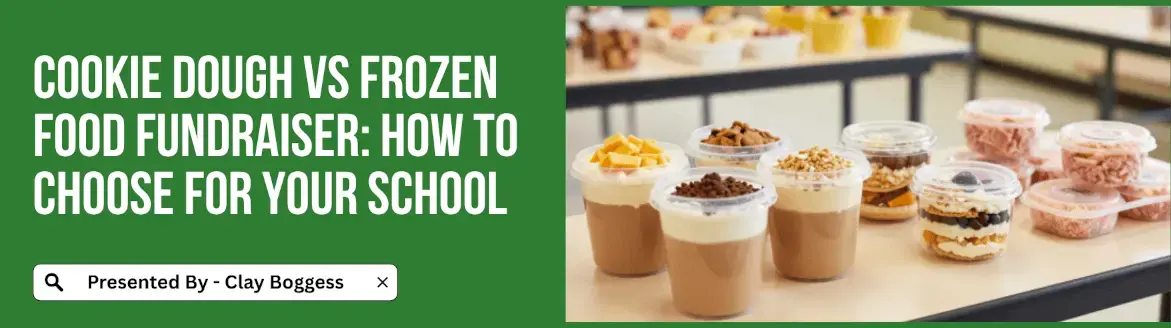
A cookie dough fundraiser focuses on a single product line, gourmet frozen or shelf-stable cookie dough, with 40 percent profit. A frozen food fundraiser uses a multi-product shopper brochure with 60 to 154 items, including cookies, muffins, pizzas, pretzels, and cinnamon rolls, with 40 to 50 percent profit. Cookie dough wins on simplicity. Frozen food wins on average order value and broader buyer appeal.
The right choice depends on the size of your group, your community's buying habits, your freezer capacity on delivery day, and whether your buyers have already purchased cookie dough from another local group in the same season. This guide walks through both formats with real product details and concrete profit math, then gives you a 5-question decision framework you can run through in 10 minutes.
Quick stats
Cookie Dough vs Frozen Food Fundraiser: At a Glance
Both formats run on the same brochure mechanics. Each seller receives a brochure, an order form, and a money envelope, takes orders for two weeks, and then your sponsor submits forms to Big Fundraising Ideas for processing. Orders arrive pre-packed by seller at no extra cost. The differences come down to what is in the brochure and how supporters respond to it.
What is a cookie dough fundraiser?
A cookie dough fundraiser is a brochure-based sales campaign in which students sell gourmet frozen or shelf-stable cookie dough to friends, family, and coworkers, then deliver the product after the two-week sale window closes. The Otis Spunkmeyer Cookies brochure is the most popular format in the program. It features 12 cookie dough flavors, plus several additional items, with an average retail price of $20 and a 40 percent profit for your group.
Quick answer: A cookie dough fundraiser earns up to 40 percent profit ($8 per $20 item), runs for two weeks, and delivers pre-packed by seller 3 to 4 weeks after order forms are submitted. Best for groups with fewer than 100 sellers or communities that have not bought cookie dough recently.
How a cookie dough fundraiser works
The process is the same five steps every time:
- Your sponsor fills out a sign-up form.
- We send a brochure, an order form, and a money envelope to every seller, all at no upfront cost.
- Sellers take orders for 2 weeks, collect payment up front, and turn in the forms to the sponsor.
- The sponsor submits all forms to Big Fundraising Ideas.
- The order arrives 3 to 4 weeks later, pre-packed by seller, ready for same-day distribution.
Cookie dough fundraiser profit math
The profit is the difference between what supporters pay and what your group owes on the invoice. A school of 300 students, with each student selling 5 items at $20 each, earns roughly $4,800 in profit from a single two-week sale. A school of 500 students, with each student selling eight items, earns approximately $12,800. There is no shipping charge if your group sells 150 or more items.
Best for which groups
Cookie dough works best for groups whose community has not yet bought cookie dough this season, for sponsors who want to keep money counting simple (one product line, one price tier), and for any school that values brand recognition. Otis Spunkmeyer has been a kitchen staple since the 1950s, and supporters know exactly what they are getting. Smaller groups (under 100 sellers) also benefit from the simplicity of a single product because per-seller logistics are easier to coordinate.
What is a frozen food shopper fundraiser?
A frozen food shopper fundraiser uses a multi-product brochure to sell prepared frozen foods, including cookie dough, muffins, pizzas, pretzels, cinnamon rolls, and other snack items. The Otis Spunkmeyer & More carries many items at an average price of $22. The Otis Spunkmeyer Extravaganza brochure features 154 items and is the largest frozen food fundraiser in the program. Profit ranges from 40 to 50 percent depending on total order size, with 70 percent profit on cash donations.
Quick answer: A frozen food fundraiser earns up to 40 percent profit (70 percent on donations), runs on the same two-week sale window as cookie dough, and includes cookie dough plus 60 to 154 other items. Best for larger groups, communities tired of cookie dough, and sponsors focused on total dollars over unit count.
What is inside a frozen food brochure
Big Fundraising Ideas offers six frozen food brochures, each tuned to a different group profile:
- Otis Spunkmeyer & More: 12 Otis Spunkmeyer cookie dough flavors, Otis 9-count muffins, top-selling cheesecakes, Joe Corbi's pizzas.
- Otis Spunkmeyer Extravaganza: 154 products covering cookie dough, frozen entrees, breakfast items, snacks, and desserts—the largest frozen food fundraiser in the BFRI lineup.
- Gourmet Cookies & More: Many products, from pre-portioned cookies to cookie dough tubs and even popcorn and dry mixes.
- One Price Otis Spunkmeyer: every item at the same price for fast money counting.
- Otis Cookies & Muffins: 13 Otis Spunkmeyer cookie dough flavors and three Otis Muffin flavors.
- Pizza Pals: 6 individually-wrapped pizzas, including Three Meat Pizza, Pepperoni, and Cheesy Garlic Pizzas.
Frozen food fundraiser profit math
Frozen food brochures earn up to 40 percent profit depending on volume. Cash donations through the brochure profit at 70 percent, and donations do not count toward the 150-item minimum. A school of 300 students, with each student selling 5 items at an average price of $22, earns approximately $6,600 to $8,250 in profit, meaningfully higher than the equivalent cookie dough campaign because of the larger per-buyer order size. Like cookie dough, there is no shipping charge once you sell 150 items.
Best for which groups
Frozen food brochures work best for groups that have recently run cookie dough, for communities where supporters appreciate variety, for sponsors who want a higher per-supporter order value, and for any program planning a major two-week push where the goal is total dollars rather than units. The Extravaganza brochure, in particular, suits groups of 200 or more sellers.
Cookie Dough vs Frozen Food Fundraiser: Side-by-side breakdown
Variety and selection
Cookie dough is one product with multiple flavors. A frozen food brochure includes many products across many categories. Variety is the single biggest differentiator. If a supporter does not bake cookies, the cookie dough brochure has nothing to sell them. The same supporter will find pizza, snacks, or breakfast items in the frozen food shopper. For groups whose buyer pool is older or more diverse, that variety often translates directly into more orders per seller.
Profit per seller
Cookie dough averages $8 profit per item at the 40 percent tier. A frozen-food brochure can earn $8- $10 per item at the 40% tier. The bigger gap shows up in average order size. A typical cookie dough buyer purchases one to two items. A frozen food buyer often purchases three to five, because there is something for every meal of the week. The math compounds: at five items per buyer instead of two, total revenue per supporter is 2.5 times higher with the frozen food brochure.
Delivery and storage logistics
Both products ship within 3 to 4 weeks after the sponsor submits order forms. Both ship frozen and arrive pre-packed by seller. The freezer capacity required on delivery day is similar, since most cookie dough fundraisers also stock hundreds of units in the freezer. The difference is the floor space your volunteers need to stage seller bags. Frozen food orders occupy more square footage because the per-supporter order is larger and more varied. Plan for 30 percent more staging space if you run the Extravaganza brochure.
Average order value
Order value is where the frozen food shopper consistently wins. A cookie dough brochure has a tight $18-$25 price range. A frozen food shopper has price points from $10 snacks to $25 dessert items, with most supporters mixing categories. Sponsors who track per-supporter dollars rather than per-seller units almost always favor the frozen food format for larger campaigns. The typical frozen-food buyer spends $45 to $75 per transaction; the typical cookie-dough buyer spends $20 to $40 per transaction.
Seasonal fit
Cookie dough sells well year-round but peaks in the fall when supporters are baking for the holidays. Frozen food shoppers sell strongest in the fall as well, with a secondary spike in late winter when families are stocking the freezer for winter break. Spring frozen food sales are softer because supporters are clearing freezer space rather than filling it. Cookie dough has a slight spring edge because its smaller storage footprint matters less to buyers who are decluttering.
Sales tax considerations
In most states, prepackaged food sold through a school brochure is not subject to sales tax because it is not prepared for immediate consumption, which applies equally to cookie dough and frozen food brochures. State rules vary, so confirm with your state's Department of Revenue before launching. Big Fundraising Ideas collects and remits sales tax in states where nexus has been established.
Allergen and dietary considerations
Cookie dough typically contains wheat, eggs, soy, and milk. Many brochures also note warnings about peanut and tree nut allergens due to shared facilities. Frozen food brochures have a broader allergen profile because they cover more categories, but the same disclosures appear in them. Both formats are kosher-certified across the major product lines in the Big Fundraising Ideas catalog. Schools with strict peanut-free policies may want to ask their fundraising specialist about peanut-free options within each brochure.
Decision framework: 5 questions to ask before you pick
Run through these five questions in order. The answers will tell you which format fits.
1. How many active sellers does your group have?
Under 100 sellers: lean cookie dough. Between 100 and 200: either format works; selection is driven by question 2. Over 200: lean frozen-food shopper, because the higher average order value scales better.
2. Has your community bought cookie dough in the last 6 months?
If another local PTA, sports team, or church group has run a cookie dough sale recently, your freezer-saturated buyers will skip the cookie dough format. Switch to a frozen-food shopper or the Otis Cookies & Muffins brochure, which pairs cookie dough with non-cookie items.
3. What is your dollar goal?
Goals under $5,000: either format will hit. Goals between $5,000 and $15,000: lean frozen food shopper for the higher per-buyer revenue. Goals over $15,000: run an Extravaganza brochure with an online store layered on top.
4. How is your delivery day staffing?
Two or three reliable volunteers: cookie dough is easier to stage and distribute. Five-plus volunteers comfortable working a 90-minute window: either format works. The Extravaganza brochure benefits from a larger team because of the broader product variety.
5. How sensitive is your community to brand recognition?
Buyers who specifically ask for Otis Spunkmeyer tend to convert better on a cookie dough brochure where the brand is the headline. Communities that respond more to variety and convenience tend to convert better among frozen food shoppers.
When cookie dough is the better choice
Pick cookie dough when:
- Your group is on the smaller side (under 100 active sellers), and you want to manage one product line rather than several.
- Your community has not bought cookie dough recently from a competing PTO, sports team, or church group in the same season.
- Your sponsor wants the simplest possible money counting on turn-in day. One product line, one price tier, fewer questions.
- Your buyer pool skews younger or includes many families with school-age children at home who actively bake.
- Your group has previously run cookie dough successfully and wants to repeat what works. Returning buyers know exactly what to expect from Otis Spunkmeyer and order without hesitation.
When a frozen food shopper is the better choice
Pick a frozen food shopper when:
- Your group is mid-sized to large (150 or more active sellers), and you need to spread purchase decisions across more product categories.
- Your community is tired of cookie dough this year. Another local group recently ran a cookie dough sale, and your supporters have already filled their freezers.
- Your sponsor cares more about total dollars raised than per-seller units. A frozen food shopper has a higher average order value because supporters can mix categories.
- Your buyer pool includes a wider age range, including supporters without kids at home who may not bake but who do want a pizza for next Friday's family night.
- You want flexibility to add cinnamon rolls, muffins, snacks, or specialty items to the brochure. Six brochure formats let you tune the lineup to your community.
A hybrid approach: when to combine both
You do not always need to pick one. Several Big Fundraising Ideas brochures already pair cookie dough with frozen food in the same lineup. The Otis Cookies & Muffins brochure features all 13 Otis Spunkmeyer cookie dough flavors and three Otis Muffin flavors. The Gourmet Cookies & More and Extravaganza brochures both include cookie dough alongside dozens of other frozen items.
If your school runs two fundraisers a year, the cleanest strategy is to alternate. A focused cookie-dough campaign in the fall makes for a strong, simple kickoff. A frozen-food shopper in late winter or early spring captures the same buyers when their freezers have emptied, and they are ready to restock. Sponsors who run this rotation often report stronger long-term participation than groups that run the same format twice.
A second hybrid option: pair any brochure with a custom online store. Supporters in other states, grandparents, and extended family can order through your school's custom link and have items shipped directly to their homes. Online sales count toward your profit and bypass any geographic limits on the brochure.
Frequently asked questions
Which is more profitable: a cookie dough fundraiser or a frozen food fundraiser?
A frozen food fundraiser typically generates more total profit because supporters buy more items per order. Cookie dough averages 1 to 2 items per buyer; frozen food averages 3 to 5 items per buyer. The per-item profit is similar, but the per-buyer revenue is 2-3 times higher for frozen food.
Do frozen food brochures include cookie dough?
Most do. The Otis Spunkmeyer Extravaganza, Gourmet Cookies & More, and Otis Cookies & Muffins brochures all include cookie dough in their lineup alongside other items. If cookie dough is the primary draw for your community, the Otis Spunkmeyer Cookies brochure is the closest hybrid option.
How much does a school typically earn with each format?
A school of 300 sellers, averaging 5 items each, earns roughly $4,800 with cookie dough and between $6,600 and $8,250 with a frozen-food shopper, depending on the brochure and average order value. Larger groups scale these numbers proportionally.
What is the minimum order for free shipping?
Some formats require 150 items and others 350 to qualify for free shipping. Donations do not count toward the 150-item threshold.
How long does delivery take?
Both formats deliver 3 to 4 weeks after the sponsor submits order forms to Big Fundraising Ideas. All orders ship to the lower 48 states, pre-packed by seller.
Are these fundraisers taxable?
Most prepackaged frozen food and cookie dough sold through a brochure are not subject to sales tax in most states because they are not prepared for immediate consumption. Big Fundraising Ideas collects and remits taxes in states where nexus has been established. Always verify with your state's Department of Revenue.
What if our community has already done cookie dough this year?
Switch to a frozen food shopper. The variety attracts buyers who recently said no to cookie dough because their freezers are full of it. The Otis Spunkmeyer Extravaganza is the safest choice in this scenario because of its 154-product range.
Can we sell online too?
Yes. Both formats pair with a custom online store that supporters can share by text, email, or social media. Orders ship directly to buyers anywhere in the country. Online sales count toward your profit and bypass the 150-item shipping threshold.
What is the average order value for each format?
Cookie dough averages $20 to $40 per buyer. Frozen food shoppers average $45 to $75 per buyer. The 2 to 2.5 times difference is the single biggest reason frozen food fundraisers tend to outperform cookie dough on total dollars raised for larger groups.
Which format is better for a small school with under 50 sellers?
Cookie dough. The single-product simplicity reduces sponsor workload, the 150-item threshold is easier to hit, and the per-seller goal math is cleaner. Small groups should expect 8 to 10 items per seller as a realistic target with cookie dough.
Can we change brochures mid-sale if it is not working?
No. The brochure is locked at the time of sale launch because the order forms, prize program, and online store are all tied to that specific brochure. Pick carefully before kickoff using the decision framework above. A fundraising specialist can help you stress-test your choice before you commit.
The bottom line
Both formats are proven. Cookie dough is the cleaner program for smaller groups, repeat buyers, and sponsors who want one product line. The frozen food shopper is the bigger play for larger groups, communities where cookie dough has saturated, and sponsors focused on total dollars raised. If you cannot pick, the simplest move is to run cookie dough this season and a frozen food shopper next. Both are no-upfront-cost programs, both ship pre-packed by the seller, and both can plug into an online store for supporters out of town.
Ready to compare your options? See the full cookie dough fundraiser lineup or browse all frozen food brochures to find the right brochure for your community. A fundraising specialist can help you match a brochure to your group size, community, and dollar goal.
Author Bio
Clay Boggess has been designing fundraising programs for schools and various nonprofit organizations throughout the US since 1999. He’s helped administrators, teachers, and outside support entities such as PTAs and PTOs raise millions of dollars. Clay is an owner and partner at Big Fundraising Ideas.

Categories
Related Articles

How Much Can a School Make…
Learn how much you can make from an Otis Spunkmeyer fundraiser; see the profit formula, a worked example, and what affects your total.

Mother's Day and Father…
Mother's Day and Father's Day fundraiser ideas for schools: what to sell, how to price gifts kids can afford, and when to start.

Hot Chocolate Bar Fundraiser…
How to run a hot chocolate bar fundraiser: what to buy, how to price cups, how to keep kids safe around hot drinks, and where it works best.