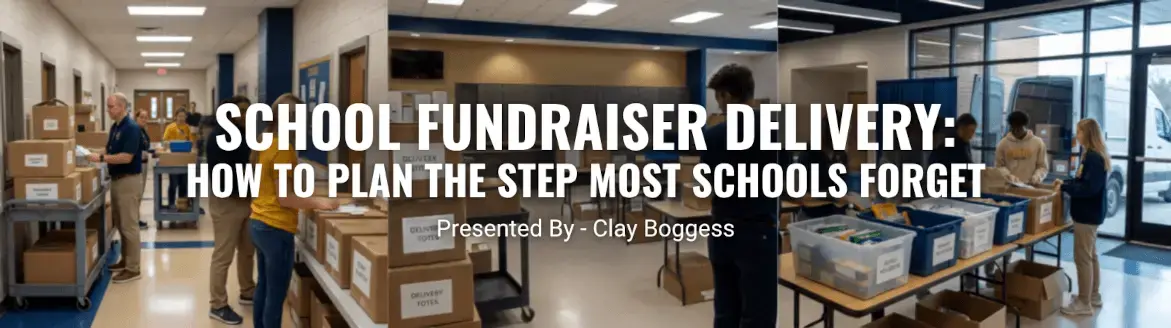
The problem is one of attention rather than difficulty. Delivery arrives at the end of a long campaign, after the exciting parts are over and the coordinator's energy is spent. It also arrives at a point where mistakes are expensive: the product is already paid for, families are already expecting it, and there is no version of the campaign that skips this part.
Big Fundraising Ideas has managed school fundraiser deliveries since 1999. This guide covers how fundraiser shipments actually move, what to ask your fundraising company before the order ships, and how to run a distribution day that finishes on schedule.
Ask These Questions Before Your Order Ships
- How are student orders packed? Prepacked by seller, or bulk by item? This determines whether distribution day is a handoff or a sorting operation, and it changes your volunteer count substantially
- Where exactly will merchandise be delivered? Curbside, inside the nearest door, or into a specific room? Confirm the actual door and whether it has double-width access
- When can we expect the order? Establish whether you will receive a delivery date, a delivery window, or a tracking number to monitor
- Will we be notified ahead of time? Confirm who calls whom, and at what number, and how much notice you will get
- How do we handle missing or damaged items? Know the process and the reporting window before you need it, not while a parent is standing in front of you
How Fundraiser Shipments Actually Move
LTL stands for Less-Than-Truckload: your order ships alongside other cargo on a truck that makes multiple stops along a route, which is why you receive a window rather than an appointment.
With LTL freight, the tracking number and carrier phone number matter more than they first appear. Calling the carrier on the morning of delivery generally yields a much tighter arrival estimate than the original window, allowing you to brief volunteers and communicate accurately with parents.
Common Delivery Questions
Can we schedule a delivery date in advance?
Usually yes, though the more common approach is to set the delivery date once the order is ready to ship. Scheduling well in advance requires committing to a date before production is complete, which introduces its own risk.
What if we need our order by a specific date?
This can be arranged, but it works backward from the deadline rather than forward from the campaign. Start the fundraiser early enough to allow processing, shipping, and delivery to complete before your date. A campaign that closes two weeks before a hard deadline has almost no margin for a freight delay.
Can we request a morning delivery?
Some carriers can arrange a morning delivery if the school is not in a remote area, but most will not guarantee it. Plan the day as though the delivery could arrive at any point in the window, and treat a morning arrival as a bonus rather than an assumption.
Preparing for Distribution Day
- Recruit volunteers before the truck arrives: sorting and distributing several hundred boxes is not a one-person job. Confirm help in advance rather than making calls while the driver waits.
- Reserve a large, secure space: a gym, cafeteria, or unused classroom that can be locked. Product left in a hallway overnight is a problem waiting to happen.
- Communicate pickup timing to parents clearly: frozen product must be picked up the same day it arrives. Non-frozen product should be picked up the next day unless the delivery lands in the morning.
- Confirm door access and pallet clearance: walk to the delivery door and verify double-width access if the shipment is palletized. Discovering this on delivery day is too late.
Frozen Deliveries Are Different
For frozen campaigns, call the carrier on the morning of delivery to narrow the window, schedule volunteers across the widest plausible range rather than a single hour, and communicate a pickup window to parents that begins comfortably after the latest likely arrival time. For specifics on frozen distribution, see the frozen food fundraiser delivery steps and the instructions for distributing bulk cookie dough.
The Delivery-Free Alternative
- Scratch card fundraisers: donation-based with usually a small single-box delivery. The school never handles a delivery.
- Online store programs: supporters order online and the product ships directly to their homes, bypassing the school entirely
- Discount cards: a single small box shipment of cards rather than hundreds of individual orders to sort
- Home delivery programs: some brochure campaigns can ship directly to the seller's home rather than to the school
Frequently Asked Questions About School Fundraiser Delivery
How does school fundraiser delivery work?
Order size determines the carrier. Orders above roughly 300 items typically ship LTL freight on pallets with a delivery window rather than a set time. Orders below roughly 300 items typically ship via UPS or a similar parcel carrier, with an estimated delivery date and boxes included. The fundraising company should provide tracking and notify you before the shipment arrives.
What is LTL freight for a school fundraiser?
LTL stands for Less-Than-Truckload. Your order ships alongside other cargo on a truck that makes multiple stops, which is why you receive a delivery window rather than an appointment. LTL shipments are usually palletized, so double-door access at the delivery point is generally necessary.
Should we distribute products on the same day they arrive?
Only for frozen items, which must be distributed the same day. For non-frozen products, receive the shipment on one day and distribute the next. That buffer absorbs freight delays and prevents families from arriving for pickup before the truck arrives.
What should we ask the fundraising company before our order ships?
How student orders are packed, exactly where merchandise will be delivered, when to expect the order, whether you will be notified in advance, and how missing or damaged items are handled. Most delivery problems are expectation mismatches that these five questions resolve in advance.
What is inside delivery?
Many fundraising companies pay extra so that orders are delivered to the nearest available door from the street rather than left at the curb. Because larger orders ship on pallets, double-door access at that entrance is generally required. Confirm which door will be used and verify its clearance before delivery day.
How many volunteers do we need for fundraiser delivery day?
It depends primarily on whether orders arrive prepacked by the seller or in bulk by item. Prepacked orders need enough hands to sort boxes by classroom and manage the pickup table. Bulk orders require assembling every individual order first, which is substantially more work. Ask how orders are packed before deciding your volunteer count.
What if items are missing or damaged?
Ask your fundraising company for their process and reporting window before the order ships. Note discrepancies as you sort rather than after distribution begins, since it is far easier to identify a shortage against a packing list than to reconstruct it from parent complaints a week later.
Can we get a guaranteed delivery time?
Rarely. Some carriers can arrange a morning delivery if the school is not remote, but few will guarantee it. Plan for the full window. With LTL freight, calling the carrier on the morning of delivery generally produces a tighter estimate than the original window.
Which fundraisers have no delivery to manage?
Scratch card fundraisers are donation-based, with usually a small single-box delivery. Online store programs ship directly to supporters' homes. Discount cards arrive as a single small box rather than hundreds of individual orders.
How far in advance should we start a fundraiser to hit a specific deadline?
Work backward from the deadline and allow time for order processing, production, shipping, and delivery, plus a buffer for freight variability. A campaign that closes two weeks before a hard deadline leaves almost no margin. If the date is fixed, tell your fundraising company at the start so the schedule can be built around it.
Author Bio
Clay Boggess has been designing fundraising programs for schools and various nonprofit organizations throughout the US since 1999. He’s helped administrators, teachers, and outside support entities such as PTAs and PTOs raise millions of dollars. Clay is an owner and partner at Big Fundraising Ideas.

Categories
Related Articles

How Much Can a School Make…
Learn how much a school can make from a popcorn fundraiser using the profit table, worked examples by group size, and what affects your total.
Holiday Beef Stick Fundraiser…
How to run a holiday beef stick fundraiser: cover ordering and delivery timing, the 15-day invoice rule, and tips to avoid leftovers.

How Much Can a School Make…
Learn how much you can make from an Otis Spunkmeyer fundraiser; see the profit formula, a worked example, and what affects your total.