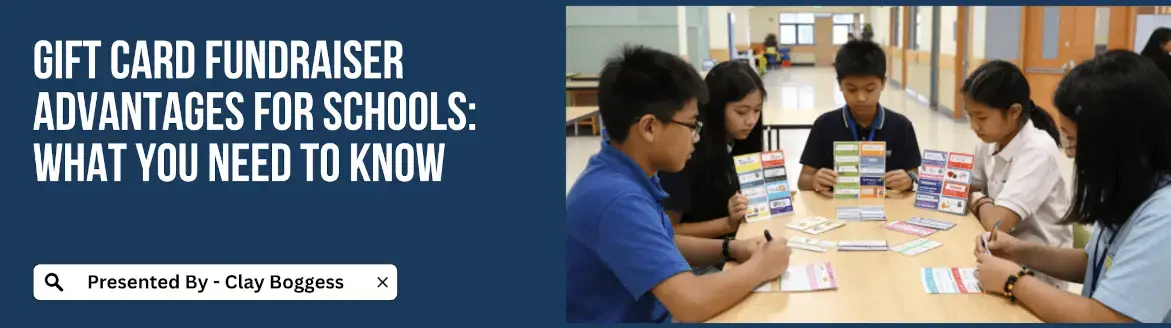
Understanding the advantages and trade-offs of gift card fundraising helps school coordinators choose the right format for their specific community. For schools where the coordinator wants to reduce delivery logistics, or where the community responds more strongly to a practical savings product than to consumable, gift card, or discount card formats, these formats are worth evaluating. For schools where margin efficiency is the primary concern, product programs consistently outperform.
Big Fundraising Ideas has supported school fundraising programs since 1999. This guide covers every advantage of the gift card fundraiser format, how the brochure and direct sale options compare, and how discount card fundraisers, at up to 75 percent profit, represent the highest-margin card-format alternative.
Advantage 1: No Physical Product Replacement Concerns
This advantage is particularly meaningful for schools that have experienced delivery and quality issues with previous product campaigns. A candle that arrived broken, a box of cookie dough that arrived damaged, or a brochure item that was out of stock all create post-campaign logistics tasks that consume the coordinator's time. Gift cards minimize these scenarios because the product is inherently simple: a card with a balance or a digital code, neither of which can spoil, break, or arrive in the wrong quantity.
Advantage 2: Buyers Can Use Cards Themselves or Give as Gifts
The gift flexibility is especially valuable for campaigns run near major gift occasions, including the holiday season, Valentine's Day, Mother's Day, and Teacher Appreciation Week. Buyers who are already in gift-purchase mode for an upcoming occasion purchase gift cards as a two-for-one: they support the school and complete a gift purchase simultaneously. This motivation is unique to card-format fundraisers because it converts a fundraising ask into a productive shopping moment for the buyer.
- Personal Use: Buyer uses the card for their own regular shopping at the featured retailer.
- Gift Use: Buyer gives the card to a family member, friend, neighbor, teacher, or colleague as an occasion gift.
- Combined Use: Buyer purchases multiple cards (one for themselves, one as a gift), generating higher per-buyer revenue than single-card sales.
Advantage 3: Broader Buyer Reach Through Online Selling
The reach advantage is most significant for schools where a meaningful percentage of the student body has extended family in other states or where parents have large workplace networks. A student whose grandparents live in another state cannot hand them a brochure, but can share a link via text that the grandparents can follow to choose a card and pay online. That sale would not have existed without the online channel.
Advantage 4: Two Format Options Give Coordinators Flexibility
Brochure Format
Students distribute catalogs, take upfront payments from buyers for orders, and submit a consolidated order at the campaign close. Cards arrive several weeks after the close and are distributed to buyers. No cards are ordered until orders are confirmed (zero unsold-inventory risk).
Direct Sale Format
The school pre-orders cards and students sell them directly from hand. Buyers receive the card on the spot, similar to a candy bar direct sale. Fast cash collection, but the school carries the risk of unsold cards for the duration of the campaign.
The Discount Card Alternative: Up to 75% Profit on a Card-Format Fundraiser
The discount card fundraiser shares the key advantages of a gift card format: buyers receive a practical product, there is no perishable item to manage, and the transaction is simple. In addition, they generate a margin that makes the program financially competitive with the best available product fundraisers. At up to 75 percent profit on a $20 sell price, 100 cards sold generate $750 in net profit. A retail gift card program at 10 percent on the same $1,000 gross generates $100 net.
Gift Card vs Discount Card: Profit Comparison
Discount card (up to 75%) and scratch card (85%) figures verified from bigfundraisingideas.com. Retail gift card margins are generally in the industry range, not BFI-specific rates.
Frequently Asked Questions About Gift Card Fundraisers
What are the main advantages of a gift card fundraiser?
No physical replacement concerns, dual-use appeal (buyers can use or gift the card), online reach to supporters anywhere, and two format options (brochure or direct sale). Primary trade-off: retail gift card margins (2-15%) are significantly lower than those for product fundraisers.
How does a gift card fundraiser work for schools?
Brochure format: students distribute catalogs, take orders with upfront payment, the school submits a consolidated order, and delivers cards at close. Direct sale: school pre-orders cards, students sell by hand. Online component: participants share a personal link, supporters order digitally, and cards ship to buyers' homes.
What is the profit margin on a gift card fundraiser?
Retail gift card/scrip programs: 2-15% depending on retailer. Compare to discount cards (up to 75%, $20/card as verified on bigfundraisingideas.com) and /scratch-card-fundraiser (85% at 25-99 cards as verified on bigfundraisingideas.com) for significantly higher margins in a similar format.
Can buyers use gift cards as gifts?
Yes. Buyers can use the card for their own shopping or give it as a gift to anyone. The dual-use appeal converts buyers who would decline a product purchase but will buy a card as an occasion gift. Most effective near major gift windows: holidays, Mother's Day, teacher appreciation, Valentine's Day.
What is a discount card and how does it compare to a gift card?
Discount cards from Big Fundraising Ideas: up to 75% profit at $20/card, personalized with school name, features local business savings valid for one year (verified from bigfundraisingideas.com/discount-card-fundraiser). Retail gift cards: 2-15% margin, prepaid balance at one retailer. Same card format, dramatically different margins.
Are there downsides to gift card fundraisers?
Profit margins (2-15%) are substantially lower than product fundraisers. Scrip programs require year-round family behavioral change, and most families do not maintain consistent participation. Buyers who forget to use their card receive no benefit, which can create negative impressions for future campaigns.
Can a gift card fundraiser be run as a brochure-based or direct-sale fundraiser?
Yes. Brochure: orders taken first, cards ordered and delivered after (no unsold inventory risk). Direct sale: school pre-orders cards; students sell by hand (faster cash, but carries the risk of unsold inventory). Choose based on coordinator capacity and community buying behavior.
How does a gift card fundraiser reach online buyers?
Participants share a personal link via text, email, and social media. Supporters anywhere in the country order and pay online with cards shipped to their homes. No school-side distribution logistics for online orders. Reaches grandparents, extended family, and parent workplace contacts who cannot receive a physical brochure.
What is the difference between a gift card fundraiser and scrip fundraising?
Gift card fundraiser: one-time campaign with students selling. Scrip: year-round program where families buy retail gift cards for regular spending. Scrip requires consistent family participation to accumulate meaningful totals. The gift card campaign is lower-maintenance, with revenue concentrated in the active window.
What is the highest-margin alternative to a gift card fundraiser?
Discount cards: up to 75% at $20/card. Scratch cards: 85% at 25-99 cards ($15/card, $85 net). Both are card-format fundraisers. Both verified from bigfundraisingideas.com. 75% and 85% margins vs 2-15% on retail gift cards.
Author Bio
Clay Boggess has been designing fundraising programs for schools and various nonprofit organizations throughout the US since 1999. He’s helped administrators, teachers, and outside support entities such as PTAs and PTOs raise millions of dollars. Clay is an owner and partner at Big Fundraising Ideas.

Related Articles

Cupcake Decorating Fundraiser…
How to run a cupcake-decorating contest fundraiser: entry fees, fair judging, allergen labeling, and three ways to raise money at one event.
Holiday Beef Stick Fundraiser…
How to run a holiday beef stick fundraiser: cover ordering and delivery timing, the 15-day invoice rule, and tips to avoid leftovers.

How Much Can a School Make…
Learn how much you can make from an Otis Spunkmeyer fundraiser; see the profit formula, a worked example, and what affects your total.