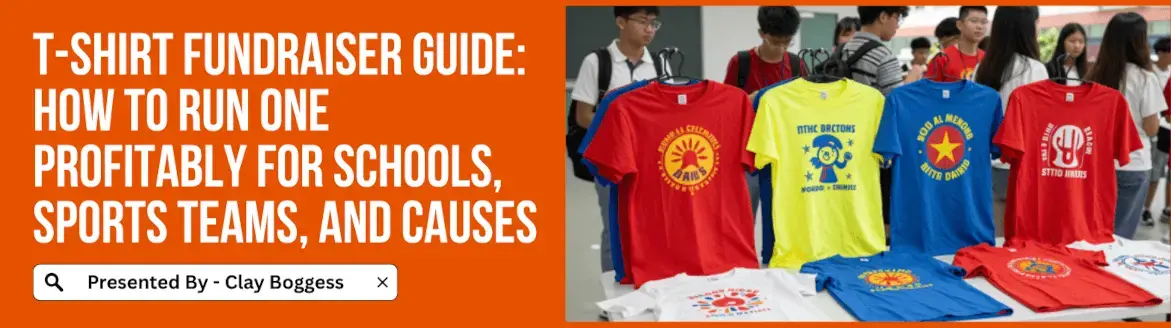
A t-shirt fundraiser sells custom-designed t-shirts featuring your school name, team logo, mascot, or cause slogan to supporters at a markup that funds your group. Through Big Fundraising Ideas Custom Apparel Online, t-shirts can run in three different formats: a Print on Demand store (up to 12 months open, no minimum, 20% profit), a Popup Store (2-week sale window, no minimum, 20% profit), or a Bulk Order (minimum 24 shirts of one design, 25% profit). No upfront cost on any of the three. Free custom design through a live consultation with BFI's design team. Every format works for t-shirts.
This guide covers exactly what a t-shirt fundraiser is, the 5-step process for running one, the three formats with explicit comparison and best-fit matching, the hybrid strategy that combines all three, five strong use cases (sports teams, church groups, memorials, school spirit weeks, tie-dye events), what to look for in a provider, the design choices that separate top sellers from average campaigns, the profit math at different scales, and the promotion playbook that takes advantage of t-shirts' unique social-media shareability.
Quick stats
What is a t-shirt fundraiser?
A t-shirt fundraiser is a fundraising campaign that sells custom-designed t-shirts to supporters, with the difference between the retail price and the production cost going to your group as profit. The format works because t-shirts are inherently shareable. Every supporter who wears the shirt becomes a walking advertisement for your cause. Unlike candy or cookie dough fundraisers that get eaten and forgotten, a t-shirt sticks around in someone's closet for years, often surfacing again on social media when worn at events.
The format suits any group with a recognizable identity to print: a school mascot, a team name, a cause slogan, a memorial tribute, or a themed-event motif. School fundraisers commonly run t-shirt campaigns alongside their other fundraising activities, treating t-shirts as a year-round revenue stream rather than a one-time push. Sports teams run shirts every season. Memorial t-shirt fundraisers run as urgent one-time campaigns when a community member needs support.
Quick answer: A t-shirt fundraiser sells custom-designed t-shirts at a markup to fund your school, team, church, or nonprofit. Through Big Fundraising Ideas, t-shirts are available in three formats, with profit ranging from 20% to 25% per shirt and zero upfront cost for any of the three.
How a t-shirt fundraiser works
The format runs in 5 sequential steps. The full cycle takes 2 to 6 weeks, depending on the format you choose.
Step 1: Choose your format
Print-on-Demand, Popup Store, or Bulk Order. The choice determines your minimum, campaign window, profit margin, and delivery timeline. First-time groups typically start with Print on Demand because it has no minimum, no upfront cost, and no inventory commitment. Groups with a known volume need (a sports team ordering roster shirts) typically prefer Bulk Order for the higher 25% margin. Spirit-week and event-tied campaigns typically prefer Popup Store for the 2-week event format.
Step 2: Design the shirt through a live consultation
BFI's design team runs a live design consultation where you select from a curated artwork library (typically 2 design options per category), customize logo placement, colors, text, and layout. The graphics department then develops proofs for your approval. Multiple printing methods are available, including screen printing, direct-to-garment, and embroidery (which works especially well for hoodies and polos in the same campaign). Custom design is included with every format at no extra cost.
Step 3: Launch the store or place the order
For Print-on-Demand: BFI builds your custom online store. You receive an activation email with your store URL. Share the link with supporters via social media, text, and email. For Popup Store: BFI builds the store, and the 2-week sale window opens on your scheduled start date. For Bulk Order: BFI takes your single order (minimum of 24 of one design in mixed sizes), production begins, and shipping takes 3-4 weeks.
Step 4: Promote with social-media-first tactics
Social media drives t-shirt sales more than any other fundraiser format because the product is visually shareable. Coordinate a launch announcement with photos of the shirt mockup. Have participants register (they get personalized sales links and a leaderboard view of their own sales). Repost photos of supporters wearing the shirt as social proof. Per BFI's data, participants who upload their own picture to their seller dashboard are ten times more likely to make sales than those who don't.
Step 5: Receive shipments and profit payments
Print on Demand: each shirt is printed (or embroidered) within 3-5 business days of order, then ships directly to the customer in 5-7 business days total. Your group receives bimonthly profit payments for up to 12 months. Popup Store: the store closes after the 2-week window; all orders ship in a single bulk shipment to your group 3-4 weeks later for distribution. Profit is paid within 10 business days of store close. Bulk Order: shipment arrives in 3-4 weeks, your group distributes the shirts and receives profit after delivery.
Three ways to run a t-shirt fundraiser
Big Fundraising Ideas offers three distinct formats for running a t-shirt fundraiser. T-shirts are the highest-volume item in all three formats. Each format has different economics, timelines, and use-case fit.
Print on Demand Store (the no-risk option)
A customized online store offering t-shirts plus a broader catalog of 80 to 100 apparel and accessory items across multiple categories. The store stays open for up to 12 months with no minimum order requirement. Each shirt is printed (or embroidered) within 3-5 business days of order placement, then shipped directly to the customer's address in 5-7 business days. Your group earns 20% profit per shirt, paid bimonthly for up to 12 months.
- Pros: Zero inventory risk; no upfront capital; long 12-month campaign window; direct ship to buyer means no distribution day; can be combined with any other BFI online fundraiser.
- Cons: Lower per-shirt profit than Bulk Order; customer pays shipping and the 3.5% processing fee at checkout; longer total wait time per buyer than Bulk Order pickup-day delivery.
Popup Store (the 2-week event format)
A 2-week e-commerce event offering approximately 10 apparel items (with t-shirts as the lead item) at wholesale-like pricing. The store opens on your scheduled start date; supporters order online during the 2-week window; the store closes; and the bulk shipment arrives at your group 3-4 weeks later for distribution. Your group earns a 20% profit per shirt, paid within 10 business days of the store's close.
- Pros: No minimum; no upfront cost; 2-week sale urgency drives strong participation; one bulk shipment is simpler logistically than handling individual orders.
- Cons: Shorter campaign window than POD; group handles distribution day; cannot run concurrently with another BFI online fundraiser like Popcorn Online.
Bulk Order (the highest-margin option)
A single bulk order of 24 or more shirts of one design in mixed sizes, with a limit of 1-2 design types per order. Wholesale pricing applies. Production and shipping arrive in 3-4 weeks. Your group earns 25% profit per shirt, the highest of the three formats. The group pays a one-time shipping charge for the bulk delivery.
- Pros: Highest profit margin (25%); simplest accounting (one transaction); fastest per-buyer delivery once distributed (no individual shipping).
- Cons: Minimum 24 shirts of one design; limited to 1-2 design types per order; group handles distribution to buyers; less flexibility for groups whose buyers want size or design variety.
Format comparison table
Quick answer: Print-on-demand has zero minimum and ongoing income, but a lower 20% profit margin. Bulk Order has the highest 25% profit but requires 24 shirts of one design. Popup Store sits between: 2-week urgency, 20% profit, no minimum. Most first-time groups start with Print-on-Demand.
The hybrid strategy: bulk to popup to Print on Demand
The smartest t-shirt fundraiser approach combines all three formats. BFI's own recommendation: place a Bulk Order or run a Popup Store first to capture the event-driven sales spike, then convert your store to Print on Demand for the rest of the school year or season.
Pro tip: A sports team can place a Bulk Order for 24+ roster shirts at 25% profit to outfit players and immediate family. Then run a 2-week Popup Store at school, featuring spirit shirts at a 20% profit margin. Finally, convert to a year-round Print-on-Demand store at 20% profit for ongoing sales to alumni, extended family, and supporters who couldn't make the popup window. The same school year generates revenue from all three formats.
The conversion from Bulk or Popup to a Print-on-Demand store is straightforward but not automatic. BFI typically conducts a brief follow-up design consultation to add designs (up to 4 per category) for the print-on-demand catalog. The school year then operates as an ongoing revenue stream rather than a one-shot fundraiser.
T-shirt fundraiser use cases
Five use cases account for the strongest t-shirt fundraiser campaigns. Each has its own design conventions, audience expectations, and best-fit format.
Sports team t-shirt fundraisers (best fit: Bulk Order)
The classic format. Print the team name, year, mascot, and player roster on a shirt. Sell to family, friends, alumni, and the broader school community. Players themselves are the strongest marketing channel because every player wearing the shirt at school drives sales among classmates. Bulk Order is the best fit because rosters know their volume in advance, and the higher 25% profit compounds over a multi-shirt order. Common variants: football shirts with mascot themes, basketball shirts with player numbers, cheer and dance squad shirts with squad slogans, and track shirts tied to season meets.
Church group t-shirt fundraisers (best fit: Popup Store or Bulk Order)
Mission trip fundraisers, building fund campaigns, youth group identity shirts, and annual giving drives. Custom designs typically feature the church name, mission slogan, or trip destination. A popup store works well when the mission trip date creates a natural deadline. Bulk Order is suitable for known volumes, where the youth group can pre-commit to 24+ shirts. Designs lean toward simple, faith-aligned typography and avoid overly trendy graphics that won't age well.
Memorial t-shirt fundraisers (best fit: Print on Demand)
Honor a community member, raise funds for a family facing medical expenses, or commemorate a cause. Sensitive design considerations apply: family approval of likeness or wording, appropriate tone, and a clear public statement of where proceeds go. Print on Demand is the best fit because the urgency of memorial fundraisers rarely allows for a 3-4 week Bulk Order timeline, and the 12-month store window means supporters across geographies can participate over time, not just during a 2-week popup window. Memorial campaigns also benefit more from social-share dynamics than any other format because supporters anywhere in the country can contribute.
School spirit t-shirt fundraisers (best fit: Popup Store)
Tied to homecoming, school spirit week, or seasonal events. Designs typically feature the school colors, mascot, and event or year prominently. The 2-week Popup Store format aligns naturally with the spirit week timeline. For broader school spirit apparel programs that go beyond t-shirts to include hoodies, drinkware, and accessories, the same Popup Store format applies.
Tie-dye t-shirt fundraisers (different format entirely)
A craft-based variant where students tie-dye blank shirts at a school or community event. The fundraiser becomes the event itself: families pay an admission fee to participate, which includes a dyed shirt. Lower per-shirt profit than custom-printed designs, but the event drives community engagement that printed campaigns cannot match. Popular with elementary and middle school PTAs running spring or end-of-year fundraisers. Tie-dye falls outside the BFI custom apparel program (which focuses on printed and embroidered shirts), so groups that run tie-dye source blank shirts and dye supplies separately.
What to look for in a t-shirt fundraiser provider
The fundraiser provider you choose shapes the entire campaign. The right provider makes the campaign feel easy. The wrong provider creates friction that depresses sales. Six factors matter most when evaluating a provider:
- Format flexibility: Does the provider offer multiple formats (online store, bulk pre-order, hybrid)? Single-format providers force a choice that may not match your group's situation.
- Design tools and support: Does the provider offer in-platform design tools, design templates, or live design consultation with a real graphic designer? Groups without a dedicated designer rely heavily on whichever option the provider offers.
- Minimum order requirement: Print-on-demand should have a 0-shirt minimum. Bulk orders typically state a clear threshold (24 is standard for BFI). Walk away from providers that hide minimums until late in the process.
- Profit margin transparency: Reputable providers publish their profit percentages openly. BFI publishes 20% POD, 20% Popup, 25% Bulk on the program page itself. Walk away from providers that hide the margin until after order placement.
- Direct-ship logistics (for POD): Does the provider ship directly to each buyer's address, or does the group still handle distribution? Direct shipping is the whole point of print-on-demand.
- Customer support response time: Test the support team before you commit. Send an email or message with a question and time the response. Slow support during the evaluation phase predicts slow support during the campaign.
Pro tip: Ask the provider for sample stores or examples of fundraiser campaigns they've run for groups similar to yours (school size, sport, cause type). BFI publishes sample stores for groups like high school boys' basketball and weightlifting, showing exactly what your store will look like before you commit.
T-shirt design tips that drive sales
The design is what separates a fundraiser shirt people wear once from a shirt they keep wearing for years. The latter generates ongoing brand exposure for your group. The former generates a one-time sale and then disappears.
Six design principles that consistently drive higher sales:
- Lead with your group identity, not the cause. "Lincoln High Lions Football 2026" outsells "Help Lincoln Football Raise Money for New Equipment" because the first looks like school pride, the second looks like a charity ask.
- Use your school or team colors prominently. Color-matched apparel sells better than off-color novelty designs because supporters see it as official spirit wear.
- Keep typography clean and readable from 10 feet away. Decorative fonts that look great on a screen often become illegible on fabric.
- Pick garment colors that match your group identity. A dark navy shirt for a navy-and-gold school. A white shirt with the mascot in school colors. Avoid neon or trendy garment colors that supporters won't wear once the trend fades.
- Consider embroidery for premium designs. BFI offers embroidery as a printing method alongside screen printing and direct-to-garment. Embroidered logos on polos or hats add a premium feel that supporters and adult buyers respond to.
- Use the live design consultation. BFI's design team runs a live consultation where you pick from a curated library of artwork, customize logo placement and colors, and review proofs before production. Don't skip the consultation step. An hour of upfront investment produces a shirt that actually sells.
How much can a t-shirt fundraiser earn?
Profit math depends on the format you choose and the retail price you set. The BFI program offers clear, published percentages: 20% on Print on Demand and Popup Store, 25% on Bulk Order. Two illustrative scenarios at a $25 retail price point:
Print on Demand scenario
100 shirts sold at $25 retail with 20% profit = $5 profit per shirt = $500 total. The customer pays shipping and a 3.5% processing fee at checkout, so the $25 retail price is the supporter's commitment plus those add-ons. Your group receives $500 spread across bimonthly payments for up to 12 months.
Bulk Order scenario
100 shirts at $25 retail with 25% profit = $6.25 profit per shirt = $625 total. Your group also pays a one-time shipping charge for the bulk delivery. Higher per-shirt profit than POD, and your group receives the full $625 after delivery rather than spread across bimonthly payments.
Hybrid campaign scenario (most groups' best path)
50-shirt Bulk Order for a sports roster at 25% = $312.50. Then a 2-week Popup Store catches 75 more shirts at 20% = $375. Then a 12-month Print-on-Demand store purchases 100 ongoing shirts at 20% = $500. Total across the school year = approximately $1,187 in t-shirt profit alone, with all three formats contributing.
Scaling matters. A 500-shirt total campaign across one or more formats clears $2,500 to $3,500. A larger high school combined sports-and-spirit campaign over a full school year can raise $10,000 or more across multiple seasons and use cases.
How to promote a t-shirt fundraiser effectively
Promotion drives t-shirt sales harder than any other fundraiser format because the product is visually shareable. Use a tracking sheet to monitor pre-order numbers (for Bulk or Popup) or live store sales (for POD), and coordinate the promotion playbook around proof-of-concept moments.
- Announce the launch with a high-quality mockup image, not text alone. Social posts with visuals outperform text posts on every platform.
- Get every participant registered with their personalized seller link. BFI's data shows 80% of registered participants sell, averaging $100 in sales each. Unregistered participants sell substantially less.
- Have participants upload their photo to their seller dashboard. Per BI's data, participants who add a picture are 10 times more likely to make sales than those who don't.
- Repost photos of supporters wearing the shirt. Tag the supporters when possible. Social proof drives more sales than promotional copy.
- Set tier milestones ("We've sold 50 shirts! Help us reach 100 by Friday") to create urgency in the second half of the campaign.
- Coordinate with school or team events. A pre-game announcement, a homecoming halftime mention, or a church service callout reaches supporters who aren't already on the campaign's social-media radar.
- Use email and text for direct asks. Social posts catch some buyers. Direct messages catch the rest.
Best groups for a t-shirt fundraiser
Schools at every level (preschool through high school), sports teams from middle school through college, church youth groups and mission teams, scout troops, booster clubs, community nonprofits running cause-specific campaigns, and memorial fundraisers for community members all successfully run t-shirt fundraisers. BFI also works with non-school groups, including church groups, sports leagues, and dance organizations.
Less ideal for very small groups (under 10 active sellers) where the design and setup overhead exceeds the realistic sales volume. Very small groups can still run t-shirt fundraisers profitably through the Print on Demand format (which has no minimum), but typically benefit more from a quicker-to-launch format, such as a candy or scratch card fundraiser.
Frequently asked questions
What is a t-shirt fundraiser?
A fundraising campaign that sells custom-designed t-shirts to supporters, with the difference between retail price and production cost going to your group as profit. Through Big Fundraising Ideas, t-shirts are available in three formats (Print on Demand, Popup Store, Bulk Order), with profit ranging from 20% to 25% per shirt and no upfront cost.
How does a t-shirt fundraiser work?
Choose one of three formats: complete a live design consultation with BFI's design team; launch the store; place a bulk order; promote with social-media-first tactics; then receive direct-ship orders (POD) or distribute bulk shipments (Popup, Bulk). Full cycle is 2 to 6 weeks, depending on format.
What are the three formats, and how do I pick?
Print on Demand stays open up to 12 months with no minimum and 20% profit; best for memorial, ongoing, and no-upfront-capital campaigns. Popup Store is a 2-week sale with no minimum and 20% profit; best for spirit weeks and event-tied campaigns. Bulk Order requires 24 shirts of one design with 25% profit; best for sports rosters and known-volume campaigns.
How much can I raise with a t-shirt fundraiser?
At a $25 retail price, you earn $5 per shirt on Print on Demand or Popup ($500 per 100 shirts) or $6.25 per shirt on Bulk Order ($625 per 100 shirts). A hybrid campaign combining all three formats across a school year can clear $1,000 to $3,500 from t-shirts alone. Larger high-school combined campaigns exceed $ 10,000.
What designs work best for t-shirt fundraisers?
Designs that lead with group identity (mascot, team name, school colors) and read as official spirit wear outsell charity-ask designs. Keep typography readable from 10 feet away, limit the number of colors, and choose garment colors that match your group identity. Use BFI's live design consultation to pick from the curated artwork library and customize your selection.
Are there any fees or costs to my group?
No upfront cost or setup fees. The customer pays a 3.5% processing fee at checkout. For Bulk and Popup orders, the group pays a one-time shipping charge when the bulk shipment arrives. If you cancel after signing the fundraiser agreement, a $50 administrative fee applies.
Are t-shirt fundraisers effective?
Yes. T-shirts generate ongoing brand exposure beyond the sale because every wearer becomes a walking advertisement. They also benefit from social-media shareability that less photogenic fundraiser products cannot match. Print-on-demand eliminates inventory risk while still earning a 20% profit per shirt.
Can I use a t-shirt fundraiser for medical expenses or personal causes?
Yes. Memorial t-shirt fundraisers honoring a community member or raising funds for medical expenses are one of the most common use cases. Print-on-Demand is the typical format because urgency rarely allows for a 3 to 4-week Bulk Order timeline, and the 12-month store window means supporters across geographies can participate over time.
What is the difference between Print on Demand and Bulk Order?
Print on Demand prints and ships each shirt as orders come in (no minimum, 20% profit, 5-7 business days direct to customer, 12-month store window). Bulk Order is a single order of 24+ shirts of one design (25% profit, 3 to 4-week production, group handles distribution). Popup Store sits in the middle: 2-week sale, no minimum, 20% profit, bulk ship to group 3-4 weeks after close.
Are eco-friendly t-shirt fundraisers available?
Yes. Organic cotton and recycled polyester garments are typically available through fundraiser providers. Ask the BFI design team during your consultation if sustainability is a priority for your campaign. Eco-friendly options strongly appeal to environmentally conscious supporters and align with school sustainability curricula.
Can I combine the t-shirt fundraiser with another BFI online fundraiser?
Print-on-Demand stores can be combined with any other BFI online fundraiser (Popcorn Online, Yankee Candles Online, etc.). Popup Apparel cannot be run concurrently with another active Popup Store, such as Popcorn Online. Bulk Orders can be combined freely with other fundraisers.
Can a t-shirt fundraiser work for a sports team?
Yes. Sports teams are one of the strongest use cases. Roster shirts with player names, year, and mascot drive both team and community sales. Bulk Order is the typical fit because rosters know their volume, and the 25% profit margin compounds across the order. Many sports teams then transition to Print on Demand for the rest of the season for ongoing alumni and family sales.
The bottom line
T-shirt fundraisers convert because the product is visually shareable, every wearer becomes ongoing brand exposure, and three flexible formats (Print on Demand, Popup Store, Bulk Order) cover virtually every group identity from sports teams to memorials. BFI's no-upfront-cost structure, free live design consultation, and 20-25% transparent profit percentages make the format accessible to first-time fundraiser groups. The hybrid strategy (Bulk to Popup to Print-on-Demand) is the highest-yield path for groups that can run a multi-format campaign throughout the school year.
Ready to launch? Start with the Custom Apparel Online program page to compare formats and view sample stores, browse the broader school fundraising products catalog to see how t-shirts fit alongside other fundraising formats, or download the school fundraising tips guide for a more detailed planning checklist. A Big Fundraising Ideas specialist can help match the right format and design approach to your group's size, identity, and fundraising goal.
Author Bio
Clay Boggess has been designing fundraising programs for schools and various nonprofit organizations throughout the US since 1999. He’s helped administrators, teachers, and outside support entities such as PTAs and PTOs raise millions of dollars. Clay is an owner and partner at Big Fundraising Ideas.

Related Articles

How Much Can a School Make…
Learn how much you can make from an Otis Spunkmeyer fundraiser; see the profit formula, a worked example, and what affects your total.

Mother's Day and Father…
Mother's Day and Father's Day fundraiser ideas for schools: what to sell, how to price gifts kids can afford, and when to start.

Hot Chocolate Bar Fundraiser…
How to run a hot chocolate bar fundraiser: what to buy, how to price cups, how to keep kids safe around hot drinks, and where it works best.