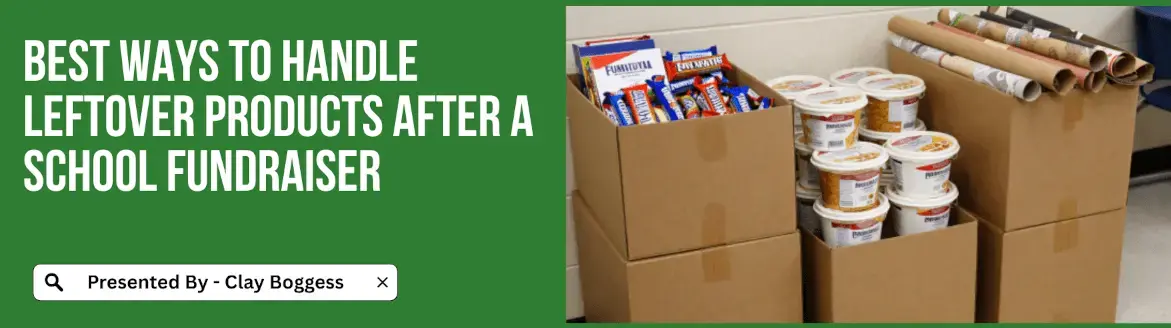
Every coordinator who has run a direct-sale fundraiser has faced the same moment: the campaign closes, the final count comes in, and there are more products on the table than expected. Leftover inventory is not a failure -- it is a common outcome of the operational challenge of estimating how much a school community will buy before the buying actually happens. What matters is having a clear plan for what to do next.
Big Fundraising Ideas has supported school fundraising programs since 1999. This guide covers why surplus happens, how to prevent it by choosing the right product and format, how to estimate inventory more accurately, and the best ways to manage leftover products after the campaign closes.
Why Leftover Products Happen
The participation problem is the most common root cause. A group of 200 students does not produce 200 active sellers. In most campaigns, 60 to 80 percent of participants sell anything at all, and the per-seller average varies widely. A coordinator who orders for 200 students and gets 120 active sellers has automatically over-ordered by 40 percent -- before accounting for any variation in per-seller volume.
- Over-ordered based on enrollment: ordering for every enrolled student assumes 100% participation, which rarely holds -- active seller rates typically run 60 to 80 percent.
- Wrong product for the community: a product that appeals strongly in one community may underperform in another -- candy bars sell fast in some schools and sit in others based on family demographics and school wellness policies
- Insufficient promotion: campaigns that do not actively push through parent email, morning announcements, and social media generate lower sell-through, leaving more inventory unsold at close
- No urgency mechanics: campaigns without daily standings, countdown announcements, or a firm close date see sales plateau early and leave more products unsold at the end
Choose the Right Format to Eliminate Leftover Risk
The format decision is made before a single product is ordered, making it the highest-leverage point for preventing surplus. Brochure fundraisers collect orders from buyers first, and the supplier ships directly to buyers after the campaign closes—the school never touches the inventory, so there is nothing left over. Scratch cards collect donations from supporters by scratching a dot on a custom card; no product is delivered to anyone, so surplus is structurally impossible.
Fundraiser Format: Leftover Risk Comparison
How to Estimate Inventory Accurately
If this is your school's first direct-sale campaign, a conservative estimate is always safer than an optimistic one. Reordering fast-moving products mid-campaign is operationally simpler than managing unsold inventory post-campaign. Use the framework below to build your initial order estimate.
Inventory Estimation Framework for Direct-Sale Fundraisers
Example: A school of 300 students at 65% participation with a per-seller average of 5 items = 300 x 0.65 x 5 = 975 items. A school ordering 300 x 5 = 1,500 items at full enrollment faces a 54% over-order relative to realistic sell-through. The framework above targets a surplus below 15 percent as a starting point, with planned reorder capacity if the sell-through exceeds the estimate.
Using Historical Data
If your school has run a comparable direct-sale program before, your per-seller average from that campaign is the most reliable input for the next order. Pull the total units sold and divide by the number of active sellers (not total enrollment). That number, applied to your current estimated participation count, gives a more accurate projection than any rule of thumb.
Starting Small with Reorder Capacity
Many school fundraising programs support mid-campaign reorders for fast-moving products. Confirming reorder availability with your representative before the campaign launches allows you to start with a conservative quantity and have a clear path to resupply if demand exceeds projections. Reordering requires lead time, so communicate your close date clearly and confirm the reorder window upfront.
Tips to Prevent Leftover Products Before the Campaign Closes
- Set a firm close date and count down daily: public countdown announcements at morning assembly drive last-day urgency, generating 20 to 30 percent of total direct-sale revenue.
- Send a parent email 48 hours before close: a specific deadline reminder consistently converts buyers who intended to purchase but had not gotten around to it.
- Offer a final-day bundle or discount: announcing a reduced price or a buy-two-get-one offer on the last day converts remaining hesitant buyers. It clears a meaningful portion of the remaining inventory.
- Assign per-seller targets: specific individual goals, framed as achievable daily amounts, and keep the middle group of sellers engaged through the full campaign window.
- Promote through multiple channels: morning announcements, parent email, social media, and classroom reminders all reach different segments of the buyer pool -- single-channel campaigns consistently leave revenue on the table.
- Use a pre-sale window: Collect buyer commitments before placing the inventory order, as this is the single most effective surplus-prevention tactic for high-risk food products.
How to Manage Leftover Products After the Fundraiser Closes
- Count and categorize immediately: conduct a physical count on closing day. Sort by product type, condition, and expiration date, establishing an accurate baseline before any items are moved, donated, or discounted.
- Check the return policy first: Review the supplier's return policy before assuming products are stranded. Products in original condition and packaging may qualify for return or credit. The Big Fundraising Ideas return policy is published on the site.
- Run an immediate clearance push: announce a discounted price for one to two days immediately after the campaign closes, while buyer engagement is still high. A morning assembly announcement plus a parent email on the same day is the most effective combination.
- Donate unexpired perishables: contact a local food bank, shelter, or community organization before any food products reach their expiration date. Donated items generate goodwill and eliminate the waste cost of spoilage. Many organizations will accept sealed food products from school fundraisers.
- Store non-perishables for future use: Smencils, discount cards, and tumblers in good condition can be held for a future campaign, a school event prize pool, or a staff appreciation sale. Label and store in a climate-controlled location with an inventory note.
- Document and adjust the next order: record the surplus quantity, the likely cause, and the revised participation rate for the next order calculation. The data from a surplus campaign is the most valuable input for preventing the next one.
The Zero-Leftover Product Options at Big Fundraising Ideas
For schools that want the fast cash flow of a direct-sale campaign without the surplus risk of a perishable product, Smencils and discount cards offer the best of both worlds. Smencils are scented pencils sold at $1 each with up to 55 percent profit -- no expiration date, storable indefinitely, and universally appealing to the student buyer demographic. Discount cards are wallet-sized cards with year-long local business savings, stored and sold like physical products, with no spoilage concerns.
For groups that want the highest margin with zero inventory management, the scratch card fundraiser at 85 percent profit is the cleanest option. Each supporter scratches a dot and donates the revealed amount—nothing is delivered, nothing is left over. A school of 200 students, each running one card, generates $17,000 gross and $15,300 net from a one-week campaign with no inventory to manage before, during, or after the campaign.
Frequently Asked Questions About Leftover Fundraiser Products
What causes leftover products after a school fundraiser?
Over-ordering based on full enrollment rather than adjusted participation rate, low community demand for the specific product, and insufficient campaign promotion. Brochure fundraisers and scratch cards eliminate the problem structurally because no product is ordered until sales are confirmed, or there is no physical product at all.
How do you prevent leftover products in a school fundraiser?
Order at 60-70 percent of enrollment for your first direct-sale campaign rather than full enrollment. Use historical per-seller data if available. Run a pre-order window before placing the inventory order for high-risk food products. Choose a brochure or scratch card format if repeated surplus has been a problem.
What should you do with leftover candy bar fundraiser products?
Candy bar leftovers can be sold at a discounted price at the next school event, donated to a local food bank or shelter if unexpired, offered to staff at cost, or used as prizes at a school activity. Check the expiration date on every unit before reoffering for sale. Review the supplier return policy—products in original condition may qualify.
Can you return unsold fundraiser products for a refund?
Return eligibility depends on the supplier and product type. Review the Big Fundraising Ideas return policy at bigfundraisingideas.com/return-policy before placing your initial order. Products ordered upfront for direct sale generally have different return terms than those for brochure orders, which are placed only after sales are confirmed.
Which fundraiser format eliminates the risk of leftover product?
Brochure fundraisers, online stores, scratch card fundraisers, and discount cards all carry zero leftover risk. Brochure orders ship to buyers after the sale closes. Scratch cards generate donations with no physical product. Discount cards are non-perishable and storable. Direct-sale is the only format that creates genuine surplus risk.
How do you estimate the right inventory for a direct-sale fundraiser?
Start with your total group enrollment, reduce it by your expected participation rate (60 to 80 percent), then multiply by the per-seller average from prior campaigns, or use a conservative 4 to 5 items for a first campaign. Add a 10-15% buffer only to your highest-demand items. Plan for a mid-campaign reorder rather than front-loading an optimistic quantity.
What are the best non-perishable fundraiser products that avoid leftover risk?
Smencils at up to 55 percent profit have no expiration date and store indefinitely. Discount cards at up to 75 percent profit are wallet-sized and have no spoilage concerns. Custom tumblers at 40 to 45 percent profit are non-perishable keepsakes. All figures verified from bigfundraisingideas.com.
Can you use leftover fundraiser products at a future event?
Non-perishable items -- Smencils, tumblers, discount cards -- can be held indefinitely for a future campaign or school event. Perishable food products must be checked against expiration dates before reuse. Always verify the specific date stamped on each product before offering for resale.
Should you discount leftover fundraiser products to clear them?
Yes. A small discount on the final day or two of the campaign is one of the most effective clearance tactics. Announce at morning assembly and in a parent email with a specific price reduction. Last-day urgency combined with a price incentive consistently converts hesitant buyers who passed on the full-price offer during the main window.
What should you do after a fundraiser closes to handle the remaining inventory?
Count immediately, check the return policy, run a two-day clearance push, donate unexpired perishables to a local organization, store non-perishables for future use, and document the cause of the surplus to make the necessary adjustments for the next order. Send a thank-you to supporters, noting results and what the funds will accomplish.
Author Bio
Clay Boggess has been designing fundraising programs for schools and various nonprofit organizations throughout the US since 1999. He’s helped administrators, teachers, and outside support entities such as PTAs and PTOs raise millions of dollars. Clay is an owner and partner at Big Fundraising Ideas.

Categories
Related Articles
Raffle Fundraiser Ideas for…
How raffles work, best prizes, permit tips, and the scratch card alternative that generates up to 90% profit with no prize required.

Coupon Book Fundraiser Ideas…
How coupon book fundraisers work, what profits to expect, and how they compare to discount card programs for school groups.

How to Improve School…
Proven ideas to boost seller participation, activate family networks, add an online store, and choose products that sell themselves.