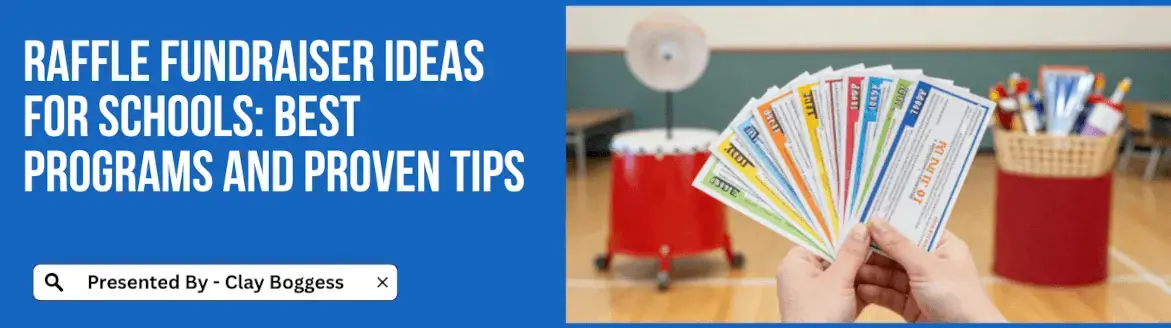
Raffle fundraisers have been a school standby for decades because they work on a simple human truth: people buy hope. A $5 ticket for a chance to win a $500 prize feels like a smart transaction, not a donation. That psychological framing drives ticket sales in ways that straightforward product fundraisers cannot always replicate, particularly among adult community members who may not need the products in a standard catalog.
Big Fundraising Ideas has supported school fundraising programs since 1999. This guide covers how school raffle fundraisers work, the best prize structures and formats, state permit considerations, and how scratch cards compare as a higher-margin alternative that eliminates the logistical complexity traditional raffles require.
How a School Raffle Fundraiser Works
The mechanics are straightforward, but the execution variables matter significantly. Ticket price, prize value, selling window, and distribution structure all affect total revenue. The most common failure point is under-selling the prize -- a prize pool that feels underwhelming relative to ticket price suppresses sales volume. The most common success factor is a single high-value lead prize that creates genuine excitement, supported by multiple smaller prizes that maintain broad ticket appeal.
- Ticket price range: $1 to $5 per ticket for general school raffles -- $10 to $25 for premium tier events with higher-value prizes
- Selling window: Two to three weeks -- long enough to reach full family and community networks, short enough to maintain urgency
- Distribution: Ticket books assigned by homeroom or classroom with a firm return date create teacher-level accountability
- Drawing format: Live drawing at a school event -- assembly, sporting event, or school fair -- maximizes visibility and excitement
- Permit compliance: Most states require a charitable gaming permit for school raffles -- check state requirements before selling a single ticket
Best Raffle Fundraiser Ideas for Schools
School Raffle Formats Compared
Basket Raffle Ideas for Schools
Top Basket Themes That Drive Ticket Sales
- Restaurant and dining: $25 to $100 in local restaurant gift cards assembled into a 'Date Night Out' basket -- adult buyers convert strongly
- Spa and relaxation: Candles, bath products, and local salon gift cards -- high perceived value, low donation cost
- Sports fan package: Local team merchandise, game-day snacks, event tickets -- strong appeal for athletic families
- School spirit basket: School-branded items, gear, and gift cards -- every family in the school is a potential buyer
- Movie night at home: Snacks, streaming gift cards, blanket, popcorn -- universally appealing, easy to assemble
- Tech and gadgets: Bluetooth speaker, phone accessories, gift cards -- highest per-ticket value perception among younger buyers
- Fitness and outdoors: Water bottle, resistance bands, local gym pass—appeals to the athletic community demographic.
50/50 Raffle: The No-Prize-Procurement Option
The 50/50 works best at events where a large captive audience can see the growing pot in real time. A running total displayed on a scoreboard or announced periodically throughout a game creates urgency—the larger the pot grows, the more attractive the ticket becomes. Football and basketball games, as well as evening auctions, are natural 50/50 environments. Ticket sellers stationed at entry points capture buyers before they settle into their seats.
State Permit Requirements for School Raffles
Key Permit Considerations
- Check before planning: Permit applications in some states take 4 to 8 weeks to process—do not begin printing tickets or selling tickets until approved.
- Revenue thresholds: Many states exempt small raffles below a gross revenue threshold (commonly $1,000 to $5,000) from full licensing requirements
- School vs. booster club: A booster club operating as an independent nonprofit may have different permit requirements than the school itself—check both entities.
- Record keeping: Most states require post-raffle financial reporting -- track all ticket sales, prize costs, and net proceeds for compliance documentation
Scratch Cards: The Highest-Margin Raffle Alternative
The scratch card fundraiser through Big Fundraising Ideas is fully customized with the school's photo, name, logo, and color scheme. Every card has 50 scratch dots. Supporters scratch a dot to reveal a donation amount between $1 and $5 and contribute that amount. When all 50 dots are scratched, the card has collected $100. Supporters receive a coupon sheet featuring local and national savings as a thank-you for participating.
Scratch Card vs. Raffle: Head-to-Head Comparison
Scratch card profit figures verified from bigfundraisingideas.com. Free shipping on all orders.
How to Run a School Raffle Fundraiser: Step by Step
- Check state permits first: Research your state gaming commission before any planning. Permit applications in many states take four to eight weeks. Start this step before contacting prize donors or printing tickets.
- Secure your prize pool: Contact local businesses to request donated prizes and a one-page sponsorship letter explaining the school's benefit. Target restaurants, retailers, experience venues, and service businesses. Fully donated prizes maximize net profit.
- Set price and print tickets: Ticket prices range from $1 to $5 for general campaigns. Print sequential numbered tickets with a matching stub for the drawing bowl. Include drawing date, school name, and prize description on every ticket.
- Distribute through homerooms: Assign a ticket book to each teacher with a firm return date two weeks out. Teachers who return the highest revenue earn visible recognition. Classroom competition drives selling effort.
- Promote the prize and the drawing: Display the prize basket or announce the 50/50 total at morning assembly, in parent emails, and on social media—the more visible the prize, the higher the ticket urgency. Set a countdown to drawing day.
- Hold a live drawing at a school event: Draw at a high-attendance event -- a game, assembly, or school fair. Announce winners publicly. Photograph the prize handoff. Post results on social media the same day. The excitement of the drawing drives participation in next year's campaign.
Raffle Fundraiser Tips That Drive More Sales
- Ticket book accountability: Give each seller a numbered ticket book with matching stubs -- the book structure makes unsold tickets visible and creates return accountability that loose tickets do not
- Prize visibility: Display the actual prize basket or prize board prominently at the school entrance, in the main office, and on social media -- visible prizes convert passive observers into active buyers
- Bulk discount: Offer 5 tickets for the price of 4 or a bundle deal -- bulk purchases increase average transaction value and capture buyers who would otherwise purchase just one ticket
- Countdown urgency: Daily or weekly countdown announcements in the week before drawing day generate last-minute purchases that represent 20 to 30% of total raffle revenue
- Parent email with prize photos: A single parent email featuring photos of the prize pool and a clear ticket purchase deadline typically generates 15 to 25% of total revenue from parents who had not yet bought
Frequently Asked Questions About Raffle Fundraisers
What are the best raffle fundraiser ideas for schools?
How do school raffle fundraisers work?
Schools sell numbered tickets, draw winning numbers at the close of the campaign, and award prizes to winners. Two to three weeks selling window. Tickets distributed through homerooms with a firm return date. Drawing held at a school event for maximum visibility.
What are the best prizes for a school raffle?
Donated gift baskets, cash (50/50 format), restaurant and experience gift cards, technology items, and local business service packages. Fully donated prizes eliminate prize cost and maximize net profit -- the best prizes cost the school nothing.
How much can a school raise with a raffle?
A 400-ticket raffle at $5 per ticket generates $2,000 in gross revenue. After deducting prizes and $50 for printing, the net profit is $1,950. Large school raffles with 1,000+ tickets and multi-tier prize structures regularly generate $5,000 to $10,000 net per campaign.
Do schools need a permit to run a raffle?
Most states require a charitable gaming or raffle permit. Requirements, fees, and timelines vary by state. Check your state gaming commission website before selling any tickets. Some states exempt school organizations with revenue below a threshold.
What is the difference between a raffle and a scratch card fundraiser?
scratch card fundraisers generate up to 90% profit with no prizes, no permits, and no unsold-ticket risk. Each card collects $100 from 50 scratched dots. Raffles require permit compliance and prize procurement, but leverage the 'chance to win' psychology that motivates certain buyer segments.
What is a 50/50 raffle?
The winner receives half of the total ticket revenue, and the school keeps the other half. 400 tickets at $5 each = $2,000 pot. The winner gets $1,000, and the school nets $1,000. No prize procurement required—the cash prize self-funds through ticket sales.
How do you promote a school raffle?
Parent email with prize photos and a clear deadline. Daily countdown announcements at morning assembly. Social media posts showing the prize pool. Physical ticket books are distributed through homerooms with visible return accountability.
Can small schools run raffles?
Yes. Small schools succeed with a focused, single, high-value donated-prize approach rather than a multi-basket system. A school with 150 students, where each family purchases two $5 tickets, generates $1,500 in gross revenue from a single drawing event.
What is the highest-profit alternative to a school raffle?
scratch card fundraisers at up to 90% profit -- $15/card at 25-99 tier, $100 gross per card, $85 net—no prize required, no permit required. A school of 200 students, each with one card, generates $15,300 net in one week.
Author Bio
Clay Boggess has been designing fundraising programs for schools and various nonprofit organizations throughout the US since 1999. He’s helped administrators, teachers, and outside support entities such as PTAs and PTOs raise millions of dollars. Clay is an owner and partner at Big Fundraising Ideas.

Categories
Related Articles

Cupcake Decorating Fundraiser…
How to run a cupcake-decorating contest fundraiser: entry fees, fair judging, allergen labeling, and three ways to raise money at one event.
Holiday Beef Stick Fundraiser…
How to run a holiday beef stick fundraiser: cover ordering and delivery timing, the 15-day invoice rule, and tips to avoid leftovers.

How Much Can a School Make…
Learn how much you can make from an Otis Spunkmeyer fundraiser; see the profit formula, a worked example, and what affects your total.