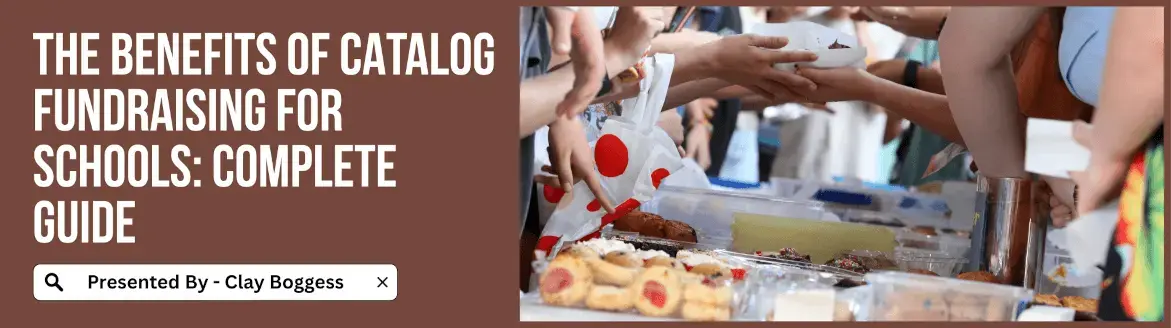
School budgets rarely cover everything. Classroom supplies, extracurricular programs, field trips, athletics, arts, and technology upgrades all require funding that district allocations do not fully provide. Catalog fundraising has earned its position as one of the most widely used school fundraising methods in the United States precisely because it solves this problem with the least logistical complexity: students take orders, the company handles fulfillment, products arrive pre-sorted, and the school keeps 40 to 50 cents of every dollar collected.
Big Fundraising Ideas has offered school brochure fundraising programs since 1999. The guide below covers what catalog fundraising is, how it works step by step, which catalog programs generate the strongest results, and how schools of all sizes can run a successful campaign with minimal coordinator time.
What Is Catalog Fundraising for Schools?
The format works because it aligns the school's fundraising need with something supporters genuinely want: quality products at competitive prices. Supporters are not being asked to donate money — they are purchasing items they would buy elsewhere, reframing the ask from charitable giving to preferred shopping, a fundamentally more sustainable engagement model for annual campaigns.
Three distinct catalog formats are available through Big Fundraising Ideas:
- Brochure-only: Students show a physical catalog, collect orders on paper forms, and products are delivered to the school for distribution
- Online-only: Students share a personalized link to a digital storefront; products ship directly to buyers' homes
- Hybrid (brochure + online): Both formats run simultaneously — recommended for maximum revenue and reach
The Key Benefits of Catalog Fundraising for Schools
Benefit 1: Zero Upfront Cost and No Financial Risk
Schools receive all promotional materials — brochures, order forms, money envelopes, and prize program flyers — at no charge before the campaign begins. Payment to the supplier is due only after the campaign closes and orders are collected, meaning the school uses money it has already received to pay its product cost. This zero-risk structure makes catalog fundraising accessible to any school regardless of available budget. The school brochure programs at Big Fundraising Ideas require no minimum order and no advance payment.
- No materials cost: Brochures, order forms, and prize flyers ship free before the campaign.
- No inventory risk: Schools order only what supporters have already paid for
- No minimum order: Viable for schools of any size from 50 to 800 students
Benefit 2: High Profit Margins — 40 to 50 Percent on Every Sale
Catalog fundraising generates 40 to 50 percent profit on every dollar of sales, which means a school collecting $10,000 in brochure orders nets $4,000 to $5,000 after accounting for product costs. This margin is consistent regardless of which products sell best within the catalog because the entire brochure is priced at the same profit tier. There are no low-margin items that drag down results — the catalog is structured to maximize the school's return on every transaction.
Catalog Fundraiser Profit by School Size — 2026
Rows with 90% participation reflect schools using Big Event Prize Programs. Calculations based on 40% average profit rate.
Benefit 3: Broad Product Appeal Across All Buyer Demographics
The product range in catalog fundraisers is deliberately designed to include something for every buyer type: cookie dough for families with young children, candles and home goods for adult supporters, seasonal food items for grandparents, flowers for spring gardens, and holiday gift products for supporters who would purchase gifts regardless. This breadth means every student has a realistic path to selling regardless of their specific supporter network. The specialty fundraiser brochures at Big Fundraising Ideas include popcorn, candles, chocolates, and seasonal collections — each category appealing to a distinct buyer segment.
- Cookie dough and baked goods: Universal appeal — families, neighbors, coworkers
- Candles and home fragrance: Strong with adult supporters and grandparents
- Seasonal food catalogs: Holiday gift buyers who would purchase elsewhere — redirected to support the school
- Flowers and spring bulbs: Gardeners and outdoor enthusiasts — a distinct buyer segment not reached by food products
- Popcorn and specialty snacks: Health-conscious buyers and snack-oriented demographics
Benefit 4: Simplified Logistics — Pre-Sorted Delivery, Minimal Coordinator Time
One of the most underappreciated benefits of catalog fundraising is what it eliminates: the logistics that make other fundraising methods difficult. Products arrive at the school pre-packed by seller name, so distribution day requires no sorting — coordinators simply call student names and hand over pre-labeled packages. The entire campaign, from kickoff to distribution, typically requires three to four coordinator hours total.
- Pre-sorted delivery: Products arrive labeled by seller — no sorting required on distribution day
- Collated supply kits: Materials arrive organized by class or homeroom — no coordinator assembly needed
- Online order tracking: Dashboard shows sales progress by seller in real time — no spreadsheets
- Coordinator total time: 3 to 4 hours for a complete brochure campaign from registration to distribution
Benefit 5: Online Store Integration Extends Reach to Supporters Everywhere
Every catalog-brochure campaign at Big Fundraising Ideas can run simultaneously with an online fundraising storefront, where supporters anywhere in the country can purchase products that ship directly to their homes, which is the single most impactful upgrade to any catalog campaign: grandparents, alumni, and out-of-area families who would never see a physical brochure become active buyers when a student sends them a personalized link. Schools running hybrid campaigns (brochure plus online) consistently generate 25 to 40 percent more revenue than brochure-only campaigns.

Benefit 6: Prize Programs Drive Higher Participation
Student participation rate is the single biggest variable in catalog fundraising revenue. A 10-percentage-point increase in participation generates more revenue than any other single change to the campaign. Big Event Prize Programs available exclusively through Big Fundraising Ideas — Super Party, Super Splash Party, Magic Show, and Reptile Adventures — increase participation rates by 30 to 50 percent compared to campaigns without structured incentives. These experiential rewards motivate students to sell by tying a visible, exciting experience to individual performance milestones.
Benefit 7: Teaches Real-World Skills While Raising Funds
A frequently cited benefit of catalog fundraising is its educational value for students. The process of showing a catalog, explaining products, collecting payment, and tracking orders introduces students to basic sales, communication, record-keeping, and responsibility skills in a low-stakes, supported environment. Schools report that students who participate in fundraising campaigns demonstrate stronger confidence in peer communication and a greater sense of ownership in school community outcomes.
Which Catalog Programs Generate the Best Results?
Every program below is available through Big Fundraising Ideas with zero upfront cost and dedicated coordinator support:
Catalog Program Comparison — Which Performs Best for Your School
Green = the highest total revenue generators. Orange = strong performers for specific seasons or demographics.
How to Run a Catalog Fundraiser for Schools: Step by Step
- Register and receive your supply kit: Select your catalog program and register with Big Fundraising Ideas. Brochures, order forms, money envelopes, and prize flyers ship to your school free of charge before the campaign launch date.
- Set your fundraising goal: Calculate the specific dollar amount your school needs. Break it down: how many sellers, at what average sale, at what profit rate. Share this goal publicly at the kickoff so students have a target to rally around.
- Hold a kickoff assembly: Run a school-wide or classroom kickoff on launch day. Distribute all materials, announce the goal and prize program, set the two-week close date, and generate excitement before students go home that night. First-day energy drives first-week sales.
- Activate the online store simultaneously: Open your online store on the same day as the kickoff. Coach parents and students to share the personal store link immediately via text and social media. The first 48 hours generate disproportionate online revenue.
- Push at the one-week midpoint: At day seven, share a sales leaderboard or class-by-class progress update. Recognize top sellers by name. Re-announce the close date. This single intervention typically generates 20 to 30 percent of the campaign's total revenue in the final three days.
- Close and submit the order: Collect all completed order forms and payment on the stated closing date — no exceptions. Submit the consolidated order to Big Fundraising Ideas for processing. Online orders are handled automatically by the platform.
- Distribute products and celebrate: Products arrive pre-sorted by seller. Call student names and hand over labeled packages. Announce the final fundraising total school-wide. Recognize top sellers and communicate exactly how the funds will be used.
How Catalog Fundraising Compares to Other School Fundraising Methods
Catalog Fundraising vs. Other Common School Fundraising Methods
For schools that want to supplement catalog campaigns with additional revenue between brochure cycles, direct-sale fundraisers, including candy bars, People's Choice Beef Jerky, Yummy Lix Lollipops, Poppin Popcorn, Smencils, and discount cards are available at 40 to 65 percent profit with 1-case minimum orders and a few-day delivery turnaround.
Frequently Asked Questions About Catalog Fundraising for Schools
What is catalog fundraising for schools?
How does catalog fundraising work for schools?
Schools register with Big Fundraising Ideas, receive free supply kits, run a two-week selling window with student brochures and an online store, collect completed order forms and payment, and submit a bulk order. Products arrive pre-sorted by seller. The total coordinator time is three to four hours for the entire campaign.
What are the benefits of catalog fundraising for schools?
The main benefits are zero upfront cost, 40 to 50 percent profit margins, broad product appeal across all buyer demographics, simplified logistics with pre-sorted delivery, online store integration that reaches families anywhere in the country, free promotional materials, and prize programs that increase student participation by 30 to 50 percent.
What types of catalogs are used in school fundraising?
School fundraising catalogs include cookie dough programs featuring Otis Spunkmeyer, seasonal holiday food and gift brochures, popcorn and specialty snack catalogs, flower and spring bulb programs, candle and home fragrance brochures, and online gift and lifestyle catalogs through Yankee Candles and Goodies and Gifts. Each catalog is designed to appeal broadly across buyer demographics.
How is catalog fundraising different from other fundraising methods?
Catalog fundraising runs over two weeks rather than a single day, requires no day-of logistics or weather-dependent planning, generates consistent 40 to 50 percent margins regardless of season, and produces repeatable results across multiple annual campaigns. It gives supporters a tangible product in return for their contribution, which sustains engagement better than pure donation appeals.
What are the costs associated with catalog fundraising for schools?
Catalog fundraising through Big Fundraising Ideas requires zero upfront cost. Schools receive all promotional materials free before the campaign. Payment is due only after the campaign closes and the school has already collected orders and money from supporters — the product cost is paid from revenue already received.
Are there specific catalogs that work best for school fundraising?
Cookie dough brochures generate the highest total revenue per campaign. Seasonal holiday food catalogs perform best in the fall. Popcorn programs work year-round. Flower bulb programs peak in spring. The best catalog matches your school's season and community demographics — most coordinators find the hybrid approach (brochure plus online store) generates the strongest combined results.
Can catalog fundraising help improve school budgets?
Yes. Schools running two catalog campaigns per year — one in the fall and one in the spring — typically generate $6,000 to $25,000 or more in annual fundraising revenue, depending on school size and participation rate. These funds directly supplement budgets for extracurricular programs, technology, classroom supplies, and needs that district funding does not cover.
How do schools ensure catalog fundraiser success?
Schools maximize results by setting a specific goal before launch, activating a prize program to drive participation, running a kickoff assembly on launch day, opening an online store simultaneously, pushing at the one-week midpoint with a progress update, and communicating post-campaign how funds were used.
How is catalog fundraising different for elementary vs. high school?
Elementary schools typically generate higher participation rates and higher per-campaign gross revenue because younger students are enthusiastic sellers, and parents are more actively involved. High school catalog fundraisers benefit from larger social media networks that drive stronger online store performance. Both levels achieve similar profit percentages.
Author Bio
Clay Boggess has been designing fundraising programs for schools and various nonprofit organizations throughout the US since 1999. He’s helped administrators, teachers, and outside support entities such as PTAs and PTOs raise millions of dollars. Clay is an owner and partner at Big Fundraising Ideas.

Related Articles
What Fundraiser Makes the…
2026 rankings for cookie dough, candy bars, popcorn, beef jerky, and online stores ranked by profit percentage and total revenue potential.
Car Wash Fundraiser Ideas for…
Everything schools need to plan a car wash fundraiser — plus a comparison of higher-profit options like cookie dough and online programs.
Walk-A-Thon Fundraiser: The…
How to plan a walk-a-thon fundraiser, boost participation, and pair it with proven product programs to maximize total revenue in one event.