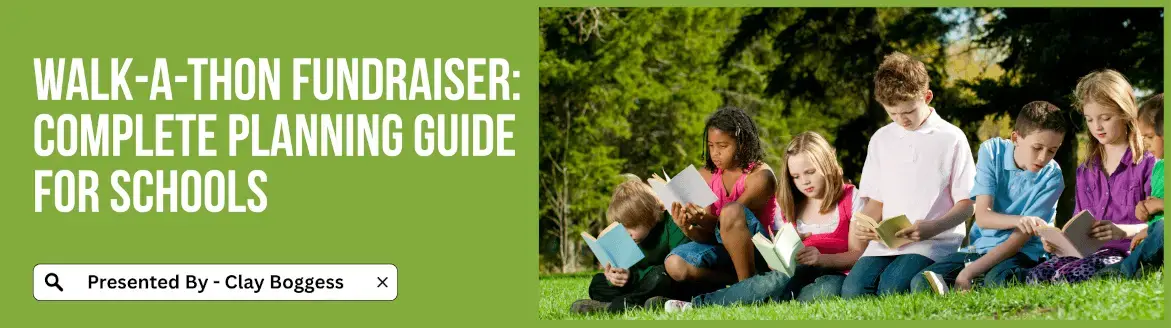
Blog Summary: A walk-a-thon fundraiser is one of the most community-friendly events a school can run, but on its own, it rarely reaches its full revenue potential. This guide covers how to plan and execute a walk-a-thon from start to finish, how to structure pledges and participation for maximum results, and how to pair the event with a direct-sale product program to significantly increase total funds raised. Schools that combine the walk-a-thon format with a product component consistently outperform those that rely solely on pledges.
Walk-a-thon fundraisers are among the most community-driven events a school can run. They bring students, staff, parents, and the broader community together around a shared physical activity, which creates a natural energy that product-only campaigns rarely generate. The challenge most schools face is that pledge drives alone often fall short of the revenue targets that justify the planning effort.
The schools that get the most out of a walk-a-thon are the ones that treat it as an event format, not a standalone fundraiser. Pairing the walk with a direct-sale product program on event day creates two simultaneous revenue streams from the same pool of participants and supporters, consistently producing higher totals than either format would on its own.
What Is a Walk-A-Thon Fundraiser?
A walk-a-thon fundraiser is a pledge-based event in which students walk laps around a track or course and collect donations from sponsors who commit a set amount per lap completed or a flat donation. The event format is one of the most inclusive in school fundraising because participation requires no selling skills and no product knowledge, just showing up and walking, which makes it accessible to every student regardless of age or grade level.
Walk-a-thons originated as charity walk events and have been adapted for school fundraising because they combine physical activity with community engagement in a format that parents and community members find easy to support. Sponsors feel good pledging per lap because they see a direct connection between the student's effort and their donation, which tends to produce higher individual pledge amounts than pure donation asks.
The core mechanics are straightforward. Students receive pledge forms or digital pledge links before the event. They ask family members, neighbors, and community contacts to pledge either a flat amount or a per-lap amount. On event day, students walk as many laps as possible within the allotted time. Pledges are collected after the event, and the school keeps 100% of the donations raised.
The walk-a-thon works best when it runs alongside a product component. Having gourmet popcorn, Yummy Lix lollipops, or People's Choice Beef Jerky available for purchase at stations along the route or at the event finish line creates a second revenue stream that captures the spending energy of parents and community members who come to cheer on participants.
How to Plan a Walk-A-Thon Fundraiser Step by Step
Successful walk-a-thon fundraisers are built on six weeks of structured preparation, not six days. The schools that hit and exceed their goals are the ones that lock in the date, route, and pledge structure early, launch the pledge collection campaign with enough runway for students to reach all their contacts, and have a clear product plan for event day before the first pledge form goes home.
- Set your fundraising goal and individual pledge target. Determine how much your school needs to raise in total, then divide by the number of expected participants to establish an individual student pledge goal. A school aiming for $12,000 with 300 participants needs an average pledge of $40 per student. Communicate this number to every student on day one.
- Select your date and route. Choose a date at least six weeks out. Most walk-a-thons use the school track, parking lot, or a defined path on school grounds that can be measured in laps. Schools that take the event off campus may require permits from local authorities, so confirm this with administration as early as possible.
- Decide on your pledge structure. Per-lap pledges motivate students to walk more laps because their sponsors' total donations depend on performance. Flat-donation pledges are simpler for younger students whose sponsors may not want an open-ended commitment. Many schools offer both options and let each student choose.
- Launch pledge collection at least four weeks before event day. Send digital pledge links alongside physical pledge forms to maximize reach. Grandparents, aunts, uncles, and family friends in other cities can all pledge digitally, which dramatically increases the pool of potential supporters compared to paper-only approaches.
- Order your event-day product inventory. Select two to three direct-sale products to sell on event day, order them in advance, and plan your product stations. Products priced at $1 to $3 are ideal for walk-a-thon settings because the buying decision is fast and impulsive.
- Execute the event day with lap tracking and product stations. Assign volunteers to track laps using hand counters or digital apps, set up product sales stations at the finish line and at refreshment points along the route, and create visible recognition for top pledge collectors and highest lap counts throughout the event.
- Collect pledges and close the campaign. Set a firm pledge-collection deadline within 1 week of the event day. Follow up directly with students who have not returned pledge envelopes by day three after the event.
Pledge Strategies That Drive Higher Walk-A-Thon Revenue
The average pledge amount per student is the most controllable variable in a walk-a-thon's total revenue, and it is directly shaped by how the ask is framed, how early students start collecting, and whether digital pledge options are available alongside paper forms. Schools that set a specific per-student dollar target and consistently provide digital pledge links consistently outperform schools that distribute paper forms without guidance on what to request.
Three pledge strategies that consistently produce stronger results:
- Frame the ask with a specific number, not a general request. Telling students to collect as many pledges as possible underperforms telling them their goal is $40. A specific number creates a concrete target every student can visualize and pursue.
- Lead with the cause, not the event. Supporters who understand exactly what the funds are for, whether that is new playground equipment, a class trip, or updated library books, pledge more generously than those who receive a generic fundraising request. Include the specific purpose on every pledge form, digital link, and parent communication.
- Add an early pledge incentive. Students who collect their first pledge within 48 hours of receiving their form tend to collect significantly more total pledges than those who start in the final week. A small incentive for students who reach their first pledge goal by a specific early deadline jump-starts participation and maintains momentum through the collection window.
Expert Insight: Walk-a-thon pledge totals increase meaningfully when the school shares daily progress toward the group goal during the pledge collection period. A simple morning announcement that says the school has reached 60% of its goal and needs everyone to collect two more pledges this week creates the kind of visible accountability that motivates students who have not yet started collecting. Schools using digital pledge platforms can automatically share real-time totals.
How to Pair a Product Sale with Your Walk-A-Thon for Maximum Revenue
A walk-a-thon brings together students, parents, siblings, and community supporters in one place for one to two hours, which is exactly the environment where direct-sale product fundraising generates its fastest sell-through. Parents who come to cheer on their children are in a supportive, generous mindset and make quick impulse purchases at $1 to $3 price points without hesitation, adding a second revenue stream to the event with almost no additional planning effort.
The three product categories that perform consistently well at walk-a-thon events are gourmet popcorn, lollipops, and beef jerky. All three are individually packaged, portable, allergy-friendly for most participants, and priced in the range where the buying decision happens in seconds. Explore the full selection of direct-sale fundraising products to find the right combination for your event.
How to set up your product component on event day:
- Gourmet popcorn at the finish line. Popcorn bags priced at $2 to $3 work extremely well at active outdoor events because participants and spectators can eat them while walking or cheering. A case of gourmet popcorn displayed at the finish line typically sells through quickly because the smell and visibility drive impulse purchases. Schools earn up to 55% profit per case sold.
- Yummy Lix lollipops at the starting area and check-in table. At $1 each, lollipops are the easiest impulse purchase at any school event. Parents picking up registration packets, siblings waiting for the event to start, and students between laps all represent natural purchase moments. A case of Yummy Lix lollipops takes up minimal table space and requires no refrigeration or special handling.
- People's Choice Beef Jerky at the halfway refreshment station. Beef jerky sticks are individually wrapped, protein-rich, and genuinely popular with middle and high school students and parents at active events. At $2 per stick, they generate strong per-transaction revenue at the midpoint of the walk, when participants are looking for a quick energy boost. Beef jerky also meets federal nutrition guidelines, which matters for schools with strict on-campus nutrition policies.

Themed Walk-A-Thon Ideas That Boost Participation
Themed walk-a-thons consistently generate higher student participation and larger spectator attendance than standard events because the theme gives students and parents a reason to engage beyond the fundraising goal itself. A walk-a-thon that doubles as a memorable school experience generates stronger social sharing, more community word-of-mouth, and a natural motivation for students to complete more laps.
Themes that work well across elementary, middle, and high school settings:
- Color Run Walk-A-Thon. Students wear white and are dusted with non-toxic colored powder at each lap station. This format is highly photogenic, generates strong social media sharing from parents, and creates built-in visual excitement that makes lap completion feel like an achievement rather than a task.
- Decade or Era Theme. Students and staff dress in outfits from a chosen decade, from the 1950s to the 1990s. Teachers' and staff participation in themed costumes consistently increases student engagement and generates memorable event photos that parents share with the broader community.
- Glow Walk. Held in the early evening with glow sticks, LED accessories, and UV lighting along the route. Glow walks attract family attendance because evening timing allows working parents to attend, increasing both the size of the spectator crowd and the purchasing audience for event-day product sales.
- School Spirit Walk. Students wear school colors and earn spirit accessories such as branded pennants, face stickers, or Smencils at lap milestones. This theme builds school identity alongside fundraising, making the event easier to justify to administrators and generating community goodwill beyond the financial outcome.
Expert Insight: Schools that give students a visible lap count display, such as a tally board, a wristband system, or a digital leaderboard, see higher average lap counts per student than schools that only track laps on paper at the end of the event. Visible progress in real time creates competitive motivation that keeps students walking longer. Even a simple chalk tally board at the finish line drives measurably better engagement than no visible tracking.
Walk-A-Thon Fundraiser Tips for Elementary, Middle, and High Schools
The walk-a-thon format scales effectively across all grade levels, but the structure that works best for kindergarteners differs from what motivates high school juniors. Matching the pledge approach, event length, and product selection to your specific student population produces significantly better results than applying a one-size approach across all grade levels.
Elementary Schools (K to 5):
Elementary walk-a-thons perform best with flat donation pledges rather than per-lap pledges, because young students and their sponsors find open-ended per-lap commitments confusing. A simple flat pledge form with a suggested amount of $20 to $25 is easy for parents to fill out and easy for students to track. An event duration of 30 to 45 minutes of walking is appropriate for younger students. Product stations stocked with lollipops and popcorn at $1 to $2 price points capture the spending energy of parents who attend to watch their young children participate.
Middle Schools (6 to 8):
Middle school students respond strongly to per-lap pledge structures because the competitive element motivates them to push for more laps. A visible leaderboard showing top lap counts by classroom or grade generates inter-class competition that drives both physical effort and pledge collection effort in the weeks before the event. Beef jerky and popcorn priced at $2 to $3 sell well to the middle school demographic at event-day stations.
High Schools (9 to 12):
High school walk-a-thons work best when student leadership, such as student council or class officers, drives the planning and promotion. Student-led events generate stronger peer participation than adult-organized events at this level. Digital pledge links shared through student social networks dramatically expand the pledge pool beyond immediate family. High school students are also the most effective sellers of event-day products and can manage product stations independently, freeing staff volunteers for event logistics. See our full range of school fundraising programs designed for each grade level.
How Much Can a Walk-A-Thon Fundraiser Raise?
The total revenue a walk-a-thon generates depends on three variables: the number of active participants, the average pledge amount per student, and whether a product sale component runs alongside the pledge drive on event day. Schools that structure all three variables intentionally, rather than hoping for strong participation and high pledges without specific targets, consistently produce results that justify the planning effort.
Product revenue estimates above assume an average spend of $3 per participant at event-day product stations, which is conservative based on typical walk-a-thon event attendance. Schools with strong parent and community spectator attendance often see product sales exceed $5 to $8 per participant, particularly when the product selection includes a variety of price points, from $1 lollipops to $3 popcorn bags.
To plan product quantity for your event, use the Calculate Your Profit tool available on each product page. It allows you to input your group size and event type to estimate the optimal order quantity based on expected sell-through. See popcorn fundraiser options and lollipop fundraiser options to plan your event-day product mix.
Frequently Asked Questions About Walk-A-Thon Fundraisers
What is a walk-a-thon fundraiser?
A walk-a-thon fundraiser is a pledge-based event where students walk laps and collect donations from sponsors who pledge a set amount per lap or a flat donation. The event format combines physical activity with community engagement and can significantly boost total revenue when paired with a product sale on event day.
How much money can a walk-a-thon fundraiser raise?
A school with 300 students, averaging $50 in pledges, generates $15,000 from pledges alone. Adding a product-sale component on event day, with an average participant spend of $3 per person, adds approximately $900, bringing the total closer to $16,000. Larger schools with strong community attendance and higher average pledge amounts can exceed $25,000 from a single walk-a-thon event.
How do you organize a walkathon fundraiser?
Organizing a walk-a-thon requires setting a clear goal, selecting a date and route at least 6 weeks in advance, distributing pledge forms or digital pledge links, communicating the fundraising purpose in every parent communication, and planning a product-sale component for event day. A structured kickoff announcement that assigns individual pledge targets to students is the single most impactful step in maximizing total revenue.
What is the best way to structure walk-a-thon pledges?
Per-lap pledge structures generate higher totals because participants are motivated to walk more laps when sponsors have pledged per lap. Flat donation pledges are simpler to administer and work well for younger elementary students. Many schools offer both options and allow each student or family to choose the structure that works best for their sponsors.
How far in advance should you plan a walk-a-thon?
A minimum of six weeks is recommended. This window allows time to secure the route and any required permits, distribute pledge forms, give students enough time to collect pledges from all their contacts, order event-day products, and organize volunteers for lap tracking and product stations.
What products sell well at a walk-a-thon?
Direct-sale products that are individually packaged, priced at $1 to $3, and easy to consume perform best. Yummy Lix lollipops, People's Choice Beef Jerky sticks, and gourmet popcorn bags consistently sell well at school walking events because they are portable, allergy-friendly, and appeal to all age groups, including parents and siblings who attend.
Do walk-a-thon fundraisers require permits?
Walk-a-thons held on school grounds typically require only standard school-event approval from the administration. Events that use public roads, sidewalks, or parks may require a permit from the local municipality. Always confirm requirements with your school administration and local authorities at least four weeks before the event to avoid last-minute complications.
How do you promote a walkathon fundraiser?
School newsletters, parent communication apps, classroom announcements, and the school website are the most reliable channels for promotion. Digital pledge links shared via text and email by students allow them to reach grandparents and out-of-town family members who would never see a paper pledge form. Social media posts that clearly state the fundraising goal and purpose consistently generate additional pledges from the broader community beyond the immediate school family.
What age groups can participate in a walk-a-thon?
Walk-a-thons are among the most inclusive fundraising formats because participants set their own pace with no competitive requirements. Elementary, middle school, and high school students all participate effectively. Events that include teachers and staff participation consistently generate higher community engagement and stronger total pledge amounts than student-only events.
Is a walk-a-thon a good fundraiser?
A walk-a-thon is an excellent fundraiser for schools that want to build community spirit alongside raising money. It requires more advanced planning than a product sale but generates strong parent and community engagement. Schools that pair the walk-a-thon with a concurrent product sale consistently raise more total funds than those running the pledge drive alone.
The Bottom Line
A walk-a-thon is one of the most community-building events a school can organize, and it is most effective when it serves as the wrapper for a product fundraiser rather than a standalone pledge drive. The event creates the gathering, the energy, and the community goodwill. The product component captures that energy as a second revenue stream, running in parallel with minimal additional planning overhead.
Big Fundraising Ideas has helped schools across the US pair event-day product sales with pledge drives since 1999, with no upfront cost, free shipping, and direct-sale products presized for school events. Browse our direct-sale fundraising products to plan your event-day product mix, or explore our full range of school fundraising programs to find the highest-profit combination for your school's upcoming walk-a-thon.
Author Bio
Clay Boggess has been designing fundraising programs for schools and various nonprofit organizations throughout the US since 1999. He’s helped administrators, teachers, and outside support entities such as PTAs and PTOs raise millions of dollars. Clay is an owner and partner at Big Fundraising Ideas.

Related Articles

Cupcake Decorating Fundraiser…
How to run a cupcake-decorating contest fundraiser: entry fees, fair judging, allergen labeling, and three ways to raise money at one event.
Holiday Beef Stick Fundraiser…
How to run a holiday beef stick fundraiser: cover ordering and delivery timing, the 15-day invoice rule, and tips to avoid leftovers.

How Much Can a School Make…
Learn how much you can make from an Otis Spunkmeyer fundraiser; see the profit formula, a worked example, and what affects your total.