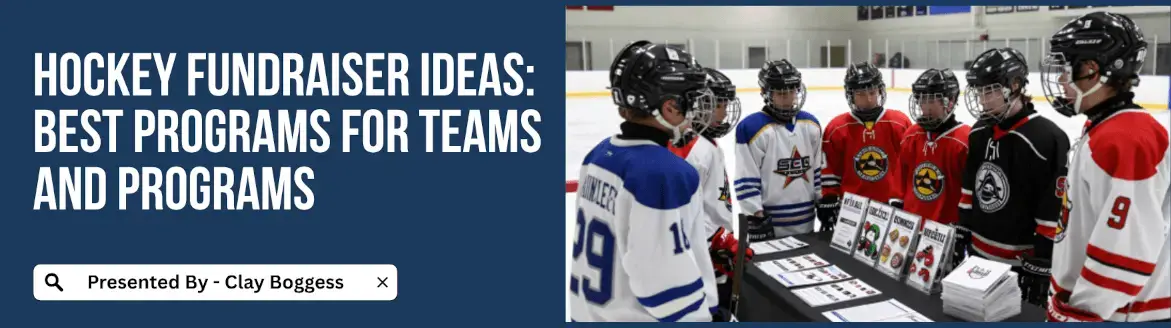
Hockey is one of the most expensive sports to run. Ice time alone can cost $200 to $400 per hour. Add equipment, tournament entry fees, travel costs, and jersey replacements, and it becomes clear why fundraising is not optional for most hockey programs -- it is a financial necessity. The challenge is finding approaches that generate real money without adding a significant burden to already-busy families and coaches.
Big Fundraising Ideas has supported sports teams and athletic programs across the United States since 1999. The programs below are built around what actually works for hockey teams -- products that match the demographic, formats that fit busy practice and tournament schedules, and structures that require minimal coordinator time.
What Is a Hockey Team Fundraiser and How Does It Work?
The structure that works for hockey programs is identical to that of other sports: a two-week window, personal accountability for each player, and a specific, named goal tied to a real team expense. The difference for hockey is demographic -- hockey families skew toward higher household incomes, stronger community networks, and a disproportionately male buyer pool that responds to protein and snack products rather than candy-based fundraisers.
- Direct-sale: Players receive pre-stocked product, sell to family and rink contacts, collect cash on the spot -- no order forms, no delivery wait
- Online storefront: Each player shares a personalized link via social media and text -- supporters purchase, and products ship directly to their home
- Custom merchandise: Tumblers and apparel branded with the team name and colors generate revenue while building team identity at the rink
Best Hockey Fundraising Ideas Ranked by Profit
Hockey Team Fundraising Programs -- 2026 Profit Comparison
All programs require zero upfront cost through Big Fundraising Ideas.
Direct-Sale Products for Hockey Teams: Fastest Cash With Zero Logistics
Beef Jerky: The Hockey Family Product
People's Choice Beef Jerky generates 45 to 55 percent profit with a product that uniquely fits the hockey demographic. Hockey families -- parents, coaches, and supporters at the rink for two or three-hour practices -- are already a captive snack-buying audience. Beef jerky positions the team as offering something health-forward that the majority of adult buyers in a hockey family network actively prefer over candy. For programs with a strong adult male buyer pool, beef jerky consistently outsells candy products per unit while generating comparable or higher per-unit net profit.
Lollipops: Highest Margin for Youth Hockey
Yummy Lix Lollipops generate 50 to 58 percent profit at a $1 price point -- the highest margin food product available. For youth hockey programs with players aged 6 to 14, the $1 price barrier eliminates virtually all buyer resistance. A young player can sell to grandparents, neighbors, and family friends without any formal sales approach. A box of 48 units at $1 each generates $26 to $28 net profit per player in a single selling window.
Candy Bars: Universal Team Standby
Kosher candy bars deliver 40 to 55 percent profit at $1 to $2 per bar and represent the simplest direct-sale option for hockey teams of any age level. Players sell them at practice, at games, and through family networks without any pitch required. For teams with a wide age range from peewee through high school, candy bars are the most universally effective single product because they generate consistent sales across all buyer demographics.
Scratch Cards: Maximum Margin, Zero Product
Scratch card fundraisers deliver up to 90 percent margin with no product to store, carry, or distribute. Each player receives a card with spots that supporters scratch to reveal the amount of their donation: no inventory, no order forms, no delivery day. For hockey programs where players already have equipment bags full of gear, scratch cards eliminate the one common complaint about product fundraisers: the need to carry more stuff to the rink.
Custom Merchandise for Hockey Programs
Custom Tumblers: Rink-Side Revenue and Brand
Custom tumblers are the strongest merchandise fundraiser for hockey programs because the rink environment naturally creates demand for insulated drinkware. A team-branded tumbler that keeps coffee hot in a cold arena is a product with genuine practical value to every hockey parent who buys it. The custom tumbler fundraiser available through Big Fundraising Ideas includes full team customization, including the team name, mascot, and colors. At $25 to $40 per tumbler, with 40 to 50 percent profit, a team of 20 players, each reaching 12 buyers, generates $2,400 to $4,800 net from a single online campaign.
Custom Apparel: Season Launch Timing
Custom apparel online -- team hoodies, warm-up jackets, and spirit wear branded with program name -- generates 40 to 50 percent profit and works best when timed to the season opener, when parent and player enthusiasm peaks. Families purchase to show affiliation at the first games of the season, creating a natural sense of urgency tied to the calendar. Teams that open their apparel store in the week before their first game consistently generate stronger sales velocity than those that launch mid-season.
Online Fundraisers for Hockey Teams
The online fundraising store offered through Big Fundraising Ideas runs simultaneously with any direct-sale program. Hockey families are natural candidates for online fundraising because the sport's tournament culture creates geographically dispersed supporter networks. A player whose team travels to three out-of-state tournaments per season has family and contacts in multiple cities who follow the player's career but cannot buy a product at a local rink. An online store link reaches all of them with a single social media post.
- Products available online: Cookie dough, popcorn, Yankee candles, custom tumblers, custom apparel, Goodies and Gifts, and more
- Logistics: Zero -- platform handles payment, fulfillment, and shipping directly to buyers at no cost to the team
- Geographic reach: Every player's personal link reaches their full social network regardless of location -- grandparents, former teammates, out-of-state family
How to Run a Hockey Team Fundraiser: Step by Step
- Set your goal: Name the specific expense. 'We need $2,400 to cover tournament registration and hotel for the regional qualifier' motivates families more than 'we need to raise money for the team.'
- Choose your format: Beef jerky or candy bars for immediate cash and rink-side sales. Custom tumblers or apparel online to build team identity and broaden reach. Both simultaneously for maximum combined revenue.
- Activate a prize: Add a prize program or individual milestone reward. Players with a personal incentive sell 30 to 50 percent more than those without one.
- Launch at practice: Distribute direct-sale product and online links at a scheduled practice. Brief the team on the goal, the close date, and what they are earning. First-day energy drives first-week results.
- Push parents to share: Send a parent email or text with the online store link on launch day. Every parent who shares their player's link reaches their full social network with zero additional effort from the team.
- Close in two weeks: Collect all direct-sale cash and close the online store on the stated date. No extensions. Firm close dates drive last-minute purchases that generate 15 to 25 percent of total campaign revenue.
- Announce the result: At the next practice or pre-game, announce the total and connect it directly to the goal. 'We covered every player's tournament registration fee' is a motivating close that builds enthusiasm for future campaigns.
Youth Hockey vs. High School Hockey Fundraising
Youth Hockey Programs (Ages 6-14)
Youth hockey fundraisers are almost entirely driven by parents -- young players are not selling independently, their parents are activating family and community networks on their behalf. The most effective programs for this age group are low-priced, direct-sale products (lollipops at $1, candy bars at $1 to $2), where every adult in the buyer pool can participate without hesitation about the budget, combined with an online store that parents share with their social networks.
High School Hockey Programs (Ages 14-18)
High school hockey players have their own social media accounts and personal networks that make online fundraising disproportionately effective compared to younger programs. A high school player with 500 Instagram followers who posts their tumbler campaign link reaches 500 potential buyers from a single post. Combine this with beef jerky direct-sale for in-person revenue at games and practices, and high school programs can generate strong results from both channels simultaneously. The sports team fundraising resources at Big Fundraising Ideas include everything needed to run both formats at once with a single coordinator.
Frequently Asked Questions About Hockey Fundraisers
What are the best hockey team fundraiser ideas?
How do hockey teams raise money?
Hockey teams raise money most effectively through product-based campaigns, in which players sell to family and rink supporters over a two-week window. Direct-sale programs like beef jerky and candy bars generate immediate cash. Online storefronts reach grandparents and out-of-state tournament families who would never participate in a local campaign.
What products sell best for hockey fundraisers?
People's Choice Beef Jerky sells best for the adult athletic demographic common in hockey family networks. Yummy Lix Lollipops generate the highest margin at 50 to 58 percent for youth hockey. Candy bars sell consistently across all hockey age groups with near-zero sales resistance.
How much can a hockey team raise?
A hockey team of 20 players with 90 percent participation, each selling 30 units of beef jerky at $5 and 50 percent profit, generates approximately $1,350 net. A custom tumbler online campaign, with each player reaching 12 buyers at $30 per tumbler, generates $3,240 in net revenue from a single two-week campaign.
What is the easiest fundraiser for a hockey team?
Scratch card fundraisers are the easiest -- no product to carry, no order forms, no delivery day. Direct-sale candy bars are the easiest food product option. Both require under two hours of total coordinator time.
Can hockey teams use online fundraisers?
Yes. Online fundraising storefronts are highly effective for hockey teams because tournament travel creates geographically dispersed supporter networks that in-person campaigns cannot reach. Each player shares a personalized link, and products ship directly to buyers anywhere.
How long should a hockey fundraiser run?
Two weeks is the optimal window. Long enough to reach every player's family network, short enough to maintain urgency. Campaigns beyond three weeks see diminishing daily revenue as initial enthusiasm fades without a firm closing deadline.
Are there hockey fundraisers with no upfront cost?
Yes. All programs at Big Fundraising Ideas require zero upfront cost. Direct-sale products are paid from revenue already collected after the campaign. Online storefronts collect buyers' payments directly, with no upfront cost to the team.
What custom merchandise works for hockey teams?
Custom tumblers branded with team name and colors are the strongest hockey merchandise because the rink environment creates natural demand for insulated drinkware. Custom apparel works best timed to the season opener when family enthusiasm peaks.
Can small hockey programs run profitable fundraisers?
Yes. Product fundraising programs at Big Fundraising Ideas have a 1-case minimum for direct-sale products and no minimums for online storefronts. A small hockey team of 12 players, each selling 25 candy bars at $2 each with a 50 percent profit, generates $300 in net from a campaign that takes under one hour to launch.
Author Bio
Clay Boggess has been designing fundraising programs for schools and various nonprofit organizations throughout the US since 1999. He’s helped administrators, teachers, and outside support entities such as PTAs and PTOs raise millions of dollars. Clay is an owner and partner at Big Fundraising Ideas.

Related Articles
Chocolate Bar Fundraiser for…
How are chocolate price swings affecting school fundraisers? See what changed in 2026, the profit per bar, and how to choose a price point.
World's Finest Chocolate…
Compare the World's Finest Chocolate fundraiser, including shipping, minimum order requirements, profit tiers, payment terms, and returns.
One-Week School Fundraiser: A…
Plan a one-week school fundraiser day by day, from product arrival and kickoff to the final push, collection, and the invoice due date.