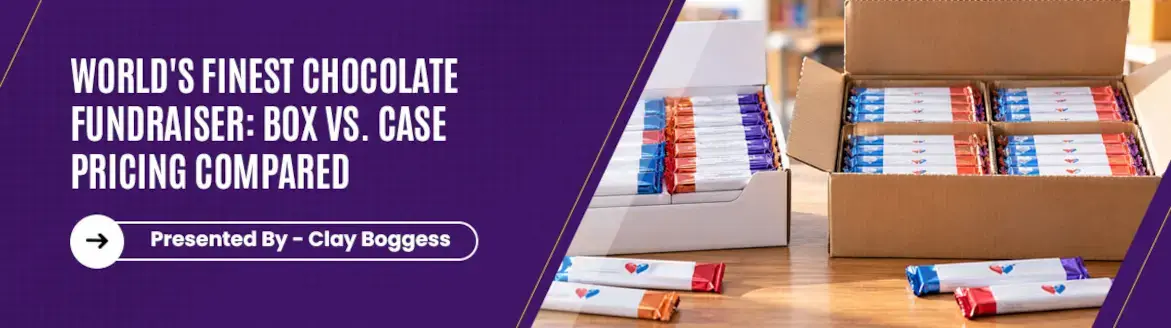
Choosing a chocolate fundraiser for schools usually comes down to a spreadsheet and a deadline. A PTO coordinator collects two or three quotes, and they arrive in different formats. One lists a box of bars with a sales value. Another lists a case that contains several inner carriers. A third leads with a percentage and leaves the unit count for later.
The problem is not dishonesty. "Box" and "case" are used loosely across the industry, and even on a single company's website, the same unit can appear under both names. A coordinator who compares a box price to a case price compares a fraction of an order to the whole, and the result looks better or worse than it really is.
Big Fundraising Ideas has supported school fundraising programs since 1999. This guide takes the published numbers for the World's Finest Chocolate bars fundraiser and for our own candy bar program, converts both to profit per bar, and lists the terms that matter beyond the headline percentage. A note on transparency: we sell chocolate bars, so we have an interest in this comparison. We have used each company's own published pages and dated them.
Why Box and Case Are Not the Same Unit
The cleanest way to avoid the trap is to ignore the container and count bars. Every chocolate fundraiser comes down to three numbers: the selling price per bar, the number of bars you receive, and the percentage of sales your group keeps.
- Selling Price per Bar: The number your families actually pay, typically $1, $2, or $3.
- Bars per Unit: How many bars sit in the box, inner carrier, or case you are being quoted.
- Profit Percentage and Its Trigger: The share your group keeps, and the order size needed to reach the higher tier.
- Everything Outside the Percentage: Shipping, upfront payment, return terms, and allergen policy.
The World's Finest Chocolate fundraiser publishes its pricing in boxes. Its FAQ and product page state that a $2 bar pack holds 40 bars sold at $2 each, making one box worth $80 in sales. The company uses the same term for this unit: it describes the pack as "40 bars per case," states profit "per box," and sets an 8-case minimum. It describes its profit tiers as 40 percent on orders under 200 cases ($32 per box) and 50 percent on orders over 200 cases ($40 per box). Some representative pages describe the higher tier as "200 or more" boxes, so ask a representative exactly where the tier begins before you plan around it.
Big Fundraising Ideas ships candy bars by the case. Our candy bar fundraisers page explains that standard inner carriers typically contain 30 to 60 bars, a case holds roughly 120 to 240 bars, and it recommends confirming exact counts for the specific product. The Nifty 50 Chocolatiers program, for example, uses an inner carrier of exactly 50 bars sorted across four flavors.
Converting Both Programs to Profit Per Bar
Here is the arithmetic in plain terms. Selling price multiplied by profit percentage gives profit per bar. Profit per bar multiplied by the number of bars you sell gives your total.
- $2 bar at 40 percent: $0.80 per bar, which is $32 on a 40-bar box and $40 on a 50-bar carrier
- $2 bar at 50 percent: $1.00 per bar, which is $40 on a 40-bar box and $50 on a 50-bar carrier
- $2 bar at 55 percent: $1.10 per bar, which is $44 on a 40-bar box and $55 on a 50-bar carrier
- $1 bar at 30 percent: $0.30 per bar, which is $15 per 50 bars and $30 per 100 bars
Here is how the two programs compare on the terms each company publishes.
The table shows why the headline percentage is only part of the story. A very large school can reach the higher tier, while a small one can't, which is why the order-size trigger deserves as much attention as the percentage.
What a Case Order Looks Like in Practice
A chocolate fundraiser is easier to manage when the unit matches the group. A parent volunteer counting bars into student order bags works faster with a 50-bar carrier than with a mixed pallet. Our Nifty 50 Chocolatiers program is built around that carrier: 50 bars, four flavors, pre-sorted. The Funtastic Collection lists a one-case minimum, which suits a smaller club or team that wants to try a chocolate bar fundraiser without a large commitment.
- Fits the Group Size: Carriers of 30 to 60 bars let a classroom, a team, or a grade level order only what it needs.
- Pre-Sorted Variety: Flavors arrive balanced, so volunteers do not spend an evening rebalancing boxes.
- Scales Up Cleanly: A school-wide sale adds cases rather than renegotiating a different program.
- Easier Reconciliation: One inner carrier equals one known dollar value, which makes cash counting and unsold-bar tracking simple.
For schools that want a peanut-free chocolate bar, our Nifty 50 Chocolatiers bars are listed as 100 percent peanut-free, gluten-free, and kosher. Those labels matter at many schools, where allergy policy rules out a program before the profit percentage is ever discussed.
Price Points: $1, $2, or $3 Bars
World's Finest Chocolate and Big Fundraising Ideas both sell the $2 bar as their center point, so the $2 comparison above is fair. Our program also includes lower and higher-priced options to suit different audiences.
- $1 Bars: America's Variety Bars are $1 each, 6-inch, cash-themed bars that are peanut-free, gluten-free, and kosher, with up to $108 per case in profit. They suit younger students selling to family and neighbors, where a dollar is an easy yes.
- $2 Bars: The standard school price. Gourmet Chocolate Bars, Nifty 50 Chocolatiers, Straight Caramel Bars, and the Funtastic Collection are all $2, with a published net of $1,600 from 10 cases.
- $3 Jumbo Bars: Premium Collection and $3 Gourmet Chocolate Bars are $3 each, with a published net of $1,440 from 10 cases and up to 55% on the Premium Collection.
A $3 bar can produce a smaller case total than a $2 bar in the published figures because fewer bars sit in each case. Compare the dollar result for the same number of cases, not the wrapper price. Review our Premium Collection if your school sells to adults and local businesses, not just families.
Which Bar Program Fits Your Group
- Elementary and Early Middle School Sellers: America's Variety Bars at $1 are an easy yes with family and neighbors, with up to $108 per case in profit.
- School-Wide and Grade-Level Sales: The $2 bars drive the most sales, and the Straight Caramel Bars and Gourmet Chocolate Bars both net $1,600 from 10 cases.
- Sports Teams, Boosters and Networks: The $3 jumbo bars suit buyers who purchase one or two bars rather than a handful.
All products through bigfundraisingideas.com. No upfront cost. Free shipping.
Terms Beyond the Percentage
Four terms deserve a written answer from every chocolate fundraiser company before you commit.
- Upfront Cost: Big Fundraising Ideas advertises no upfront cost, with no fees or setup charges, and the product pages list payment within 15 days of receiving the product. World's Finest Chocolate requires upfront payment on online orders, and approved credit accounts are invoiced after the fundraiser, typically due within 30 days. Ask any company whether you pay on delivery, after the sale, or in advance. The no-upfront-cost fundraisers page explains how ours work.
- Shipping: Free delivery is listed on every featured candy bar product with no minimum spend. World's Finest Chocolate's online shop advertises free shipping, while its FAQ says shipping charges vary by order method and order size. Ask whether freight is added to the invoice, because a few hundred dollars in charges can erase several percentage points of profit on a small order.
- Returns: World's Finest says it doesn't accept returns unless there is a product quality issue, and that eligible credit accounts may return unopened boxes within 60 days for a fee, depending on credit terms and order size. Our product pages state that unsold product is not accepted back. Read our return policy and ask every company for its written criteria.
- Allergen Policy: Confirm that the specific bar, not just the brand, is peanut-free, and ask about tree nuts, since some bars from both companies contain almonds. Contact the team before ordering to match products to your school's policy.
A Fair Way to Compare Any Chocolate Fundraiser
- Step One: Set a realistic bar count based on last year's sales or your enrollment, not the best-case brochure example.
- Step Two: Find the profit tier that applies to that count and write down the percentage.
- Step Three: Multiply the bars by the selling price and the percentage to get total profit.
- Step Four: Subtract shipping or freight and any payment fees, then note the payment due date.
- Step Five: Confirm the exact bar is peanut-free before you order.
A worked example: a school expecting to sell 1,000 bars at $2 earns $800 at a 40 percent tier, $1,000 at 50 percent, and $1,100 at 55 percent. The $300 spread between the low and high tiers is the real value of reaching a higher order size, and it is the number worth testing with each company before you choose.
If you want to explore the full range of programs before narrowing to chocolate, our candy fundraisers page lists every candy option, and our How it Works page walks through ordering, delivery, and payment.
Frequently Asked Questions About the World's Finest Chocolate Fundraiser
What is the World's Finest Chocolate fundraiser?
It is a school and group fundraising program that sells chocolate bars through student sellers, with profit determined by order size. According to the company's FAQ, the $2 pack contains 40 bars per case, and each box sells for $80. The published tiers are 40 percent on orders under 200 cases and 50 percent on orders over 200 cases.
How much is the World's Finest Chocolate per box?
A $2 box contains 40 bars and sells for $80. At the 40 percent tier, the group keeps $32 per box, or about $48; at the 50 percent tier, it keeps $40, or $1.00 per bar. Shipping and sales tax are separate, so confirm the current terms and charges with a representative or at checkout.
Where can I buy World's Finest Chocolate bars for a fundraiser?
Groups with goals under $3,200 can order up to 100 cases online, and larger goals work with a representative. The company also lists a store locator for retail purchases. Schools that want a comparable chocolate bar fundraiser can order from Big Fundraising Ideas candy bars at no upfront cost, with free shipping on every featured candy bar product.
How much profit does a school make selling World's Finest Chocolate?
The published tiers are 40 percent on orders under 200 cases and 50 percent on orders over 200 cases. On a $2 bar, that is $0.80 and $1.00 per bar. A school selling 1,000 bars would keep about $800 at the lower tier and $1,000 at the higher one, before shipping and tax.
Is a chocolate bar fundraiser a good way to raise money for schools?
Yes, when the price point and order size match the group. Chocolate bars sell quickly, require no explanation, and appeal to families and neighbors alike. The best results come from choosing a program whose profit tier you can realistically reach and from confirming peanut-free options before ordering.
What is the difference between a box and a case in a fundraiser?
A box is usually a small unit a seller can carry, while a case is a shipping unit that may hold several boxes or inner carriers. Companies use the terms loosely. World's Finest Chocolate, for example, uses both words for the same 40-bar, $80 unit, while Big Fundraising Ideas cases hold several inner carriers. Always ask for the bar count in the unit you are quoted, and compare profit per bar.
How many bars come in a case of fundraiser candy?
Inner carriers typically hold 30 to 60 bars, and a case holds roughly 120 to 240 bars, depending on the product. Our Nifty 50 Chocolatiers carrier holds exactly 50 bars across four flavors. Ask for the exact count on the product you choose.
What is the best chocolate fundraiser for schools?
The best program is the one with the highest profit per bar at the volume your group will actually sell, with terms your volunteers can manage. Compare $2 bars with $2 bars, check the order-size trigger for the top profit tier, and add shipping and payment terms before deciding. See our most profitable school fundraisers guide for how chocolate compares with other programs.
Are there peanut-free chocolate fundraiser options?
Yes. Our Gourmet Chocolate Bars, Nifty 50 Chocolatiers, America's Variety Bars, Straight Caramel Bars, and Funtastic Collection are listed as peanut-free, gluten-free, and kosher, and the $3 lineups are gluten-free except for a wafer flavor. World's Finest Chocolate also describes itself as peanut-free. Peanut-free isn't the same as nut-free, since some bars from both companies contain almonds, so contact the team before ordering to confirm which bars fit your school's allergy policy.
What should I ask every chocolate fundraiser company before ordering?
Ask for the bars per unit, the profit tier at your expected volume, when payment is due, whether freight is charged, the return criteria in writing, and the allergen status of the exact bar. Those six answers let you convert any quote to profit per bar and compare programs fairly. See also: elementary school fundraisers and discount card fundraisers.
Need help comparing quotes? Reach out today for a FREE consultation with an expert. Contact Big Fundraising Ideas or call (866) 980-9930, Monday through Friday, 8:00 a.m. to 5:00 p.m. CST. Related reading: most profitable school fundraisers, elementary school fundraisers, and discount card fundraisers.
Author Bio
Clay Boggess has been designing fundraising programs for schools and various nonprofit organizations throughout the US since 1999. He’s helped administrators, teachers, and outside support entities such as PTAs and PTOs raise millions of dollars. Clay is an owner and partner at Big Fundraising Ideas.

Categories
Related Articles
What Is the Minimum Order for…
Compare direct-sale, brochure, and online minimums to see how order size will affect your school's fundraising profit.
Global Cocoa Supply Crisis:…
What is the global cocoa supply crisis, why does chocolate cost more, where does supply stand, and what should schools do about it?
Chocolate Bar Fundraiser for…
How are chocolate price swings affecting school fundraisers? See what changed in 2026, the profit per bar, and how to choose a price point.