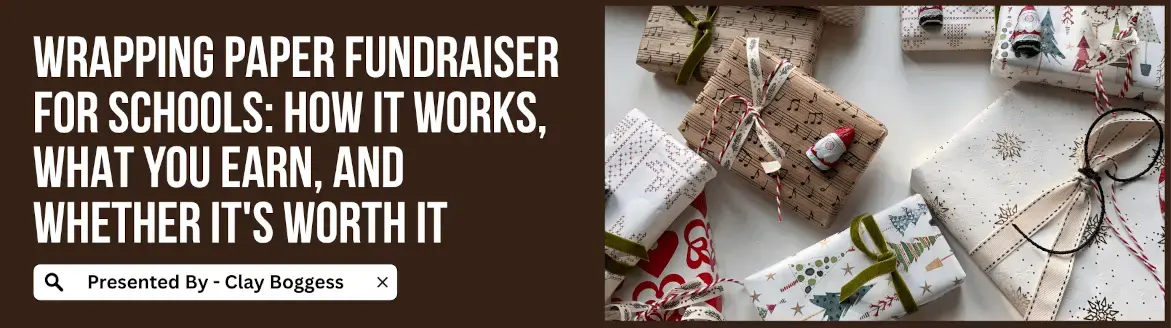
Blog Summary: A wrapping paper fundraiser is a product-based school campaign in which students sell premium gift wrap, accessories, and holiday items through a brochure or online storefront, earning 40 percent profit per order with no upfront cost to the school. Programs typically run two to three weeks in the fall to capture holiday shopping demand. Charleston Wrap is the leading supplier in the fundraising industry, distinguished by heavier paper stock, reversible designs, and recyclable Enviro-core construction.
The timing pressure on school fundraising budgets is real. Equipment, field trips, classroom supplies, and extracurricular programs all compete for dollars that school district allocations rarely cover in full. Product fundraisers have become the most reliable gap-filler precisely because they require nothing upfront — no financial risk, no labor-intensive volunteer events, and no weather dependence. Among product fundraisers, the wrapping paper category holds a structural advantage that most coordinators underestimate: it aligns with something supporters are already planning to buy.
Big Fundraising Ideas has partnered with school programs across the USA since 1999. This guide covers everything a principal or PTA coordinator needs to evaluate a wrapping paper fundraiser — how it works, what the realistic profit numbers look like, how Charleston Wrap compares to alternatives, and a practical step-by-step launch timeline.
How a Wrapping Paper Fundraiser Works
The mechanics are simple enough that a first-time coordinator can run a successful campaign without prior fundraising experience. Here is the full sequence:
- Register with your program supplier: Submit your school information and estimated participant count. You will receive supply kits within a few business days at no cost.
- Distribute materials to students: Each student receives a product catalog or brochure and an order form. For online programs, each student receives a personalized link to share with family and supporters.
- Run the selling window: The campaign runs for two weeks. Students show the catalog to family, neighbors, and community contacts and collect orders with payment. Online participants share their personal link by text, email, and social media.
- Hold a kickoff to build momentum: Schools that run an opening assembly or classroom kickoff with a clear goal announcement see 20 to 30 percent higher participation rates than those that send materials home.
- Close and submit the bulk order: Collect all order forms and payments on the stated closing date. Submit the consolidated order to your supplier. For online fundraisers, the platform handles this step automatically.
- Receive and sort products: Products arrive pre-sorted by seller in brochure programs. Online programs ship directly to buyers, eliminating the need for distribution.
- Distribute and celebrate: Hold a brief recognition event to announce the final total and reward top sellers, thereby closing the loop with students and building enthusiasm for next year.
How Much Money Can Your School Raise?
Profit projections depend on three variables: roster size, participation rate, and average order value. The table below covers typical scenarios across small, medium, and large schools using realistic participation and order assumptions.
Wrapping Paper Fundraiser Profit by School Size
Calculations based on 45% average profit rate. Online storefronts and prize programs drive higher participation.

Two factors push these numbers significantly higher in practice. First, online storefronts remove geographic constraints on supporters — grandparents, alumni, and out-of-state family members become accessible buyers, increasing average order size. Second, Big Event Prize Programs tied to individual selling milestones consistently push participation above 85 percent. Schools that use experiential prize incentives — Super Party events, Magic Shows, or Reptile Adventures — rather than standard toy prizes routinely report participation rates 20 to 30 percentage points higher than programs without them.
Why Charleston Wrap Outperforms Other Gift Wrap Programs
Most coordinators evaluate gift wrap programs on profit percentage and price point. These matters are not what determine whether your supporters come back next year. Product quality is. A supporter who receives a heavy, beautifully designed, reversible roll of gift wrap that outperforms anything they can buy at a retail store becomes a repeat buyer. A supporter who receives a thin, coreless roll that creases on the first foot does not.
Here is what the technical differences actually mean for your fundraiser:
Paper Quality Comparison: What the Specs Mean for Your Fundraiser
Wrapping Paper Fundraiser vs. Other Fall Fundraising Programs
No single fundraising program is the right fit for every school. The choice depends on your supporter demographics, the time of year, your logistical bandwidth, and whether your community tends toward food-based or lifestyle product purchases. The comparison below covers the four most common fall fundraising alternatives so coordinators can make an informed decision before committing to a program.
Fall Fundraiser Comparison: Which Program Fits Your School?
Internal link note for editors: Link 'Cookie Dough' to /cookie-dough-fundraisers | Link 'Popcorn' to /popcorn-fundraisers | Link 'Frozen Food' to /frozen-food-fundraisers in CMS.
How to Run a Wrapping Paper Fundraiser: Six-Week Planning Timeline
Weeks 1-2: Planning and Registration
- Set your fundraising dollar goal and calculate how many students need to sell how much to reach it.
- Select your program — brochure only, online only, or hybrid (recommended for maximum reach)
- Register with your supplier and confirm the supply kit delivery date
- Send an advance notice to parents explaining the upcoming fundraiser, its purpose, and expected dates
- Identify and brief your volunteer coordinator, who will manage distribution and collection
Week 3: Kickoff Preparation
- Receive and organize supply kits — one packet per student participant
- Prepare kickoff presentation: goal thermometer, prize program display, and talking points for teachers
- Set up an online store if using a digital component — confirm student registration links are working
- Prepare parent communication: kickoff letter, online store instructions, and social sharing guide
Weeks 4-5: Active Selling Window
- Hold a kickoff assembly or classroom launch — announce the goal, distribute materials, and generate excitement.
- Send the parent email with the online store link the same day as kickoff — the first 48 hours drive the highest volume.
- Post daily or weekly progress updates in the school newsletter or app — public momentum drives participation.
- Check in at the one-week mark: recognize top sellers, re-announce the goal gap, and add urgency.
- Send a final 48-hour reminder before the closing date
Week 6: Close, Submit, and Celebrate
- Collect all order forms and payments on the stated closing date — no late exceptions to maintain trust.
- Reconcile totals and submit the bulk order to your supplier
- Plan distribution day logistics — pre-sorted by seller for brochure programs
- Announce the final fundraising total school-wide and recognize the top sellers and participating classrooms
- Send a thank-you communication to parents — closing the loop builds goodwill for next year's campaign
Big Fundraising Ideas provides free supply kits, a dedicated fundraising coordinator, and direct support from registration through distribution. Every school brochure fundraiser and online fundraising program we offer includes this support structure with no upfront cost.
Frequently Asked Questions About Wrapping Paper Fundraisers
What is a wrapping paper fundraiser for schools?
How much profit does a wrapping paper fundraiser make?
Most school wrapping paper fundraisers generate 40 to 50 percent profit on every dollar sold. A school of 250 students with 70 percent participation, each selling an average of $45 in products, nets approximately $3,544 in a single two-week campaign with zero upfront cost.
How does a Charleston Wrap fundraiser work?
Schools register, receive supply kits including order forms and catalogs, distribute materials to students, run a two to three-week selling window, and submit the bulk order at close. Charleston Wrap handles fulfillment and ships products either to the school for distribution or directly to buyers in online mode.
When is the best time to run a wrapping paper fundraiser?
Fall (September through November) is the optimal window for wrapping paper fundraisers because it aligns with holiday shopping demand. Supporters are already planning to buy gift wrap, thereby reducing the sales effort for students and significantly increasing average order values.
Is a wrapping paper fundraiser better than a cookie dough fundraiser?
Both generate similar profit percentages of 40 percent. Wrapping paper fundraisers perform best in the fall due to holiday timing, while cookie dough fundraisers work effectively year-round. Schools with strong fall programs often run wrapping paper in fall and cookie dough in spring to maximize two annual campaigns without supporter fatigue.
How long does a school wrapping paper fundraiser run?
Most wrapping paper fundraisers run two to three weeks. Shorter campaigns of 10 to 14 days tend to generate greater urgency and higher participation rates than longer campaigns, where early momentum fades before the close date.
Does Charleston Wrap offer online fundraising?
Yes. Charleston Wrap provides an online storefront option where supporters can browse and purchase from any location with direct-to-home shipping, extending reach beyond immediate family and neighbors to grandparents, alumni, and out-of-town supporters who cannot participate in traditional brochure-based programs.
What makes Charleston Wrap different from other gift wrap fundraisers?
Charleston Wrap uses UltraHeavy paper (60-pound stock versus the 38-pound retail standard), reversible designs, Sullivan Paper Company's rotogravure printing process, and recyclable Enviro-core construction. These quality differences translate into higher supporter repeat purchase rates — the most important long-term factor in annual fundraising performance.
Can wrapping paper fundraisers be done online?
Yes. Online wrapping paper fundraisers allow supporters to purchase products through a personalized digital storefront and receive orders shipped directly to their home. This model is particularly effective for schools with geographically dispersed supporter networks. See our online fundraiser programs for full details.
What other fall fundraisers work well alongside wrapping paper?
Schools that run wrapping paper as their primary fall product often pair it with a no-upfront-cost frozen food program as a secondary offering for supporters who prefer food items over gifts. Candy bar and beef stick direct-sale programs can also run concurrently as a low-effort add-on that different student groups manage independently.
Author Bio
Clay Boggess has been designing fundraising programs for schools and various nonprofit organizations throughout the US since 1999. He’s helped administrators, teachers, and outside support entities such as PTAs and PTOs raise millions of dollars. Clay is an owner and partner at Big Fundraising Ideas.

Related Articles
Fundraising Ideas for…
Compare approaches by nonprofit size, available volunteer capacity, and timeline, and identify which programs deliver the strongest results.
101 Low and No-Cost School…
Discover 101 free and low-cost fundraising incentives that boost sales by up to 20%. Organized by grade level, campaign phase, and budget.
Best Fundraising Ideas for…
Discover the best fundraising ideas for students at each grade level. From product sales to online programs, find proven strategies that work.