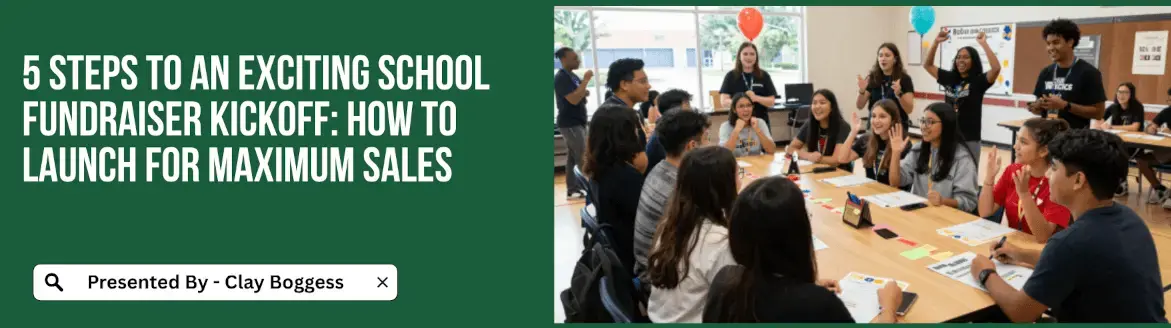
A well-executed kickoff creates selling momentum that compounds across the first week. A poorly executed one -- materials handed out with a few vague remarks at the end of a class period -- leaves the campaign starting flat with no mechanism to recover the day-one energy it needed. The students who sell the most in a product fundraiser are almost always the ones who left the kickoff assembly excited, started the same afternoon, and reached their best buyer within the first 24 hours. The students who sell the least are almost always the ones who received their materials without ceremony and set them aside for later.
Big Fundraising Ideas has been providing school fundraiser kickoff resources to elementary, middle, and high schools since 1999. This guide covers the five steps that consistently produce the most successful kickoff assemblies and the specific actions within each step that make the difference between a campaign that launches strong and one that never finds its footing.
Why the Kickoff Is the Most Important 20 Minutes of Your Fundraiser
This day-one urgency is not hypothetical. Data from Big Fundraising Ideas campaigns consistently shows that the majority of brochure fundraiser sales are generated in the first 3 to 4 days of a two-week window. The students who maximize this window are almost always those whose schools held a compelling kickoff assembly. The students who underperform almost always come from schools where the kickoff was treated as a formality rather than the campaign's most important event.
- Day 1-4: the majority of brochure sales are generated in this window -- the kickoff directly determines how many students activate immediately
- Days 5-10: momentum sustains for students who started strong; students who didn't start in the first few days rarely catch up to their peers
- Days 11-14: a well-promoted close pushes final sales -- but the close announcement only works if the kickoff created a campaign students already believe in
Step 1: Promote Before the Kickoff to Build Anticipation
The presale promotion has a specific goal: to create awareness and anticipation without revealing everything. Announce that a special assembly is coming and that it's going to be good. Mention it in morning announcements. Post it on the school marquee and website. Send a brief note home with students—not the full fundraiser information letter, just a "coming soon" notice. The goal is for every student to arrive at the kickoff already engaged rather than needing to be won from zero.
Presale Promotion Checklist
- Morning announcements: brief daily mention starting 5 days before the kickoff -- 'our big fundraiser launch is coming this Friday'
- School marquee: 'Fundraiser kickoff -- [day and date]' -- visible to parents on drop-off and pickup
- School website: brief notice with the launch date and a teaser about what the fundraiser will fund
- Parent email or note home: a single-sentence note with the kickoff date and the purpose of the fundraiser -- primes parents to support from day one
- Teacher briefing: Meet with teachers before the kickoff to explain the program, the goals, and how to reinforce the message in class
Step 2: Ensure Everyone Is Present
Make the kickoff assembly mandatory and coordinate with teachers and administration before the date to confirm full attendance. This requires communicating the kickoff schedule to every teacher at least a week in advance so they can plan their class schedules around the assembly time. A kickoff that 10 percent of students miss due to scheduling conflicts or teacher resistance yields 10 percent less day-one momentum than a fully attended one -- and day-one momentum is the variable that determines the campaign's overall outcome.
Step 3: Involve the Principal as Opener and Closer
Brief the principal before the assembly with three specific points to cover: the specific expense or need the fundraiser will fund, why student participation is expected rather than optional, and a brief introduction of the presenter who will cover the program details. The principal then reappears at the end to deliver two to three sentences of closing remarks as materials are distributed -- reinforcing the importance of the campaign at the exact moment students are receiving their selling materials for the first time.
- Principal's opening (2-3 minutes): why this fundraiser matters, what the money will fund, why participation is expected
- Handoff to presenter: principal introduces the program and exits to the side or sits visible in the assembly as a silent endorsement of the proceedings
- Principal's closing (1-2 minutes): brief reinforcing remarks as materials are distributed -- 'I'm looking forward to seeing everyone participate in this'
Step 4: Play Music at Entry and Exit
Choose radio-edited (clean) versions of music your current student age group actively listens to and enjoys. The specific songs matter far less than the energy level -- choose music that your students will recognize and respond to positively. Fade the music to zero when the presenter is ready to begin. Restart it at the end of the assembly as students pick up their materials. This transition signals to students when silence is appropriate and when the room's energy is open to conversation.
Step 5: Think Big, Loud, and Reveal the Prizes Last
The prize reveal sequence is the peak of kickoff excitement and must be handled deliberately. Covering prizes before students enter creates visible suspense -- every student can see the covered items and spends the first minutes of the assembly wondering what is underneath. Revealing prizes one at a time, building from smaller items to the most exciting, gives the presenter multiple reaction moments to build energy across the assembly rather than a single revelation that peaks and fades.
Prize Reveal Best Practices
- Cover before entry: use dark bedsheets or tablecloths so shapes are not visible -- the suspense of covered items builds anticipation throughout the opening portion of the assembly
- Reveal one at a time: remove the covering from each item individually as you discuss it, starting with smaller prizes and ending with the most exciting.
- Save the best for last: the final reveal should be the item that elicits the strongest reaction—often the Big Event Prize Program announcement for elementary schools.
- Let the room react: pause after each reveal, letting the excitement build before moving on to the next—do not rush through the sequence.
- Distribute materials after the final reveal: students receive selling materials at the moment of peak enthusiasm, not before
Big Event Prize Programs: The Most Powerful Kickoff Reveal
The Big Event reveal works at the kickoff because it is specific, visual, and communicated to every student simultaneously. Show photos or video of the Super Splash Party or the Super Party as part of the prize presentation. Name the threshold -- 'every student who sells 8 items will attend the Super Party' -- clearly and visibly. Every student leaves the kickoff knowing exactly what they are working toward. Visit bigfundraisingideas.com/big-event-prize-programs to see verified school reviews and program details.
After the Kickoff: Maintaining Momentum
- Days 1-4: daily morning assembly update with total items sold to date -- this creates accountability for students who haven't started yet and recognition for those who have
- Midpoint: parent email with current standing, percentage of goal achieved, and a reminder of what the money will fund and when the campaign closes
- Final 48 hours: specific close date and time announced at morning assembly with how many students have reached their goal and how many are still one to two items short -- this drives the final urgency spike that typically generates 15 to 25 percent of total campaign revenue
Frequently Asked Questions About School Fundraiser Kickoffs
How do you kick off a school fundraiser?
5 steps: (1) promote beforehand to build anticipation, (2) ensure full student attendance, (3) involve the principal as opener and closer, (4) play music at entry and exit, (5) use a large screen and good sound system, reveal prizes one at a time with the best last, distribute materials at peak enthusiasm. Complete in 15-20 minutes. Most sales happen in the first 3-4 days—bigfundraisingideas.com for full kickoff resources.
Why is the school fundraiser kickoff so important?
Most brochure fundraiser sales happen within the first 3 to 4 days. The kickoff's job is to generate enough enthusiasm that students start selling immediately after the assembly. A kickoff that falls flat leaves the campaign underperforming from day one with no mechanism to recover.
Should the principal be involved in the kickoff?
Yes. A principal who takes 2-3 minutes to explain why the fundraiser matters and close with brief reinforcing remarks communicates the campaign's importance in a way no other adult in the school can. Students assign authority to administrators that translates directly into motivation to participate.
How do you promote a fundraiser before the kickoff?
Morning announcements starting 5 days before ('our fundraiser kickoff is this Friday'), school marquee with the date, school website notice, brief parent note home, and a teacher briefing meeting. Goal: create anticipation without revealing everything so students arrive curious rather than neutral.
How long should the kickoff assembly take?
15 to 20 minutes. Principal introduction (2-3 min), product and goal presentation (5-7 min), prize reveal (3-5 min), material distribution with principal closing (2-3 min). Every minute beyond 20 diminishes the per-minute energy return. Students should leave excited, materials in hand, knowing exactly what to do.
How do you reveal prizes at a kickoff?
Cover prize items with dark bedsheets before students enter. Reveal one at a time, smallest to most exciting, pausing after each for the room to react. Save the best for last. For elementary and middle school: the Big Event Prize Program announcement (Super Splash Party, Super Party, Reptile Adventures, Magic Show) is the most powerful final reveal.
What music should you play at a school fundraiser kickoff?
Radio-edited versions of music your students actively listen to. Play as students enter. Fade when the presenter starts. Restart as students exit. The specific songs matter less than the energy level—choose music students will recognize and respond to. Signal transitions between talking and moving.
How do you get full student attendance at the kickoff?
Make attendance mandatory. Coordinate with teachers and administration at least one week before the assembly date. A full room amplifies every student's enthusiasm through peer excitement compounding—a 10 percent attendance shortfall results in a measurable reduction in day-one sales momentum.
What should you say at a school fundraiser kickoff?
Four things: why the fundraiser matters (specific expense or need for funds), what students need to do (exactly how selling works), what they earn for participating (prizes or Big Event program), and when it ends (specific close date). Administrative logistics go in the participant letter, not the kickoff assembly.
How do you maintain momentum after the kickoff?
Daily morning assembly standings update for the first 3-4 days. Midpoint parent email with current progress and goal status. Final 48-hour close announcement with specific date and time, how many students have reached their goal, and how many are 1-2 items short. Consistent communication outperforms kickoff-only and close-only announcements.
Author Bio
Clay Boggess has been designing fundraising programs for schools and various nonprofit organizations throughout the US since 1999. He’s helped administrators, teachers, and outside support entities such as PTAs and PTOs raise millions of dollars. Clay is an owner and partner at Big Fundraising Ideas.

Related Articles

Holiday Beef Stick Fundraiser…
How to run a holiday beef stick fundraiser: cover ordering and delivery timing, the 15-day invoice rule, and tips to avoid leftovers.

How Much Can a School Make…
Learn how much you can make from an Otis Spunkmeyer fundraiser; see the profit formula, a worked example, and what affects your total.

Mother's Day and Father…
Mother's Day and Father's Day fundraiser ideas for schools: what to sell, how to price gifts kids can afford, and when to start.