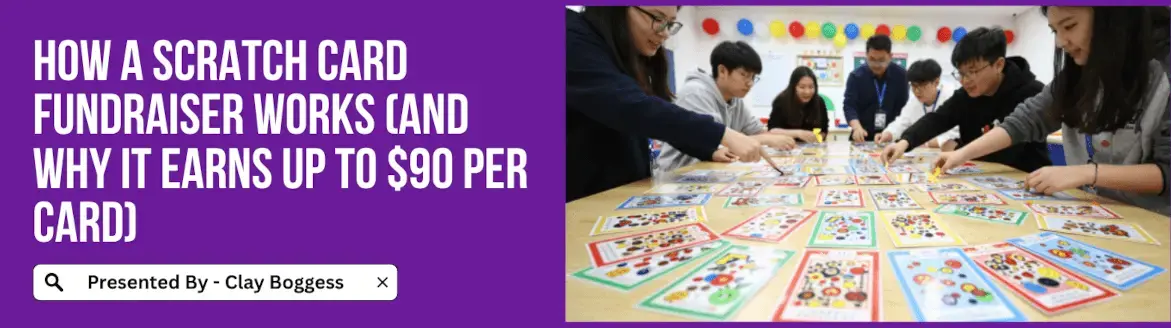
A scratch card fundraiser is a no-product donation format where supporters scratch off dots on a personalized card to reveal donation amounts ranging from 50 cents to $3, then donate that amount and receive a coupon sheet in return. Each completed card collects $100 in donations and earns your group $80-$90 in profit, depending on the volume tier you order. There is no product to deliver, no order forms to process, and no 3-week production wait required by brochure-based fundraisers.
This guide covers how a scratch card fundraiser works step by step, the profit math at different group sizes, the legal distinction between scratch cards and raffle tickets, the custom design process, the best groups for the format, and the tactical sales tips that separate top campaigns from average ones.
Quick stats
What is a scratch card fundraiser?
A scratch card fundraiser is a donation-based fundraising program where students or volunteers carry personalized cards covered with scratch-off dots. When a supporter agrees to participate, they scratch off one or more dots to reveal donation amounts ranging from 50 cents to $3. The supporter donates the amount(s) revealed and receives a coupon sheet in return, offering discounts at well-known national retailers, including The Popcorn Factory, Omaha Steaks, and Overstock.com.
The format is fundamentally different from brochure fundraisers because there is no physical product changing hands. The card itself is the entire transaction mechanism. The simplicity is the entire point: no inventory, no order forms, no delivery logistics, and no money chase after the fact. The whole transaction completes the moment a supporter donates.
Quick answer: A scratch card fundraiser is a no-product donation fundraiser where supporters scratch off dots on a personalized card to reveal donation amounts of $ 0.50 to $3, donate that amount, and receive a coupon sheet as a thank-you gift. Your group earns $80 to $90 per completed card.
How a scratch card fundraiser works
The format runs in 5 sequential steps. Planning a scratch card fundraiser well means hitting each step cleanly. Most groups complete the full cycle in 2 to 3 weeks from order placement to invoice payment.
Step 1: Order your scratch cards
Your group orders cards upfront, typically one card per student or per active seller. Big Fundraising Ideas designs each card for free with your group's name, picture, and a custom message tied to your cause. The volume of cards you order determines your profit tier at the back end. Larger orders unlock higher per-card profit.
Step 2: Run a kickoff meeting with the approach script
Distribute one card per student. Train students on a simple 3-line approach: state your name, state what you are raising money for, and ask the supporter to participate. The script is the heart of the campaign because the scratch randomizes the actual donation amount. The student is not asking for a specific dollar amount; they are just inviting the supporter to engage with the card.
Step 3: Students approach supporters
Each student carries one card and approaches family, friends, neighbors, parents, coworkers, and (with appropriate adult supervision) community contacts. A supporter agrees to participate, scratches off one or more dots, and pays the revealed amount(s) on the spot. Many supporters scratch multiple dots and pay each one. Some donate more than the card reveals because the format feels personal and the cause feels real. Some donate even without scratching any dots.
Step 4: Track outstanding money and cards
Use a tracking sheet to monitor which students have completed their cards and which still have outstanding money. A completed card means the student has collected $100 total. Students should not turn in their cards until every dot is scratched off; partially scratched cards leave donations on the table. Set an internal deadline date for completion and announce it at kickoff.
Step 5: Submit your final tally and pay your invoice
Collect all cards and money on or before the deadline. Pay the Big Fundraising Ideas invoice for the cards based on the volume tier you ordered. Keep the remainder as profit. Public schools can use a purchase order with payment due 15 days after delivery, which makes the cash flow easier on the front end.
Scratch card fundraiser profit math
The math is unusually transparent because the per-card gross is fixed at $100. Profit per card varies only with the volume your group orders. Here is the breakdown at four illustrative tiers:
These tiers are illustrative. Contact a Big Fundraising Ideas specialist for an exact quote tied to your card volume and group profile. The profit math shows the unique appeal of the scratch card format: a 100-student campaign nets roughly $8,700 in profit. The same 100-student group running a cookie dough brochure fundraiser at a $20 retail price, with 5 items per student and 40 percent profit, nets about $4,000. The scratch card profit is more than double, because there is no manufacturer cost eating into the margin.
Why scratch cards earn more than product fundraisers
The structural reason scratch cards earn 80 to 90 percent margins is that there is no physical product cost in the unit economics. The full $100 collected per card, minus the BFRI invoice cost (a portion of the gross depending on volume), becomes your group's profit. Compare the unit economics across formats:
Cookie dough fundraisers: group profit is around 40 percent because manufacturing, packaging, and shipping costs are real. Buyers get a tangible $20 product.
Candy bar fundraisers: group profit can reach up to 55 percent because per-unit costs are lower than for cookie dough, but the product still incurs high manufacturing and shipping costs.
Popcorn fundraisers: group profit ranges from 40 to 50 percent at the brochure level, depending on volume and the specific brand selected.
Scratch card fundraisers: group profit reaches 80 to 90 percent because the card itself is paper, and the "product" the supporter receives is a coupon sheet distributed through partner networks at no per-card cost to your group.
The trade-off is real, not hidden. Gross per supporter is typically lower for scratch cards (50 cents to a few dollars per supporter) than for product fundraisers (e.g., a $20 cookie dough product). So scratch cards win on margin but require more supporter interactions to hit the same total dollar goal. Most groups solve this by running scratch cards alongside another fundraiser, not as the sole format.
Custom scratch card design
Every Big Fundraising Ideas scratch card is custom-designed for your group at no additional cost. The design process includes:
- Your group's name on the cover
- Your group's logo or photo (school, team, organization)
- A custom color scheme to match your organization
- A fundraising message tied to your specific cause
Design turnaround is typically 1 to 2 business days from approval to printing. Order at least 1 to 2 weeks before your kickoff date to allow time for design, production, and shipping. Custom design is included with every order and never billed separately.
How to promote a scratch card fundraiser
The format depends on the student-to-supporter conversation more than on broadcast promotion. Promotion is really about preparing your students to approach supporters with confidence. The tactical playbook:
- Run a kickoff meeting with the 3-line script (name, cause, ask)
- Practice the script as a role-play during the kickoff so students gain comfort
- Set per-student goals (one completed card = $100 per student)
- Use a tracking sheet to flag students falling behind
- Recognize the first 5 students who complete cards publicly to motivate the rest
- Schedule the deadline date with a public reveal of the group total
- Pair with a parent letter explaining the format, so parents who see students carrying cards know what's happening
Social media does not drive scratch card sales the way it drives product fundraiser sales, because the format depends on the personal ask. Use social media to celebrate progress and recognize top performers, not to sell.
Quick answer: Promotion is conversation-driven, not broadcast-driven. The student-to-supporter ask is the entire campaign. Train students well at the kickoff, set per-student goals at $100 each, and use a tracking sheet to keep slow starters accountable.
Scratch cards vs raffle tickets vs lottery: the legal distinction
This distinction matters for schools and nonprofits because the wrong fundraiser format can require permits or violate state law.
- Raffle tickets: Random drawing for a prize. Regulated under state lottery and gaming laws in most US states. Many states require nonprofit raffle permits and impose limits on prize value, ticket price, and reporting requirements.
- Lottery tickets: State-licensed gambling product. Cannot be resold as a fundraiser without explicit state authorization, which is typically not granted to private schools or nonprofit groups.
- Scratch card fundraisers (BFRI format): No element of chance and no prize draw. The "scratch" reveals a predetermined donation amount, and every participating supporter receives a guaranteed coupon sheet thank-you gift. Legally, this is a donation solicitation with a thank-you gift attached, not a gambling product or raffle.
Legal note: The donation-with-thank-you structure means scratch card fundraisers are typically not regulated as gambling and do not require raffle permits. State rules vary, so confirm specific compliance with your state's attorney general or department of consumer protection if your group is uncertain. The information in this article is general guidance and not legal advice.
Are scratch card fundraisers legal in all states?
Yes, in essentially all US states. The format is structured as a donation solicitation with a coupon sheet thank-you gift, not a prize-based raffle, so it does not fall under state lottery or gaming regulations. State charitable solicitation registration requirements vary, however, and some states require nonprofits to register before soliciting donations of any kind.
If your group is a registered nonprofit, complete your state's charitable solicitation registration before launching any donation campaign, including scratch cards. Public and private schools running scratch card fundraisers as part of school-sponsored activities typically operate under the school's existing tax-exempt status without separate registration. Sports teams, scout troops, and church groups should check with their parent organization's compliance officer.
Best groups for a scratch card fundraiser
The format works particularly well for groups whose members can hold a confident 30-second conversation with a supporter. The strongest matches:
- Public schools are raising funds for the general fund, programs, or specific equipment needs. Middle and high school students adapt to the script easily.
- Sports teams at the middle school, high school, and college levels, especially when concession alternatives are limited or already saturated.
- Church groups running mission-trip funds, building-fund campaigns, or annual-giving drives.
- Scout troops raise funds for travel, equipment, or service projects.
- Nonprofits running annual giving campaigns where supporters expect a thank-you gift in return for their donation.
- Booster clubs supplement other fundraising activities with a no-product, high-margin format that runs alongside the main season campaign.
The format is a less natural fit for elementary school students under age 10, who may not be comfortable with the confident donation-ask script the format depends on. Very small groups (fewer than 15 active sellers) may also find the per-student card-tracking overhead greater than the format justifies. Both edge cases can still work, but require more sponsor involvement and more parent volunteer time.
Can scratch card fundraisers be done online?
The traditional scratch card format is fundamentally in-person because the physical scratch interaction is the moment of supporter engagement. Big Fundraising Ideas pairs the in-person scratch card campaign with an online fundraising store for the supporters that students cannot reach face-to-face. Out-of-state grandparents, family in other communities, and remote supporters can contribute through the online store while the local students focus on in-person scratch card asks.
Sales tips for a successful scratch card fundraiser
Eight tactical moves separate top campaigns from average ones. The first three are preserved from the original article on this page because they have stood the test of time. The remaining five expand the playbook.
1. Use a tracking sheet to monitor outstanding cards and money. Without it, slow-starting students drift, and you finish the campaign with a percentage of unfinished cards still in circulation.
2. Set a clear deadline date for card completion and money turn-in. Announce it at kickoff and repeat it every week.
3. Require every dot scratched before students turn cards in. Partially scratched cards leave donations on the table, and they break the supporter promise (each supporter who scratched and donated expects every dot to be honored).
4. Teach the 3-line script at kickoff: name, cause, ask. Role-play it during the meeting so students practice the words. Confident delivery is the entire campaign.
5. Recognize the first 5 students who complete cards. Public recognition motivates more than the underlying acknowledgment, and the early movers set the tone for the rest of the group.
6. Bring cards to community events. Sports games, church suppers, school carnivals, and parent-teacher nights all give students more supporter contacts in less time than door-to-door asks.
7. Pair with a parent letter explaining the format. Parents who see students carrying cards need to understand the donation structure so they can support both the students' efforts and their workplaces' asks.
8. Do not pressure supporters to scratch additional dots beyond the first one. The personal-touch ask is what makes the format work. Pushing supporters past their initial comfort level damages future relationships and undermines the brand of every campaign that follows.
Frequently asked questions
What is a scratch card fundraiser?
A scratch card fundraiser is a no-product donation fundraising format where supporters scratch off dots on a personalized card to reveal donation amounts of $ 0.50 to $3, donate that amount, and receive a coupon sheet as a thank-you gift. Your group earns $80 to $90 per completed card, depending on volume.
How does a scratch card fundraiser work?
Your group orders custom-designed cards upfront, distributes one per student, students approach supporters who scratch dots and donate the revealed amounts, students collect $100 per completed card, your group pays the BFRI invoice, and keeps the rest as profit.
How do you organize a scratch card fundraiser?
Order cards 1 to 2 weeks before kickoff; run a kickoff meeting to teach the 3-line script; distribute one card per student; track outstanding money with a tracking sheet; set a deadline; collect cards and money by the deadline; and pay the invoice. The full cycle runs 2 to 3 weeks.
Are scratch card fundraisers effective?
Yes. Scratch card fundraisers earn 80 to 90 percent margins, more than double the margin of typical product fundraisers. The trade-off is lower gross per supporter (50 cents to a few dollars vs. $20 for cookie dough), so high participation is essential. Groups that match the format to a confident-seller audience consistently outperform product fundraisers on a margin basis.
What is the profit margin for scratch card fundraisers?
80-90% of the $100 collected per card. A 25-card order typically earns about $80 per card. A 200-card order typically earns about $90 per card. Larger volumes unlock higher per-card profit because the unit cost of the cards scales down with volume.
How much money can you raise with a scratch card fundraiser?
A 25-card campaign nets approximately $2,000. A 100-card campaign nets approximately $8,700. A 200-card campaign nets approximately $18,000. Larger groups running concurrent in-person campaigns at events can scale further. Contact a Big Fundraising Ideas specialist for an exact quote tied to your group size.
Are scratch card fundraisers legal in all states?
Yes, in essentially all US states. The format is a donation solicitation with a coupon sheet thank-you gift, not a prize-based raffle, so it does not fall under state lottery or gaming regulations. State charitable solicitation registration may apply to nonprofits, so confirm specific compliance before launching.
What is the difference between a scratch card and a raffle ticket?
A raffle ticket is a chance to win a prize through random drawing, which is regulated under state lottery and gaming laws. A scratch card fundraiser is a donation solicitation in which the scratch card reveals a predetermined donation amount, and every participating supporter receives a guaranteed coupon sheet: no prize, no chance, no gambling regulation.
What are the best scratch cards for fundraising?
The Big Fundraising Ideas custom scratch card is the standard format: 50 dots per card, donations of 50 cents to $3 per dot, $100 gross per completed card, free custom design with your group's logo and photo, and a coupon sheet partnership with The Popcorn Factory, Omaha Steaks, and Overstock. Confirm the current partnership lineup with a fundraising specialist.
How long does a scratch card fundraiser last?
One to two weeks is the standard sale window. Shorter campaigns lose late starters. Longer campaigns lose momentum. One week is enough for students to approach their primary supporter network without the campaign feeling stale.
Can scratch card fundraisers be done online?
The traditional scratch card format is in-person, since the physical scratch is the moment of supporter engagement. BFRI pairs in-person scratch card campaigns with an online fundraising store for supporters who cannot be reached face-to-face. Out-of-state family, remote supporters, and grandparents contribute through the online store, while local students focus on in-person scratch-card asks.
The bottom line
A scratch card fundraiser earns more profit per supporter than any product-based fundraiser because no manufacturing or shipping costs eat into the margin. The $80-$90-per-card profit, custom-designed format, immediate cash collection, and lack of raffle-permit complications make it one of the simplest high-margin fundraisers in the Big Fundraising Ideas catalog. The format works best for confident-seller groups (middle school and up, sports teams, nonprofits, scouts, church groups). It runs cleanly alongside any product fundraiser that needs a high-margin supplement.
Ready to start? Order custom scratch cards or browse the full lineup of school fundraising products to compare scratch cards against brochure-based and direct-sale formats.
Author Bio
Clay Boggess has been designing fundraising programs for schools and various nonprofit organizations throughout the US since 1999. He’s helped administrators, teachers, and outside support entities such as PTAs and PTOs raise millions of dollars. Clay is an owner and partner at Big Fundraising Ideas.

Categories
Related Articles
Direct Donation Drive vs…
Direct donation drive vs. product fundraiser: which schools each format suits, why the ask reaches a different audience, and how to decide.

Grade-Level vs School-Wide:…
Grade-level vs school-wide fundraiser structures compared: coordinator workload, family fatigue, goal clarity, and how to decide which type works.

What Participation Rate…
Learn what participation rate a fundraiser should hit, how to calculate your real number, what drives it up, & why it matters more than the product.