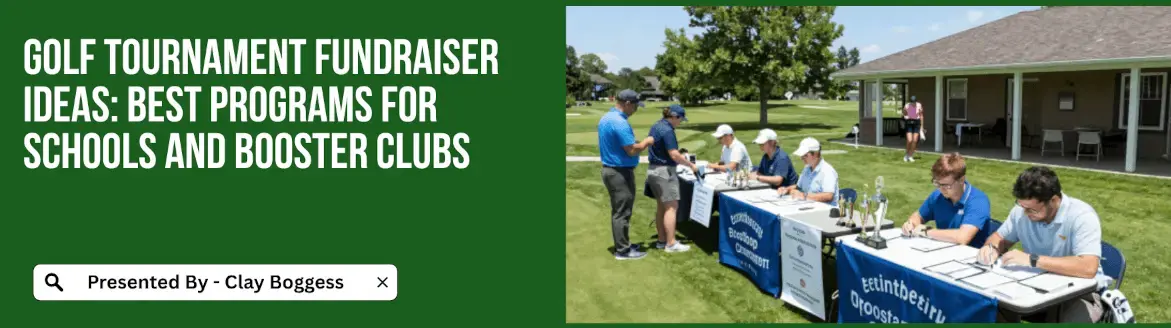
A golf tournament is not the easiest fundraiser to plan. It requires a course commitment, a volunteer committee, and an outreach effort that begins 90 days before the event. But it has a revenue ceiling that most other school fundraisers cannot approach, and it serves a specific function that product sales and coin drives cannot replicate: it gives local business sponsors a meaningful, visible way to support the school in a social setting that generates goodwill for both parties.
Big Fundraising Ideas has supported school fundraising programs for booster clubs and PTAs since 1999. This guide covers how to structure a golf tournament fundraiser from venue to revenue, which formats and contest types generate the most net profit, what merchandise to sell on course, and how to build a multi-revenue-stream event that outperforms a registration-only tournament.
How a Golf Tournament Fundraiser Works
The structure works because each revenue stream targets a different group. Registration revenue comes from golfers. Sponsorship revenue comes from businesses. On-course contest revenue comes from golfers who are already there and in a spending mindset. Dinner and auction revenue come from the entire attendee group at the moment when the event's social energy is highest. None of these streams competes with the others, which is why layering them produces compound results.
- Registration fees: $80 to $150 per player, collected from golfers as the baseline revenue stream
- Tiered sponsorships: hole sponsors at $250-$500, cart and beverage sponsors at $500-$1,000, title sponsor at $3,000-$5,000
- On-course contests: mulligan packages ($20 for three), closest-to-the-pin entry fee, putting contest at the practice green
- 19th hole dinner and auction: silent auction on donated items, raffle drawing, contest prize awards, sponsor recognition
- Merchandise sales: custom-branded items sold at registration or on course -- tumblers, discount cards
Best Golf Tournament Revenue Streams
Golf Tournament Revenue Streams: Structure and Typical Range
Golf Tournament Formats That Work Best
Stroke play and best ball formats reward individual skill and are standard in competitive tournaments. They are generally the wrong choice for a school fundraiser because they create uneven experiences: strong golfers finish quickly. In contrast, casual golfers fall behind, the pace of play degrades, and the social energy that makes the 19th hole dinner valuable suffers. The scramble keeps every foursome competitive and together from the first tee to the 18th green.
Format Options and When to Use Them
- Scramble (recommended): all four players tee off, the group plays from the best ball -- fastest pace, most social, best fit for mixed-skill groups and charity events
- Best ball: each player plays their own ball, the lowest score per hole counts for the team -- more competitive, better for experienced golfer groups
- 9-hole scramble: ideal for small booster clubs -- half the course time, same sponsorship and dinner structure, lower planning overhead
- Shotgun start: all foursomes start simultaneously at different holes -- every group finishes at approximately the same time, maximizing dinner attendance and auction participation
Sponsorship Packages That Fill Quickly
Standard Tiered Sponsorship Structure
What to Sell on Course and at Registration
The tumbler fundraiser through Big Fundraising Ideas produces a personalized 20-oz tumbler with the school name, mascot, and colors. At golf tournaments, branded tumblers serve a dual purpose: they are a practical product golfers will use on course and a keepsake that carries the event's branding into the community long after the tournament ends. At up to 45 percent profit on a $25 to $30 sell price with free shipping, a table of 50 tumblers sold at registration generates $1,250 to $1,500 gross and $562 to $675 net.
The discount card fundraiser, with up to 75 percent profit on a $20 sell price, converts particularly well at golf events because adult golfers and their families are the core buyer demographic for local savings offers. Selling discount cards at the registration table alongside tumblers adds a low-barrier second product that captures buyers who do not want merchandise but will spend $20 for a year of local business savings.
Product Sales at Golf Tournament: Verified Data
All profit figures verified from bigfundraisingideas.com product pages—free shipping on all products.
Adding a Scratch Card Campaign Alongside the Tournament
The scratch card fundraiser through Big Fundraising Ideas is personalized with the school's name, photo, and colors. Each supporter scratches a dot, revealing a donation amount between $1 and $5, and contributes that amount—no prize required, no permit required, no product delivery. Running 50 cards during the tournament window generates $5,000 gross and $4,250 net from the community network—revenue that does not cannibalize a single golfer registration or business sponsorship.
How to Plan a Golf Tournament Fundraiser: Step by Step
- Secure the course 90-120 days out: contact local courses for a charity rate on a weekday or slower weekend slot. Confirm cart fees, clubhouse access for the dinner, and policy on outside merchandise sales. A shotgun start requires the course to block the entire facility for your window.
- Build the volunteer committee: assign 8 to 12 volunteers to cover sponsor outreach, registration, on-course logistics, the auction or raffle, and the dinner. One person cannot run a golf tournament. Divided responsibility with clear ownership is the difference between a smooth event and a chaotic one.
- Launch sponsor outreach at 90 days: send tiered packages to local businesses. Prioritize businesses that already support the school. A phone call followed by an email converts better than a cold email alone. Hole sponsorships fill first and generate the most revenue per contact hour.
- Open golfer registration at 60-75 days: price foursomes at $80-$150 per player. Include a mulligan add-on at checkout. Publish the format, start time, and dinner details. Registration closes faster when the dinner is listed as included.
- Plan on-course merchandise and contests: order tumblers 30 days out with the school name and colors. Set up a closest-to-the-pin contest with a donated prize. Plan a putting contest or skills challenge at the practice green for early arrivals. Sell discount cards and mulligans at the registration check-in table.
- Run the 19th hole dinner as the revenue anchor: a focused silent auction of 15 to 25 donated items, a raffle drawing, sponsor recognition, and contest prize awards. Keep the program tight -- 90 minutes is ideal. A relaxed, well-paced dinner with visible sponsor appreciation generates more goodwill and more bids than a rushed event.
Frequently Asked Questions About Golf Tournament Fundraisers
How do you run a golf tournament fundraiser?
Secure the course 90 to 120 days out, recruit a volunteer committee, launch sponsor outreach at tiered levels, open golfer registration with a mulligan add-on, plan on-course contests and merchandise, and run a 19th hole dinner with a silent auction. Layering all four revenue streams consistently outperforms registration-only tournaments by two to three times.
How much can a school raise with a golf tournament?
A tournament with 72 golfers at $100 per player generates $7,200 in registration fees. Full hole sponsorships add $4,500 to $9,000. Mulligans, a silent auction, and merchandise add $3,000 to $8,000 more. Well—run tournaments with strong sponsorship typically net $12,000 to $25,000. Experienced booster clubs with established business relationships reach the upper range.
What are the best revenue streams for a golf tournament?
Tiered hole sponsorships (highest revenue per contact hour), mulligan packages ($20 for three per player at checkout), a 19th hole silent auction on donated items, and branded merchandise at registration. Custom tumblers at up to 45 percent profit and discount cards at up to 75 percent profit -- both verified from bigfundraisingideas.com -- are the strongest merchandise options.
What is a golf tournament hole sponsor?
A business that pays $250 to $500 to have its name and signage displayed at a specific hole for the tournament day. All 18 holes sponsored at $250 to $500 each generate $4,500 to $9,000 -- often exceeding golfer registration revenue. There is no capacity ceiling on sponsorships, making it the most scalable revenue stream in the tournament.
What format works best for a school golf tournament?
The scramble. Each player tees off, the group plays from the best ball, and everyone plays from that position until the hole is complete. Faster pace, more accessible to casual golfers, consistent group play, and everyone finishes in time for dinner. Shotgun start recommended so all foursomes finish simultaneously.
How far in advance should you plan a golf tournament?
90 to 120 days. Golf courses book popular dates months ahead. Sponsor outreach needs time for internal business budget approvals. Registration fills more reliably with a longer window. Events planned 30 days out consistently underperform on sponsorships and registration.
What do you need to run a golf tournament fundraiser?
Golf course contract, 8 to 12 person volunteer committee, sponsor outreach list, registration platform, hole sponsor signage, on-course contest supplies, 19th hole dinner reservation, silent auction or raffle items, and branded merchandise for registered players. Most courses provide carts and scoring support.
What prizes work best for golf tournament contests?
Closest-to-the-pin: weekend getaway packages, large gift card bundles, electronics, sports equipment. Mulligan and putting contests: restaurant gift cards, merchandise. All donated prizes from local businesses eliminate prize cost and maximize net revenue.
Can small booster clubs run a golf tournament?
Yes. A 9-hole scramble with 48 golfers at $75 per player, plus 9-hole sponsors at $250 each, generates $5,850 gross with significantly lower planning overhead. Running a scratch card campaign alongside the event through family and community networks adds product revenue with zero additional event logistics.
What fundraising products work best at golf tournaments?
Custom tumblers at up to 45 percent profit ($30 sell price) and discount cards at up to 75 percent profit ($20) -- both verified from bigfundraisingideas.com -- are the strongest on-course merchandise options. Scratch cards at 85 percent profit (25-99 cards) are distributed across the school community alongside the tournament, adding a third revenue stream targeting an entirely different buyer group.
Author Bio
Clay Boggess has been designing fundraising programs for schools and various nonprofit organizations throughout the US since 1999. He’s helped administrators, teachers, and outside support entities such as PTAs and PTOs raise millions of dollars. Clay is an owner and partner at Big Fundraising Ideas.

Related Articles

How Does a School Get Paid…
How does a school get paid after a fundraiser? See how direct-sale, brochure, and online fundraisers settle invoices or send profit payments.

How Much Can a School Make…
Learn how much a school can make from a popcorn fundraiser using the profit table, worked examples by group size, and what affects your total.

Cupcake Decorating Fundraiser…
How to run a cupcake-decorating contest fundraiser: entry fees, fair judging, allergen labeling, and three ways to raise money at one event.