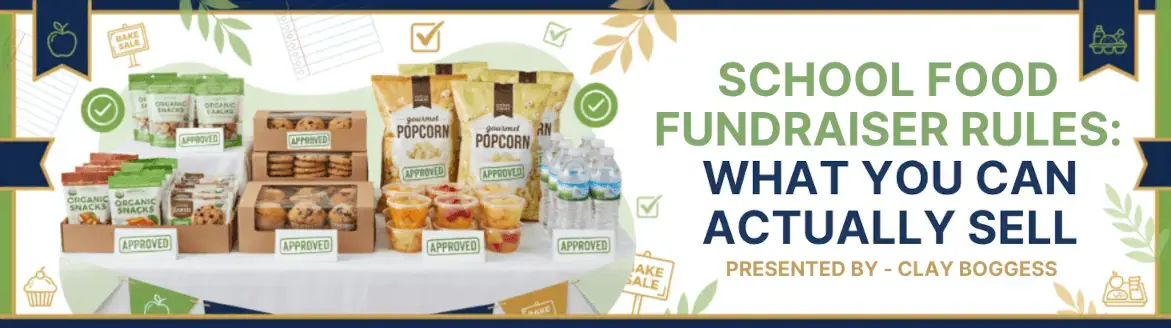
Federal Smart Snacks rules apply when all three of the following are true at the same time: the food is sold to students, on the school campus, and during the school day. Break any one and the standards do not apply.
That is the whole test. Everything that follows depends on precisely defining those three terms, because the regulatory definitions are not what most people assume.
Big Fundraising Ideas has supported school fundraising programs since 1999. This guide covers what the rules actually say, what they do not cover, how exempt fundraiser days work in your state, and what to check before signing a fundraiser contract.
What the Rule Actually Is
- School Day: Federal regulation defines this as "the period from the midnight before, to 30 minutes after the end of the official school day." Thirty minutes. If your school dismisses at 3:10, the school day ends at 3:40 for these purposes.
- School Campus: "All areas of the property under the jurisdiction of the school that are accessible to students during the school day." The operative phrase is "accessible to students," which is why the rules cover the cafeteria, hallways, and school store, and stop at the property line.
- Competitive Food: All food and beverages other than reimbursed meals, sold to students on campus during the school day.
A note on sources: USDA's Food and Nutrition Service was reorganized into the Food and Nutrition Administration in April 2026. Older links to fns.usda.gov now redirect to fna.usda.gov. Historical guidance memos retain their original document numbers.
What the Rule Does Not Cover
- Take-home and Order-taker Fundraisers: Cookie dough fundraisers, frozen food fundraisers, and brochure fundraisers generally are outside the standards.
- Anything Sold More than 30 Minutes After Dismissal: Evening concerts, Friday night football, weekend tournaments, fall festivals, back-to-school night.
- Off-campus Sales: A car wash at a hardware store lot, a restaurant dine-out night, a booth at the county fair.
- Sales to Adults: The standards govern the sale of food to students. A staff appreciation breakfast or a parent coffee cart is a different question.
- Non-food Fundraisers: wrapping paper, candles, discount cards, scratch cards, spirit wear.
Federal law is the floor, not the ceiling. Your state can be stricter, and so can your district's local school wellness policy. Both have authority to restrict take-home fundraisers even where USDA does not. The honest version of the answer is therefore: federal rules almost certainly permit your brochure fundraiser, so now check your district's wellness policy, because that is the document that can still say no. It is a public record, so ask your principal or your district's child nutrition director.
The Exempt Fundraiser Rule
- The range between states is enormous: some permit none at all; others permit up to thirty a year.
- Texas: 6 days per campus per year
- Indiana: 2 per building per year
- New York: 0
- California: 0 (state regulation permits no exemptions)
- One limit applies everywhere: Even in a state granting exemptions, exempt fundraiser food may not be sold in the food service area during meal service. No candy table beside the lunch line.
- Compliant and non-food fundraisers are unlimited; the cap applies only to non-compliant food fundraisers.
Do not rely on a state-by-state chart found online. The most complete public dataset is from 2018, and several states have changed since. Check your own state agency directly and search for your state department of education plus "Smart Snacks fundraiser exemption."
What Makes a Snack Compliant
The general standard requires the item to be one of the following: a grain product that is at least 50 percent whole grains by weight or has whole grain as the first ingredient; or an item with a fruit, vegetable, dairy product, or protein food as the first ingredient; or a combination food containing at least one quarter cup of fruit and/or vegetable.
The sodium limit for snacks has been 200 mg since July 2016. Several pages still in circulation cite 230 mg, which was the earlier figure. Beverage standards are tiered by grade level and have their own rules, so check the current regulation directly rather than a summary, since published figures conflict.
Which Fundraiser Types Are Affected
All products through bigfundraisingideas.com. No upfront cost. Free shipping.
Bake Sales Answer to Two Rulebooks
- Check Both Rulebooks: Federal Smart Snacks and your state's cottage food law operate independently.
- Labeling Requirements Vary: Some states require homemade goods to bear a statement that they are not subject to state inspection, along with full ingredient lists and a list of major allergens.
- Commercially Produced Product Avoids both Problems: It arrives with an FDA-compliant ingredient statement, an allergen declaration, a nutrition panel, a lot code, and a manufacturer, all of which are made in an inspected facility.
- The Practical Difference: When a principal asks whether a product is compliant, you hand over a spec sheet instead of a shrug. Our page on how beef jerky fundraisers meet school nutritional guidelines shows what that documentation looks like.
Allergens and Labeling
This is not an argument that bake sales are bad. It is a reason to know which kind of event you are running and to be straightforward with families about it. Schools running food programs for students with allergies should be able to provide documentation on request, which depends on who made the product rather than what it is.
Before You Sign a Fundraiser Contract
- Where will product change hands? On campus during the day, or delivered home
- When is the sale? Inside the school day as defined, or after
- Who is buying? Students, or adults
- If on campus and during the day, does the product meet Smart Snacks standards? Run it through the Product Calculator.
- If it does not: how many exempt fundraiser days does your state allow, and how many has your school already used this year?
- What does your district's wellness policy say? It can be stricter than federal rules.
- Can the company provide nutrition and allergen documentation? If not, that is your answer. See our guide to questions to ask a school fundraising company.
Frequently Asked Questions About School Food Fundraiser Rules
Can schools sell candy for fundraisers?
It depends on where and when. Candy sold to students on campus during the school day must either meet Smart Snacks standards or use one of your state's exempt fundraiser days, and some states allow zero. Candy sold at an evening event, off campus, or through a take-home order-taker fundraiser falls entirely outside federal standards. Check your state's exemption count and your district's wellness policy before planning an on-campus sale.
Do Smart Snacks rules apply to cookie dough fundraisers?
Generally no. USDA states directly that items preordered and distributed in a precooked state or in bulk for home consumption are not required to meet the standards, specifically naming frozen pizza and cookie dough. Students may take orders at school, and product may be delivered during the school day. Your district's local wellness policy can still restrict these fundraisers, so confirm that separately. See cookie dough fundraisers.
What counts as the school day for Smart Snacks?
Federal regulation defines it as the period from the midnight before through 30 minutes after the end of the official school day. That is a narrow window. A concession stand at an evening game, a weekend tournament, or a fall festival all fall outside it. If your school dismisses at 3:10, the school day ends at 3:40 for these purposes.
How many exempt fundraisers can a school have per year?
It varies entirely by state, and the default is zero. Federal regulation lets each state agency set the number of infrequent fundraisers permitted to sell food that does not meet the standards. Texas allows 6 days per campus per year, Indiana allows 2 per building, and New York and California allow none. Check your own state department of education rather than relying on a chart, since several states have changed their policies.
Do bake sales have to meet Smart Snacks standards?
A bake sale held on campus during the school day does. One held at an evening event does not. Either way, your state's cottage food law also applies and is sometimes stricter. Some states bar home-kitchen food sales at schools entirely, while others exempt occasional charitable bake sales but require specific labeling and signage. Check both rulebooks.
Do the rules apply to food sold to parents and teachers?
The standards govern competitive foods sold to students. A staff appreciation breakfast or a parent coffee cart is a different situation. That said, if students have access to the same table during the school day, you are back inside the rule. Keep adult-only sales genuinely adult-only in both time and place.
How do I know if a product is Smart Snacks compliant?
Use the Smart Snacks Product Calculator, operated by the Alliance for a Healthier Generation. It is free, and the USDA has determined its results to be accurate for assessing compliance with federal requirements. Enter the product's nutrition information, and it returns a yes or no. Any reputable fundraising company should also provide nutrition and allergen documentation on request.
What can we sell on campus during the school day without a compliance problem?
Non-food programs remove the question entirely. Discount cards at $20 each, scratch cards which are donation-based and collect approximately $100 per completed card, and Smencils at $1 to $2 are all outside the standards because none of them is food. Smencils in particular give students a product they can sell during school hours.
Which fundraisers are affected by school nutrition rules?
On-campus daytime sales are affected: the school store, vending accessible to students, a lunchtime candy sale, and a daytime bake sale. Not affected: brochure and catalog order-takers delivered home, frozen food delivered home, anything sold at an evening event or off campus, sales to adults, and all non-food programs. See our food fundraisers range for programs in each category.
Who enforces school food fundraiser rules?
State agencies administer the standards and monitor compliance through the same review process used for school meal programs, with local education agencies responsible on a day-to-day basis. Practically, the person who will raise it with your PTA is your principal or your district's child nutrition director. Bringing documentation to that conversation resolves it quickly. See also our guide to fundraising regulations for school stakeholders.
Author Bio
Clay Boggess has been designing fundraising programs for schools and various nonprofit organizations throughout the US since 1999. He’s helped administrators, teachers, and outside support entities such as PTAs and PTOs raise millions of dollars. Clay is an owner and partner at Big Fundraising Ideas.

Categories
Related Articles

Cupcake Decorating Fundraiser…
How to run a cupcake-decorating contest fundraiser: entry fees, fair judging, allergen labeling, and three ways to raise money at one event.
Holiday Beef Stick Fundraiser…
How to run a holiday beef stick fundraiser: cover ordering and delivery timing, the 15-day invoice rule, and tips to avoid leftovers.
How Much Can a School Make…
Learn how much you can make from an Otis Spunkmeyer fundraiser; see the profit formula, a worked example, and what affects your total.