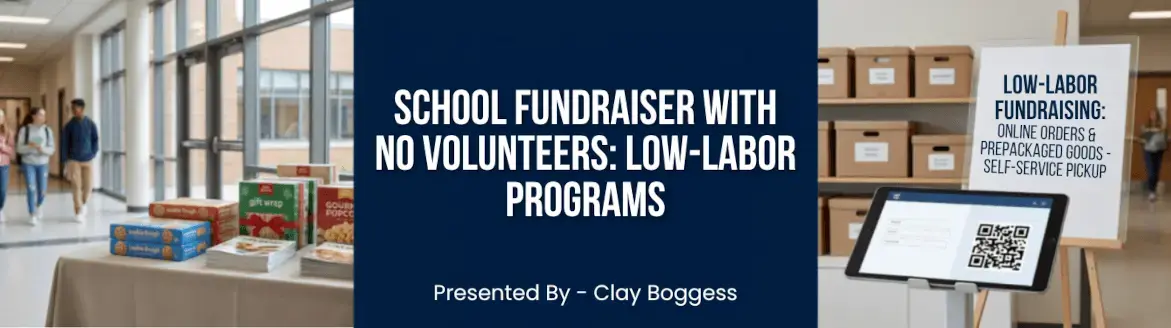
This matters more than it appears, because the failure mode is not usually a campaign that never happens. It is a campaign that happens badly. A brochure program run without enough hands results in a delivery day when product sits unsorted, families wait, and orders go home wrong. Revenue may still arrive, but the experience damages participation the following year. Running a smaller-labor format well beats running a larger-labor format badly, in both revenue and goodwill.
Big Fundraising Ideas has supported school fundraising programs since 1999, including many run by a single coordinator. This guide covers where the work actually lands in a campaign, which formats require the fewest hands, and how to choose one that fits the help you have available.
Where the Work Actually Is
- Setup and kickoff: light for every format. One person can distribute materials and run a kickoff.
- During the selling window: light for every format. Announcements and reminders are coordinator tasks, not crew tasks.
- Close and reconciliation: moderate to heavy depending on whether money and order forms have to be tallied against individual sellers
- Delivery day sorting: the single heaviest stage in any campaign that involves physical product arriving at the school
- Distribution to families: heavy, and time-bound. Families arrive within a narrow window, and the operation has to be ready.
Fundraiser Formats Ranked by Hands Required
The formats that require the fewest volunteers are those in which the product never passes through the school. Donation-based programs and direct-ship online stores remove delivery day and distribution entirely, which eliminates the two heaviest stages of a campaign. Physical product programs sit at the other end because every order has to be received, sorted, and handed to the right family.
All programs available through bigfundraisingideas.com. No upfront cost. Free shipping.
The Lowest-Labor Options
Scratch cards
The lowest-labor format available. Scratch card fundraisers are donation-based, so there is no product to receive, sort, or distribute. Each student takes a card personalized with the school name, collects donations from their community network, and returns the completed card. Each completed card collects $100 gross. The coordinator's entire job is to distribute, collect, and submit cards. There is no delivery day. The minimum order is 10 cards, so it works for schools of any size.
Online store
An online store program completely removes the school from the fulfillment chain. Students share a personal link, supporters order from any device, and the product ships directly to their homes. Nothing arrives at the school. For a coordinator with no help at all, this is the only format with genuinely zero physical logistics, and it also reaches out-of-area families that a brochure never could.
Discount cards
Discount cards arrive as a single compact shipment rather than hundreds of individual orders. There is no sorting by seller and no per-family distribution, because each card is identical. Cards sell for $20 and are handed out in packs at the start of the campaign. The main coordinator's task is to track cards issued against money returned.
If You Must Run a Brochure Campaign
- Ask whether orders arrive prepacked by seller: this is the single biggest variable in delivery-day labor. Prepacked orders turn distribution into a handoff. Bulk-by-item orders require assembling each order individually first, which multiplies the work.
- Ask about direct-to-home shipping: some programs can ship to the seller's home rather than to the school, which removes delivery day entirely. Confirm availability before selecting the program.
- Add the online store alongside the brochure: online orders ship directly to buyers and add revenue without adding any distribution work.
- Recruit for delivery day only: a request for help on one specific afternoon converts far better than a request to join the fundraising committee. Name the date, the hours, and the number of people needed.
- Stagger family pickup by grade: assigning grade-level pickup windows spreads arrivals across the afternoon so two people can manage what would otherwise require six
For the full delivery-day picture, see school fundraiser delivery. For recruiting help when it is worth trying, see recruiting school fundraiser volunteers.
Use Students and Staff Instead of Parent Volunteers
- Older students for sorting: middle school student council members are capable of sorting boxes by classroom under supervision, and it counts as service hours
- Teachers for classroom distribution: handing prepacked orders to students in homeroom removes the family pickup operation for non-frozen product entirely
- Front office for collection: a labeled bin in the office collects returned forms and money without requiring a person to staff it
- The principal for announcements: daily standings in morning announcements cost the coordinator nothing and are the highest-value ongoing task in a campaign
Frequently Asked Questions
What is the easiest school fundraiser to run with no volunteers?
Scratch cards and online store programs. Scratch cards are donation-based with no product to distribute. Online stores ship directly to supporters' homes, so nothing arrives at the school. Both can be managed by a single coordinator with no delivery day at all.
Can one person run a school fundraiser alone?
Yes, if the format is chosen accordingly. One coordinator can run a scratch card campaign or an online store. A brochure campaign generally cannot be, because delivery day requires several people over a few hours.
Why do brochure fundraisers need more volunteers?
Because a physical product arrives at the school and every order has to be received, sorted, and handed to the correct family within a narrow window. That is the heaviest stage of any campaign. See school fundraiser delivery for how delivery logistics work.
How many volunteers does a fundraiser delivery day need?
It depends primarily on whether orders arrive pre-packed by seller or in bulk by item. Prepacked orders need enough hands to sort by classroom and staff a pickup table. Bulk orders require assembling every individual order first, which is substantially more work. Ask how orders are packed before committing to a program.
Is it worth running a smaller fundraiser if we have no help?
Usually yes. A lower-labor program executed cleanly outperforms a higher-revenue program executed badly, because a poor delivery experience costs participation in the following year's campaign. The projected revenue on a brochure program assumes it is run properly.
Can we avoid a delivery day entirely?
Yes. Scratch cards involve no product distribution at all. Online stores ship directly to buyers. Some brochure programs also offer direct-to-home shipping, which removes the school from fulfillment—ask your fundraising company whether it is available for the program you are considering.
How do we get help for just one day?
Ask for the specific day rather than for committee membership. Name the date, the hours, and the number of people needed. A request to help sort boxes on a Thursday afternoon converts far better than an open-ended request to join the fundraising committee, because the commitment is bounded and visible.
Can students help run the fundraiser?
Yes. Older students and student council members can sort boxes by classroom under supervision, and for many it counts toward service hours. Teachers can distribute pre-packed orders during homeroom, eliminating the family pickup process for non-frozen products.
What is the lowest-effort way to add revenue without more work?
Run an online store alongside the main campaign. Online orders ship directly to supporters, so they add revenue and reach out-of-area families without adding any distribution work at the school.
Do discount cards need volunteers?
Discount cards need very few volunteers. Cards arrive in a single compact shipment rather than as hundreds of individual orders, and because every card is identical, there is no sorting by seller. The coordinator distributes packs and tracks cards issued against money returned.
Author Bio
Clay Boggess has been designing fundraising programs for schools and various nonprofit organizations throughout the US since 1999. He’s helped administrators, teachers, and outside support entities such as PTAs and PTOs raise millions of dollars. Clay is an owner and partner at Big Fundraising Ideas.

Related Articles

How Much Can a School Make…
Learn how much you can make from an Otis Spunkmeyer fundraiser; see the profit formula, a worked example, and what affects your total.

Mother's Day and Father…
Mother's Day and Father's Day fundraiser ideas for schools: what to sell, how to price gifts kids can afford, and when to start.

Hot Chocolate Bar Fundraiser…
How to run a hot chocolate bar fundraiser: what to buy, how to price cups, how to keep kids safe around hot drinks, and where it works best.