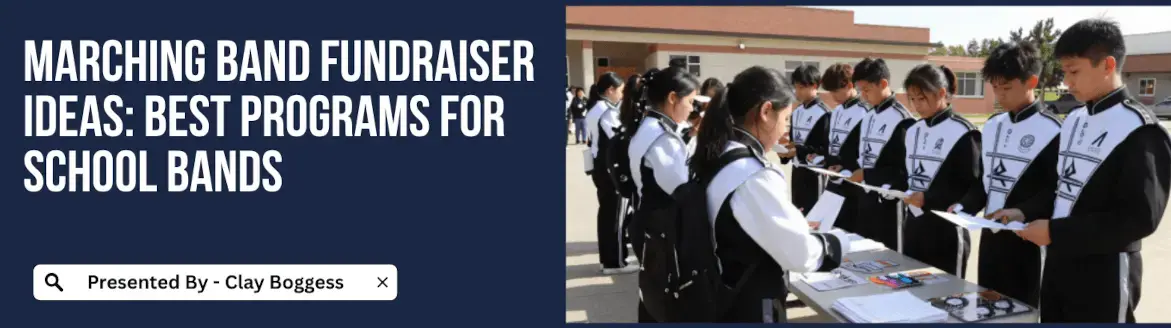
Marching band is one of the most expensive extracurricular programs in American schools. Uniforms, instruments, transportation, competition fees, clinicians, props, and music licensing add up to thousands of dollars per season. These are costs that school athletic budgets rarely cover in full, and that fall squarely on the band program and its booster organization to offset through fundraising. The good news is that the marching band community is also one of the most organized and motivated fundraising audiences in school activities.
Big Fundraising Ideas has supported school fundraising programs since 1999. Every profit figure in this guide is verified from the live product pages at bigfundraisingideas.com before publication. No margin is estimated or approximated.
What Marching Band Programs Need Fundraising For
- Uniforms: At $250 to $650 per member for a new uniform set, this is the single largest capital expense for most marching programs.
- Competition fees: Regional and state competition entry fees ranging from $300 to $2,500 per event, plus adjudicator and facility charges
- Travel and transportation: Bus rental, hotel rooms, and meal costs for overnight competition trips -- often $100 to $300 per member per trip
- Instrument maintenance: Repair, cleaning, and replacement of school-owned instruments -- woodwinds, brass, and percussion collectively require annual maintenance budgets
- Equipment and props: Color guard flags and rifles, drum major accessories, field equipment, and the custom props that define a competitive show
- Music and clinicians: Licensing costs for arrangements, clinician fees for sectional coaching, and choreography expenses for competitive shows
Scratch Card Fundraiser
The scratch card fundraiser is personalized with the band's photo, school name, logo, and color scheme. Each supporter scratches a dot to reveal a donation amount and receives a coupon sheet of savings at popular retailers as a token of appreciation. Band members approach family members, neighbors, and community supporters. These are the same audience they would sell a product to, but with a faster transaction and no inventory to manage.
Scratch Card Revenue by Band Size
One card per member. $100 gross per completed card. Verified from bigfundraisingideas.com/scratch-card-fundraiser. Min 10 cards. Free shipping.
Smencils Fundraiser
The Smencils fundraiser comes in multiple themed varieties, including Original, Valentine's, Holiday, Halloween, Spring, Soda Pop Shop, and Fruit Zoo. Band programs can select the variety that best matches the time of year (Valentine's Smencils in February, Holiday Smencils in November and December, or Original Smencils year-round). You can order a minimum of 1 case with free shipping and 1-2 business days of processing.
- Verified profit: Up to 50 percent (from bigfundraisingideas.com/smencils-fundraising)
- Sell price: $1 per Smencil, depending on the variety
- Product: Scented No. 2 pencils made from 100 percent recycled newspaper, non-toxic, hypoallergenic, 2-year scent guarantee
- In-school sales: Non-food product with no Smart Snacks restriction (can be sold to students during school hours)
- Minimum: 1 case (accessible to any band size)
Candy Bar Fundraiser
The candy bar fundraiser works best for marching bands when sold at performances, games, pep rallies, and after-school events where a captive audience is already engaged with the band. The $1 to $2 price point eliminates the consideration that a higher-priced product has, and buyers generally say yes instantly. For a band that needs fast cash before a competition payment deadline, a two-week candy bar campaign generates reliable revenue quickly.
Note on Smart Snacks: Candy bars generally cannot be sold to students on campus during the school day under USDA standards. Sell before school, after school, at performances, at competitions, or through a brochure for compliant in-school selling. Check your district policy before any on-campus sale.
Yummy Lix Lollipops
The lollipop fundraiser through Big Fundraising Ideas features Yummy Lix lollipops in multiple flavors. At $1 per unit and up to 53 percent profit, a band member who sells 100 lollipops generates $53 in net profit. For competitions and game-night events where band members have access to crowds of engaged community supporters, lollipops provide a fast, high-volume selling option alongside the scratch card campaign running through the community at the same time.
Discount Card Fundraiser
The discount card fundraiser is personalized with the band or school name and features local business savings valid for one year. Parents who take discount cards to their workplaces reach a concentrated pool of adult buyers that student-only selling never reaches. A parent who sells 10 cards at $20 each, at 75 percent profit, generates $150 in net income during a single workplace lunch break.
Program Comparison: Choosing the Right Format
All figures verified from live product pages at bigfundraisingideas.com. Free shipping on all orders.
How to Run a Marching Band Fundraiser: Step by Step
- Set a specific goal: Name the expense (new uniforms, competition travel, instrument repair). Specific goals motivate sellers and make the ask more compelling for donors.
- Choose your format: Scratch cards for maximum margin and no logistics; Smencils for in-school selling without food restrictions; candy bars for fast cash at events; discount cards for booster adult networks.
- Launch at practice: Distribute materials at a scheduled rehearsal. Brief in under 10 minutes (goal, close date, what the money funds). Immediate selling captures the best buyers before competing programs do.
- Sell at band events: Performances, competitions, and pep rallies create captive audiences of motivated supporters. Set up a table at the entrance with direct-sale products and discount cards.
- Activate booster networks: Ask parents to take materials to work. A parent who sells 10 discount cards at $20 each, at 75 percent profit, generates $150 in net profit in one lunch break.
- Close firmly and recognize: Set a firm close date and announce final standings at the last rehearsal before close. Recognize top sellers. A firm deadline drives 20 to 30 percent of total revenue in the final 48 hours.
Frequently Asked Questions About Marching Band Fundraisers
What are the best marching band fundraiser ideas?
Scratch cards at 90% profit (100+ cards at $10/card, $90 net), Smencils at up to 50%, candy bars at up to 55%, lollipops at up to 53%, and discount cards at up to 75%. All verified from bigfundraisingideas.com.
How much can a marching band raise with scratch cards?
60 members x 1 card each at $15/card = $900 cost, $6,000 gross, $5,100 net at 85% profit. Verified from bigfundraisingideas.com/scratch-card-fundraiser. Min 10 cards.
Why are Smencils a good fundraiser for marching bands?
Smencils at up to 50% profit are non-food (no Smart Snacks compliance concerns during school hours). Teachers support the product because students use it during class. Available in themed varieties for every season. Verified from bigfundraisingideas.com/smencils-fundraising.
Can marching bands sell candy bars during school hours?
Candy bars generally cannot be sold to students on campus during the school day under USDA Smart Snacks standards. Sell before and after school, at performances, at competitions, and through a brochure. Check your district policy. Smencils are the in-school-compliant alternative at the same verified profit margin.
What is the highest-profit fundraiser for a marching band?
Scratch cards at 90% profit ($10/card at the 100+ card tier, $100 gross, $90 net): no product, no order forms, no delivery. A band of 60, each with one card, generates $5,100 net in one week. Verified from bigfundraisingideas.com/scratch-card-fundraiser.
What fundraisers work at band competitions and performances?
Candy bars at up to 55% and lollipops at up to 53% are the fastest event transactions. Discount cards at up to 75% convert well with adult family supporters in a giving mindset. All verified from bigfundraisingideas.com.
How do discount cards work for band fundraising?
Discount cards at up to 75% profit, $10/card, personalized with band or school name. Features local business savings for one year. Band boosters and parents sell to adult community members. Parent workplace sales generate the highest per-seller average. Verified from bigfundraisingideas.com/discount-card-fundraiser.
When is the best time to run a marching band fundraiser?
Late summer before the marching season (August or September). Members are energized by the upcoming season, and the competition schedule has not yet crowded the calendar with travel and performance obligations. Pre-season campaigns run before buyer fatigue sets in.
Can a small marching band raise meaningful money?
Yes. A band of 30, each with one scratch card, generates $2,550 in net profit at 85%. At up to 50% on Smencils and candy bars, every seller who reaches 25 to 30 sales generates meaningful revenue regardless of roster size. High-margin formats make small bands competitive with larger ones.
What does a marching band use fundraising money for?
Uniforms ($250 to $650 per member), competition fees, travel and transportation, instrument maintenance, color guard equipment, props, clinician fees, and music licensing. Uniforms and competition travel are the two largest expenses for most competitive programs.
Author Bio
Clay Boggess has been designing fundraising programs for schools and various nonprofit organizations throughout the US since 1999. He’s helped administrators, teachers, and outside support entities such as PTAs and PTOs raise millions of dollars. Clay is an owner and partner at Big Fundraising Ideas.

Related Articles

Cupcake Decorating Fundraiser…
How to run a cupcake-decorating contest fundraiser: entry fees, fair judging, allergen labeling, and three ways to raise money at one event.
Holiday Beef Stick Fundraiser…
How to run a holiday beef stick fundraiser: cover ordering and delivery timing, the 15-day invoice rule, and tips to avoid leftovers.
How Much Can a School Make…
Learn how much you can make from an Otis Spunkmeyer fundraiser; see the profit formula, a worked example, and what affects your total.