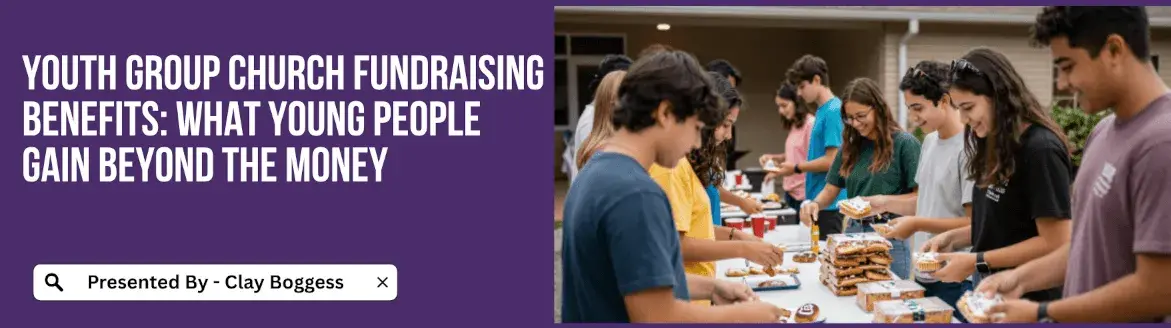
Youth groups -- whether church-based, community-organized, or connected to other faith communities -- consistently face the same funding challenge: program costs exceed what dues and institutional support provide. Mission trips, service projects, retreats, equipment, and community events all require money that the group must generate independently. Fundraising is the mechanism that closes this gap. But the fundraiser's value to the youth who participate in it extends well beyond the check that arrives at the end of the campaign.
Big Fundraising Ideas has supported youth group and church fundraising programs since 1999. This guide covers the five developmental benefits of youth group fundraising, how each benefit develops through direct participation, and the fundraising programs that deliver the highest margins for church youth groups of any size.
Benefit 1: Goal-Setting
Students who fundraise regularly develop a practical approach to goal-setting that carries over into academic, athletic, and professional contexts. A student who has successfully managed their individual fundraising target across three or four campaigns understands intuitively how to break a large objective into daily actions, track their progress, and push through the final week when momentum flags. This is not a skill that is taught in a single fundraiser. It compounds with each participation.
Benefit 2: Teamwork
Church youth groups that structure their fundraisers as shared-stake campaigns -- with the group goal publicly stated, individual targets assigned, and progress tracked collectively -- generate both stronger fundraising results and stronger team cohesion than groups that run campaigns as individual sales competitions with no interdependency among groups.
Benefit 3: Communication
The communication practice in fundraising has a specific structure: introduce the reason for the ask, present the product or format clearly, handle a no graciously, and complete the transaction confidently when the answer is yes. Youth who have practiced this structure across 15 to 30 individual buyer interactions over multiple fundraising campaigns have meaningfully more real-world communication experience than peers who have not. Church youth groups that brief participants on this structure before sending them out generate better results and more confident sellers.
Benefit 4: Perseverance
Church youth group fundraisers are particularly effective at teaching perseverance because the congregation provides a buyer network where most supporters are personally motivated to help the youth succeed. Even in this receptive environment, not every ask produces a yes. The rejections that do occur happen within a safe, familiar community, which makes them the ideal context for developing rejection resilience -- challenging enough to be real, supportive enough to be safe.
Benefit 5: Personal Responsibility
When a youth leader checks in at day five of a two-week campaign and asks each member how many items they have sold, every participant faces their individual accountability in a way that group activities rarely produce. Students who are behind learn to recommit and accelerate. Students who are ahead learn the satisfaction of leading by example. Both experiences compound into the personal responsibility habits that define adult effectiveness.
Best Fundraising Programs for Church Youth Groups
All profit figures verified from bigfundraisingideas.com product pages—no upfront cost on all programs. Free shipping. Minimum 10 scratch cards.
Using the Congregation as a Buyer Pool
Effective congregation outreach follows a simple sequence: announce the campaign from the pulpit or at the service with the specific goal and close date; distribute materials at the service entrance where congregation members are already gathered; follow up in the bulletin and the church newsletter; and have youth members approach congregation members they know personally after the service. The scratch card fundraiser is particularly effective in congregation settings because the donation-based format -- supporters scratch a dot and give whatever amount it reveals -- aligns naturally with the giving values already active in a church community.
Frequently Asked Questions About Youth Group Church Fundraising Benefits
What are the benefits of youth group church fundraising beyond raising money?
Goal-setting (specific financial target with individual accountability), teamwork (shared-stake group accountability), communication (approaching adults professionally with a specific ask), perseverance (handling rejection and continuing), and personal responsibility (owning an individual contribution to the group goal). These five skills compound across multiple campaigns.
How does church fundraising teach goal-setting?
Each participant receives an individual contribution target. The experience of setting a specific goal, tracking progress toward it, and pushing through the final days develops a practical relationship with goal-setting that no classroom exercise can replicate because the outcome is real, the timeline is fixed, and the stakes are visible to the whole group.
What do church youth group fundraisers teach teamwork?
Scratch cards and brochure programs with shared group goals teach teamwork through shared accountability -- every individual's contribution directly determines whether the group reaches the target. This mutual dependency creates genuine teamwork motivation that cooperative activities without real stakes cannot produce.
What are the best fundraising products for church youth groups?
Scratch cards (85%, $85 net/card), discount cards (up to 75%), Smencils (up to 55%), candy bars (up to 55%), lollipops (up to 53%). All verified bigfundraisingideas.com. No upfront cost.
What are good fundraising ideas for a church youth mission trip?
Scratch cards at 85% profit -- 20 youth x 1 card each = $1,700 net in one week. For larger mission trip budgets ($5,000-$15,000+), combine scratch cards, a brochure program, and a congregation direct-giving appeal across multiple campaign windows—no upfront cost on all BFI programs.
How does fundraising teach communication skills?
Youth practice approaching adults outside their immediate family with a specific ask, graciously handling a no, and confidently completing a transaction when the answer is yes. 20-30 real buyer interactions over the course of a fundraising campaign provide a more practical communication experience than any workshop or role-play exercise.
Can youth groups use the congregation as a buyer pool?
Yes -- the congregation is the most receptive buyer pool available. Announce during the church service, distribute materials at the service entrance, and follow up in the bulletin. Scratch cards align naturally with congregation giving values -- supporters donate whatever dot they scratch, no product purchase required.
How do fundraisers teach perseverance to youth?
Not every supporter says yes. A youth member who approaches 15 people and closes 8, handles 7 rejections within a safe, familiar community. The practice of accepting a no, adjusting approach, and trying again in this context builds the resilience that structured youth programs aim to develop.
How do fundraisers teach personal responsibility?
Each participant receives a specific individual target and is accountable to it—to themselves, their group, and their leader. Check-ins at day five of a two-week campaign make individual accountability visible and measurable. Students behind recommit. Students ahead lead by example. Both experiences build the personal responsibility habits that define adult effectiveness.
What is the best fundraiser for a small church youth group?
Scratch cards scale to any size. 10 youth x 1 card = $850 net at 85% profit. Min 10 cards, no upfront cost. Each participant has one clear task. Coordination requirements are minimal. Verified bigfundraisingideas.com/scratch-card-fundraiser.
Author Bio
Clay Boggess has been designing fundraising programs for schools and various nonprofit organizations throughout the US since 1999. He’s helped administrators, teachers, and outside support entities such as PTAs and PTOs raise millions of dollars. Clay is an owner and partner at Big Fundraising Ideas.

Categories
Related Articles
Is It Time to Switch…
Signs it may be time to switch fundraising companies, what changes when you do, and the questions to ask before committing to a new one.
Direct Donation Drive vs…
Direct donation drive vs. product fundraiser: which schools each format suits, why the ask reaches a different audience, and how to decide.

Grade-Level vs School-Wide:…
Grade-level vs school-wide fundraiser structures compared: coordinator workload, family fatigue, goal clarity, and how to decide which type works.