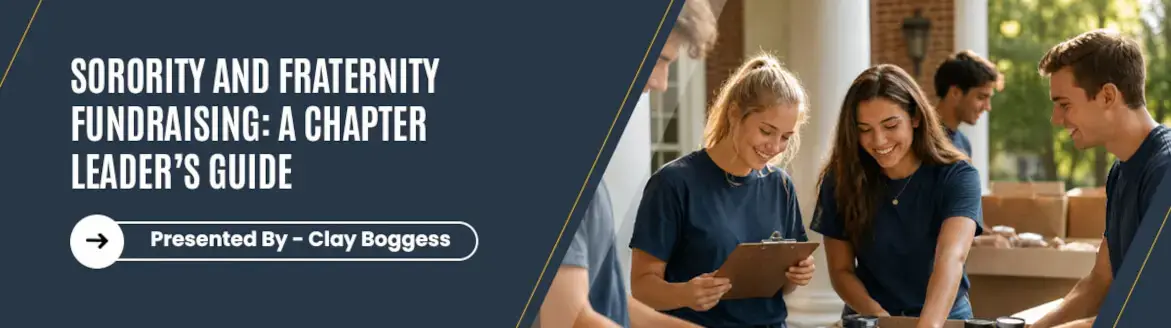
Chapter fundraising also carries an obligation that most student groups do not have. National organizations set philanthropic requirements, and the chapter is accountable for meeting them. That accountability is useful, because it gives the campaign a fixed target and a deadline rather than an open-ended aspiration.
Big Fundraising Ideas has supported college and organization fundraising programs since 1999. This guide covers why chapter fundraising matters beyond the requirement, who to target, which formats suit a Greek chapter, and how to build a campaign that a new executive board can repeat.
Why Chapter Fundraising Matters Beyond the Requirement
- It Fulfills Chapter Obligations: National leadership generally sets philanthropic requirements, and confirming the specifics during planning prevents a scramble at the deadline.
- It Develops Skills Members Will Use: Asking someone for money, explaining a cause clearly, and following through on a commitment are transferable skills that most academic coursework does not teach.
- It Builds the Alumni Relationship Early: Members who fundraised as students become alumni who give, because the habit and the connection were established before graduation.
- It Strengthens the Chapter Internally: A chapter that achieves something together builds a cohesion that social events alone do not produce.
Who to Target
The alumni group is the one chapter's most consistently underused. A chapter alumna who was in the same organization has a connection to the specific chapter, not a general charitable interest. That connection converts at rates a cold ask never approaches. Most chapters have an alumni list and never contact it outside of formal events.
Formats That Fit a Greek Chapter
Scratch Card Campaigns
The closest match to how a chapter is structured. Each member receives a card containing 50 dots. Supporters scratch a dot to reveal a donation amount and contribute it directly. Each completed card collects $100 gross. With no product to carry, store, or deliver, a chapter of sixty members can run a full campaign in about a week without a single meeting devoted to logistics. Learn more about scratch card fundraisers.
Discount Cards
Personalized cards sold at $20 each with local business savings valid for a year. These work particularly well for chapters because local businesses near campus are a natural fit for the coupon lineup, and members can sell to fellow students who genuinely use the discounts. See discount card fundraiser options.
Direct-sale Products at Events
Candy bars and lollipops at $1 to $2 convert quickly at tabling events, philanthropy weeks, and campus gatherings where members are already present. These are supplements to a main campaign rather than a campaign on their own.
Peer-to-peer Within the Chapter
Members run individual mini-campaigns within their own networks, with the chapter tracking totals collectively. This is less a product choice than a structure, and it layers on top of any of the formats above. Friendly competition between members or pledge classes reliably raises participation.
Running a Campaign That Actually Closes
- Confirm the Requirement First: Check what national leadership requires before planning anything, so the target and the deadline are fixed from the start.
- Set a Specific Chapter Goal and a Per-member Number: A chapter goal alone is abstract. A per-member figure shows each individual their share.
- Assign Ownership Beyond the Executive Board: A campaign carried entirely by two officers ends when those two get busy. Distribute specific tasks to interested members.
- Keep the Selling Window Short: The ideal window is about two weeks. Chapter attention does not last long, and a distant deadline leads to procrastination rather than more selling.
- Write Down What Happened: Focus on totals, what worked, what did not, and the contacts used. A one-page record handed to the next board is the difference between improving and restarting.
Frequently Asked Questions
What is the best fundraiser for a sorority or fraternity?
Formats where every member can participate through their own network simultaneously. Scratch card campaigns fit the chapter structure particularly well, generating $100 in gross per completed card with no product logistics. Discount cards at $20 work well near campus. Events add visibility but should not be the whole plan.
How much should a chapter aim to raise?
Start from whatever national leadership requires, then set a per-member number rather than only a chapter total. A chapter goal is abstract to an individual member; a per-member figure tells each person exactly what their share is and makes the total feel achievable.
Who should a Greek chapter ask for donations?
Four groups with different motivations: chapter alumni who want to pay it forward through their own experience, parents of members supporting their child's organization, fellow students seeking social connection, and local businesses seeking visibility among student customers. Alumni are the most underused of the four.
How do you get chapter members to participate in fundraising?
Give each member a specific number rather than a general request, keep the campaign short at about two weeks, and add friendly competition between members or pledge classes. Chapters that assign ownership only to the executive board see participation collapse as soon as those officers get busy.
Should a chapter run an event or a product fundraiser?
Both, with different roles. A product or donation campaign run through every member's network is the revenue engine, because it activates dozens of separate networks simultaneously. An event adds campus visibility and chapter culture. A plan that depends on a single event is capped by what one evening can produce.
How long should a chapter fundraising campaign run?
About two weeks. Chapter attention does not sustain beyond that, and a distant deadline leads to procrastination rather than additional selling. See how long a school fundraiser should run, along with the underlying reasoning, which applies to chapters as well.
How do chapters reach alumni for fundraising?
Through the chapter's own alumni list, alumni chapter events, and social media. The advantage is specificity: an alumna of the same chapter has a connection to that chapter rather than a general charitable interest, which converts far better than a cold ask. Most chapters maintain a list and never use it outside formal events.
What should a chapter do to make next year's campaign easier?
Write down what happened. Totals, what worked, what did not, and which contacts were used, in a one-page record handed to the incoming board. Annual leadership turnover is the structural weakness in chapter fundraising, and a written record is the only thing that stops each board from starting over.
Can a small chapter fundraise effectively?
Yes. Scratch cards scale to any size with a minimum of 10 cards, so a chapter of fifteen can run a real campaign. Small chapters also tend to have higher per-member participation, which partly offsets the smaller roster.
Do we need a separate campaign for each philanthropy partner?
Generally, no, and splitting effort across several causes usually weakens all of them. One clear cause with one clear number is easier for members to explain and easier for supporters to understand than a campaign supporting multiple partners at once.
Author Bio
Clay Boggess has been designing fundraising programs for schools and various nonprofit organizations throughout the US since 1999. He’s helped administrators, teachers, and outside support entities such as PTAs and PTOs raise millions of dollars. Clay is an owner and partner at Big Fundraising Ideas.

Related Articles
Is It Time to Switch…
Signs it may be time to switch fundraising companies, what changes when you do, and the questions to ask before committing to a new one.
Direct Donation Drive vs…
Direct donation drive vs. product fundraiser: which schools each format suits, why the ask reaches a different audience, and how to decide.

Grade-Level vs School-Wide:…
Grade-level vs school-wide fundraiser structures compared: coordinator workload, family fatigue, goal clarity, and how to decide which type works.