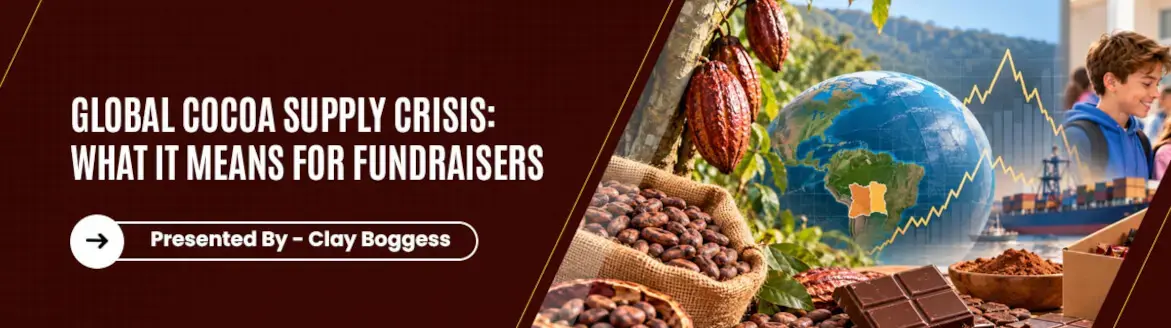
Cocoa is the key ingredient in chocolate, and over the last three years its price went from an ordinary commodity quote to a headline. The effects reached candy aisles and school fundraising tables. If you run a chocolate bar fundraiser, you may be wondering what happened, whether it is over, and what to do about it.
This guide explains the supply crisis in plain terms, with every figure dated and sourced, then shows what it means for your fundraiser. Big Fundraising Ideas has supported school fundraising programs since 1999.
What Is the Global Cocoa Supply Crisis?
Ivory Coast and Ghana together produce about 60% of the world's cocoa, according to a World Bank economist and other analysts. That concentration meant bad weather and disease in two countries could move the global market. Between July 2022 and February 2024, cocoa prices rose 136%, according to UNCTAD, the United Nations trade and development body. Cocoa then kept climbing, reaching a record near $12,900 per metric ton in December 2024.
Here is the timeline, with the source for each step:
Cocoa prices change daily, and trackers differ slightly, so these figures are approximate and dated. Check a current source before quoting them.
Why Did the Cocoa Supply Break?
UNCTAD, CNBC, and World Bank commentary, 2024. Farmer income, labor, and sustainability are separate topics not covered here.
Related point: Ghana and Ivory Coast governments set fixed farmgate prices at the start of each season, so farmers did not benefit directly from the market rally. In Ivory Coast, the guaranteed price rose from 1,000 CFA francs per kilogram in 2023/24 to 1,800 in 2024/25 and a record 2,800 in 2025/26, then fell sharply, according to Ecofin.
Where Supply Stands in Fall 2026
- A Surplus, for Now: The ICCO estimates a 2024/25 surplus of 37,000 tonnes. Production rose 8.5% while grindings, the amount of cocoa processed, fell 3.3%. End-of-season stocks reached 1.309 million tonnes, and the stocks-to-grinding ratio rose to 28.2%.
- Weaker Demand: The drop in grindings suggests chocolate makers processed less cocoa. Analysts link this to high prices, but the ICCO figures show only the fall.
- Data Gaps: The ICCO's latest bulletin temporarily withheld its 2025/26 production and grinding data, so last season's official balance is not yet available.
- Full Warehouses: Exchange stocks hit a 2.25-year high in September, according to Trading Economics, which is weighing on prices.
- A Worrying New Harvest: Ghana's state cocoa marketing company has warned its 2026/27 harvest could fall 18% to 38%. Ivory Coast's main crop began September 1 and runs to February 28, 2027, and Trading Economics noted dry conditions and a weaker outlook for the main harvest.
- A Big Price Cut for Farmers: Reuters reported that Ivory Coast set its farmgate price at 1,200 CFA francs per kilogram, about $2.12, 57% below last year's record. Some analysts worry that low farmgate prices leave growers less able to care for their trees.
The result is that analysts disagree. Some see a market easing after a shock, and others see risk in the new harvest. No one can say with certainty where prices go next, and this guide doesn't try to.
How Cocoa Costs Reach the Chocolate Bar
- Makers Buy Ahead: A Wells Fargo analyst told Axios in October 2025 that candy on shelves reflected cocoa bought earlier at record prices. That is why shelf prices lag the commodity.
- Candy Prices Rose: Candy and chewing gum prices rose 8.1% in August 2026 from a year earlier, according to Bureau of Labor Statistics data reported on October 11, compared with 3.4% for all consumer prices.
- Shoppers Compare Prices: In a National Retail Federation survey of 7,889 consumers in September 2026, more than a third said they would compare prices if Halloween merchandise cost more than expected.
- Bars can Change Size: Coverage in 2025 noted that shrinkflation, smaller portions at the same price, persisted even as cocoa supplies improved. Compare the weight of a bar, not just its price.
Common Myths, and What the Evidence Shows
What It Means for a School Chocolate Fundraiser
1. Choose the Price Point Deliberately
A higher-priced bar means fewer sales to reach your goal. On the live product pages, the $1 America's Variety bars earn $72 to $108 profit per case, and the $2 Gourmet bars earn $160 to $220 per case, with profit rising as you order more cases. See the full tables on the candy bar fundraiser page.
2. Size the Order From Sign-Ups
The candy bar products have a one-case minimum, free shipping, and no upfront cost, and unsold product is not accepted back. That makes order size the main risk. Because the minimum is one case, you can test a higher price point on a small order.
3. Consider the Product Mix
Chocolate is not the only choice. The $2 Funtastic Collection mixes candy bars and gummy bears, and the candy fundraisers page lists other candy options. Other formats include popcorn, Smencils, scratch cards, and online stores.
4. Mind the Calendar
The America's Variety page states that shipping may be held when temperatures reach 76 degrees to protect the chocolate, so plan warm-weather sales carefully. Cocoa news also moves quickly, so ask your vendor for current terms before you order and again before you reorder.
What to Watch Next
- ICCO Quarterly Bulletins: For the official supply and demand balance, including the 2025/26 data that is still withheld.
- Ivory Coast and Ghana Harvest News: Including port arrivals and Ghana's harvest forecast.
- Exchange Stocks and Futures: Full warehouses and falling prices tend to move together.
- Weather: El Niño risk and rainfall in West Africa.
- Retail Prices: The Bureau of Labor Statistics candy price index shows when lower cocoa reaches shelves.
Frequently Asked Questions About the Cocoa Supply Crisis
What is the global cocoa supply crisis?
It refers to the period beginning around 2023 when West African cocoa harvests fell short, prices rose sharply, and the world cocoa balance went into deficit. The International Cocoa Organization reports a 492,000-tonne deficit in 2023/24. Weather, plant disease, and aging trees drove the shortfall, and Ivory Coast and Ghana together produce about 60% of the world's cocoa.
Is the cocoa shortage over?
Partly. The ICCO estimates a 37,000-tonne surplus for 2024/25, and exchange stocks hit a 2.25-year high in September 2026. But Ghana's state cocoa marketing company has warned that its 2026/27 harvest could fall by 18% to 38%, and prices rebounded from about $2,850 in April to roughly $5,100 to $5,400 in early October. Analysts disagree about what comes next.
Why is chocolate still expensive if cocoa prices fell?
Cocoa fell sharply from its record near $12,900 per metric ton, but it has more than doubled from its April 2026 low, and shelf prices lag commodity prices because makers buy ingredients months ahead. Candy and chewing gum prices were up 8.1% in August 2026 from a year earlier, according to Bureau of Labor Statistics data.
What caused the cocoa shortage?
UNCTAD points to weather, including El Niño-driven drought and heavy rain, and plant diseases such as cacao swollen shoot virus and black pod. Analysts also cite aging trees, limited replanting since the early 2000s, and heavy reliance on two countries.
How do cocoa prices affect school fundraisers?
They affect the bar price, profit per case, and what buyers will pay. Many groups now compare $1, $2, and $3 bars to see how many they need to sell, and they size their orders based on real sign-ups so they don't carry unsold product.
Should we avoid chocolate for our fundraiser?
Not necessarily. Chocolate is still widely bought, but groups can compare prices, test a single case, or choose another product, such as popcorn, gummies, Smencils, scratch cards, or an online store. The right choice depends on your buyers and your goal.
Will chocolate prices go down?
Nobody can say for certain. Cocoa futures have fallen from record highs but rebounded in 2026; supply forecasts are mixed, and shelf prices lag. Ask your vendor for current terms before you order, and check again before you reorder.
Do cocoa farmers benefit when cocoa prices rise?
Not directly in the two largest producing countries. Their governments set fixed farmgate prices at the start of each season. Ivory Coast set the 2026/27 main crop farmgate price at 1,200 CFA francs per kilogram, down 57% from the record 2,800 paid the year before.
Does Big Fundraising Ideas have a chocolate bar fundraiser?
Yes. It offers $1, $2, and $3 chocolate bars, with a one-case minimum, free shipping, and no upfront cost. Payment is due within 15 days of receiving the product, and unsold product is not accepted back.
Author Bio
Clay Boggess has been designing fundraising programs for schools and various nonprofit organizations throughout the US since 1999. He’s helped administrators, teachers, and outside support entities such as PTAs and PTOs raise millions of dollars. Clay is an owner and partner at Big Fundraising Ideas.

Categories
Related Articles

Chocolate Bar Fundraiser for…
How are chocolate price swings affecting school fundraisers? See what changed in 2026, the profit per bar, and how to choose a price point.
World's Finest Chocolate…
Compare the World's Finest Chocolate fundraiser, including shipping, minimum order requirements, profit tiers, payment terms, and returns.

One-Week School Fundraiser: A…
Plan a one-week school fundraiser day by day, from product arrival and kickoff to the final push, collection, and the invoice due date.