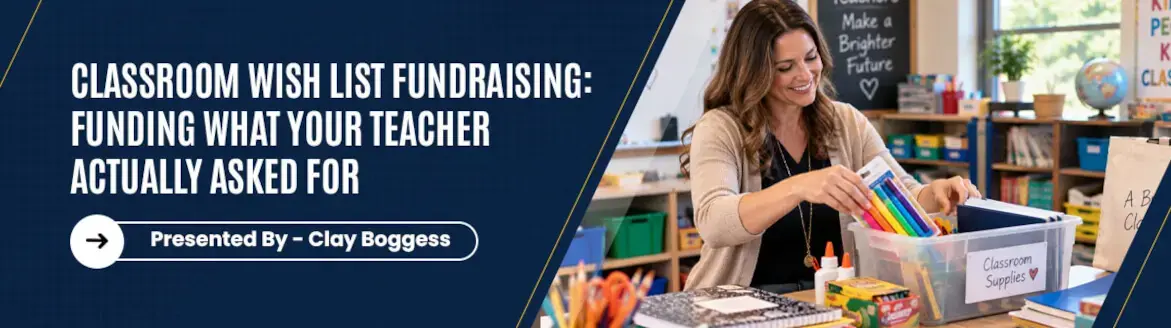
Most classroom fundraising starts backward. A room parent decides to raise money, picks a product, runs the campaign, and only afterward asks the teacher what is needed. By the time the teacher is consulted, the campaign has already been framed around a product rather than a purpose, and the ask to supporters is generic because there's nothing specific to point to yet.
A wish list fundraiser reverses that order. Big Fundraising Ideas has supported classroom and school fundraising programs since 1999. This guide covers how to build a wish list campaign from a real teacher request, which programs fit a single-classroom scale, and how to price and pitch it so the ask is easy to say yes to.
What a Classroom Wish List Fundraiser Actually Is
- The List Comes from the Teacher, Not the Fundraising Organizer: The person spending their own money on the classroom is the only one who actually knows what is missing.
- Every Item Is Priced: A wish list with no prices attached is just a list. Pricing it turns it into a campaign with a real number.
- The Goal Is the List’s Total, Not a Round Number: A specific total like $340 reads as more credible than a general goal like $500.
- It Can Run for One Classroom or Across Several: A single teacher's list works as a standalone small campaign, and several lists can run side by side without competing, since each names a different destination.
Why Naming the Exact Items Works Better
National surveys have repeatedly found that teachers spend a meaningful amount of their own money on classroom supplies every school year, often without any expectation of being reimbursed. That spending pattern is exactly why a named list resonates. Supporters who read a specific request are not being asked to fund an abstraction. They are being asked to replace money a teacher would otherwise spend personally on items the classroom genuinely needs.
- Trust is Built Into the Format: A photo of the actual handwritten or printed list, with items and prices visible, is more persuasive than any written appeal describing classroom needs in general terms.
- Partial Funding Still Feels Complete: A supporter who funds one item on a list of six has visibly accomplished something, whereas a partial donation to a vague fund has no clear endpoint.
- It Is Easy to Explain in One Sentence: We are raising $340 to buy Mrs. Ortiz's class a new classroom library and a rug is a complete pitch that a student, a parent, or a volunteer can repeat accurately.
Building the List With the Teacher
- Ask the Teacher Directly, not Through a Survey: A five-minute conversation produces a more honest list than a form the teacher fills out between classes.
- Cap It at What Is Genuinely Fundable: Six to ten items is a workable range. A list of thirty items dilutes the specificity that makes this format work.
- Get a Real Price for Each Item: A rough estimate is fine, but a total the teacher can stand behind if asked is better.
- Ask Why One or Two Items Matter Most: A short note on the reason behind the highest-priority item becomes the one sentence that opens the campaign pitch.
- Set the Goal to the List Total, Not a Round Number: $340 is more credible than $350 rounded up, because it visibly comes from the list rather than from guessing.
Which Fundraising Format Fits a Wish List Campaign
For most classroom wish list goals, a scratch card fundraiser best matches the campaign's scale. Each card is personalized, collects approximately $100 gross from one seller's community network, and requires no product to carry or deliver. A goal of $300 to $400 is reachable with three or four students each distributing a single card, which fits a one-classroom campaign far better than a school-wide brochure drive would.
Discount cards at $20 each work well when the classroom's parent network is the primary audience, since the card is a familiar, low-friction purchase for adults who already want to help. Candy bars and Smencils support a wish list goal at school events or during in-classroom selling, since Smencils are non-food and can be sold during school hours without Smart Snacks compliance concerns.
All products through bigfundraisingideas.com. No upfront cost. Free shipping.
Pitching the Campaign
- Lead With the Teacher's Name and the Total: We are raising $340 for Mrs. Ortiz's classroom library and rug is a complete opening line.
- Share the Actual List, Not a Summary of It: A photo of the real list outperforms a paragraph describing its contents.
- Let Supporters Fund a Specific Item if the Format Allows: Naming which item a contribution completed gives supporters something concrete to feel good about.
- Report Back With a Photo of the Items in Use: Closing the loop with a picture of the new rug or the restocked library shelf helps supporters give again next time.
When to Run One Classroom's Campaign vs Several
For a school considering whether to run classroom-level campaigns alongside a school-wide one, the reasoning in grade-level vs. school-wide fundraiser structures applies directly. A wish list campaign is naturally classroom-scale, and it complements a larger school-wide campaign rather than competing with it, since the two are asking for genuinely different things.
Frequently Asked Questions
What is a classroom wish list fundraiser?
A campaign built around one teacher's itemized, priced list of specific classroom needs, with the fundraising goal set to the list's total cost. It replaces a general classroom fund ask with a concrete, visible target, which tends to convert better because supporters can see exactly what their contribution buys.
How do I get a teacher's classroom wish list?
Ask directly in a short conversation rather than through a form. Aim for six to ten specific, priced items rather than a long, unpriced list, and ask the teacher why one or two items matter most, since that becomes the opening line of the campaign pitch.
How much do teachers spend on their own classrooms?
National surveys have repeatedly found that teachers spend a meaningful amount of their own money on classroom supplies each year, often with no expectation of reimbursement. That pattern helps explain why a specific, priced wish list resonates with supporters: it visibly replaces money a teacher would otherwise spend personally.
What fundraiser format works best for a classroom wish list?
A scratch card fundraiser fits most classroom-scale goals well, since each card collects about $100 gross with no product logistics. Discount cards work well when the classroom's parent network is the main audience.
Should the wish list have a dollar amount or just items?
Both. List each item with a real price, and set the campaign goal to the list total rather than a round number. A specific total like $340 reads as more credible than a rounded figure because it visibly comes from adding up the actual items.
Can a wish list fundraiser run alongside a school-wide campaign?
Yes, without competing, because each names a different specific destination. See grade-level vs. school-wide fundraiser structures for how classroom-level and school-wide campaigns can run together without asking families for the same thing twice.
How is this different from a general classroom fund?
A general classroom fund raises money first and decides how to spend it later, which forces a vague ask because nothing specific exists yet. A wish list fundraiser names the items and their prices before asking for anything, so every dollar raised has a known destination from the start.
What should the campaign pitch include?
The teacher's name, the total dollar goal, and ideally a photo of the actual list rather than a written summary. A photo of a real, priced list in the teacher's own handwriting or on a printed sheet consistently outperforms polished marketing copy describing the same need.
Can students sell for a classroom wish list campaign during school hours?
Smencils are non-food and can be sold during school hours with no Smart Snacks compliance concerns, which makes them workable for younger students selling directly in the classroom. See Smencils fundraising. Other direct-sale products generally must be sold before or after school or at events outside instructional time.
What happens after the wish list goal is reached?
Report back to supporters with a photo of the items in actual use in the classroom. Closing the loop this way is what makes supporters more willing to fund the next classroom's list, since they can see the previous campaign's promise was kept.
Author Bio
Clay Boggess has been designing fundraising programs for schools and various nonprofit organizations throughout the US since 1999. He’s helped administrators, teachers, and outside support entities such as PTAs and PTOs raise millions of dollars. Clay is an owner and partner at Big Fundraising Ideas.

Categories
Related Articles

World's Finest Chocolate…
Compare the World's Finest Chocolate fundraiser, including shipping, minimum order requirements, profit tiers, payment terms, and returns.
One-Week School Fundraiser: A…
Plan a one-week school fundraiser day by day, from product arrival and kickoff to the final push, collection, and the invoice due date.

How Does a School Get Paid…
How does a school get paid after a fundraiser? See how direct-sale, brochure, and online fundraisers settle invoices or send profit payments.